Showing posts with label imagination. Show all posts

Apr 14, 2026

MAKING THREE WISHES... for IMAGINATION!

Today I celebrate picture books that demonstrate and honor the irrepressible imaginations of young readers. George Bernard Shaw's quote is worth remembering:

“We don't stop playing because we grow old; we grow old because we stop playing”. 

The first is SUNDUST,
Kokila, 2025     CALDECOTT HONOR BOOK

written and illustrated by Zeke Peña. This adventure is set in the desert wildlife just beyond an urban 
landscape, beyond the "bulldozers and things that don't belong". There  cacti and hummingbirds thrive, there blossoms and scaled critters reveal themselves, there chrysalis develops and butterflies emerge, there sudden rains turn concrete drains into watery adventures. Throughout each step and discovery, the words are as crisp and revealing. The colors and lines, expressions and sprawls are expansive. As a vibrant, nearly-neon sun moves toward setting, the long day of exploration winds down and a mother's call is heard. Even so, the two friends linger long enough to watch the final sunset, gathering "sundust", feeling the universe of stardust within themselves. 
A day such as theirs is a gift, to them, and to  any reader lucky enough to open the covers of this book. Journey with them as they notice and appreciate nature at its finest. A marvelous world is waiting just beyond the edge of the everyday.
NEAL PORTER BOOKS
HOLIDAY HOUSE, 2020


Next up is a less reality-based adventure but one equally inviting. Author Philip Stead and illustrator Matthew Cordell have combined their creative talents in another cartoon-style picture book, but in an entirely different visual effect. Characters in SUNDUST feel firmly anchored in their habitat, even as their post-swim brown skin dries in cracks that resemble the hard-caked earth. In FOLLOW THAT FROG the text is more complex and adventurous, as are the various pages of full and spot illustrations. Speech bubbles combine with hand-letter sound effects, longer text, and cross-hatched and intricate drawings from quilts to chickens to dreamy-memory sequences related by Aunt Josephine. She recounts her youthful Peruvian adventure involving a giant frog who swallows an admiral's son. Succeeding pages reveal rides on ostriches and tortoise backs, pirates, misdirection, rescues. Throughout this surreal tale, a loud KNOCK continues. I leave it to you to fully explore (intentional word choice) the continents, critters, and comedy that bounces off these pages. 
NEAL PORTER BOOKS
HOLIDAY HOUSE, 2026


Finally (for today, at least) is a picture book that celebrates the cumulative creativity of kids left to their imaginations. Most cultures include the spontaneous game of ... "The floor is lava"... or some other assertion that requires survival by hopping from chair to couch, or even counter-surfing. In IF THIS WERE THE WORLD, written by Stephen Barr and illustrated by Ag Ford, the story spans one recess period in which various suggestions like the above example are shared, then each is countered by "we played that yesterday... or last week..."  or other indication that these imaginative kiddos are not afraid of big ideas. That's when a boy lifts a perfectly round orange from his lunchbox and challenges:
 "What if THIS... were the world?"
After sharing the juicy segments, other possibilities emerge- large spheres, a massive tree, and more. In each scenario they explore ways to use, share, and even over-use the supposed "world" in their imagination. Each fails to fully succeed. Finally, ... But I will not share the conclusion, despite the fact that I long to do so! There is such simplicity and depth to the conclusion that it feels nearly like a prayer. Not a formal or "religious" one, but a sense of awakening to ourselves and our place among our true world. The current moon mission has been sending color images of our amazing planet. That's a timely reminder of the power of awareness of just how precious our planet and our places on it and among each other really are. 
May you all, one and all, read these. And be inspired to PLAY!


Mar 27, 2026

Don't HIDEAWAY the Magic of Childhood Imagination!

 Far too many children in the world, at home and afar, are so occupied with survival that imagination must lie dormant. Others, also far too many, have outsourced their minds to screens. This picture book provides glorious casual insight into the magical space of early imagination could be just the right choice for those who DO indulge in self-generated world-building as well as for those who have abdicated the realm.

RED COMET PRESS. 2023


HIDEAWAY
is written by Melania Longo and illustrated by Alesandro Sanna, with translation  by Brenda Porter. While I follow the latest releases, widely acclaimed or otherwise, I get especially excited when I encounter a picture book from prior years that missed my radar. That matters even more when it is from a smaller press and remains deeply relevant in the current moment.

Picture book production timelines are even greater when  foreign acquisition and translation play a role. Across the board, this book merited the time and effort involved. 

Knowing how lengthy the process is to take a picture book idea from origin to contract to full illustration and production, the 2023 release date indicates to me that some or most of this story emerged during the covid-lock-down years. At the very least, all creatives involved offer us a view through the gauze of a young imagination, or two. There's little we will miss about those years, other than beloved folks who were lost to the virus. One of the small things we can celebrate is the likelihood that more children rediscovered their imaginations during those imposed periods of isolation from intensely-scheduled lives.

This picture book feels like a capsule version of such a life, worth preserving and recovering.

The assertive narrator is fully self-possessed and also possessed of a vivid and expensive imagination. Her account of  the Hideaway of slender branches is revealed to readers in an authentic child voice that introduces her best adventurer friend (her brother with long legs that sometime disturb the structure but is worth the company). Nothing dramatic or explosive or heartbreaking occurs in this hideaway, unlike THE PERFECT SHELTER (reviewed HERE). I should clarify that nothing EXTERNAL of consequence happens. But this pair of adventurers find within the slender stems of their HIDEAWAY a world without walls. They travel with massive animals, play roles, recognize aspects of nature we too often ignore, and more. Across seasons, and in the course of a day, they exhaust the realms of their imaginations and instantly reboot with more to come. A bedtime return to the household is unavoidable, but the energy of imaginative spirits transforms their bedroom, too. Ultimately, even settling under covers suggests dreams filled with travel and discovery. 

The authentic voice of the narrator (kudos to both author and translator) is richly  enhanced by full spreads of fluid, visually-enticing elements, with colors and details that recapture attention at each rereading. Black line accents focus on the story line while shadows, white space figures, delicate swirls, and barely discernible lines suggest an ethereal quality in that borderland between nature and the surreal. 

Not enough can ever be said about the essential role of imagination in a child's life, but also in our collective futures. My current check says this title is on back order, so request it at your local library. If you enjoy it as much as I do, order one or more copies at your local indie-bookstore to gift to a child, school, or little free library. The invitation to imagination is worth sharing, and worth waiting for.


Jan 2, 2026

New Year Resolution: TOUCH GRASS (Leaf Town Forever)

 There are so many ways in which I'm "out of the loop" when it comes to social media and current lingo. Am I alone in STILL not understanding what six-seven means as it leaves center stage and something new takes the spotlight? But TOUCH GRASS is one phrase that I have understood from first hearing, and one that just might be the basis for a New Year Resolution that you won't regret. With digital lives and gaming and social media and texting and.... "all the things" filling our adult lives and those of our kids, TOUCH GRASS is that reminder to PUT DOWN the electronics and get outdoors. If you are in a climate that involves snow and ice, then seasonal rewording is welcome. Touch snow, touch buds, touch grass, touch blossoms, touch crispy fall leaves, touch evergreens. Whatever you do, the TOUCH part is what matters. It's more than just going outdoors and looking around. The premise of the prompt is to engage, to make yourself a part of the nature scene surrounding you. 

In the same way that petting a pup or listening to birdsong has been demonstrated to lower blood pressure, engaging with nature, mindfully and intentionally, can bring us back to ourselves. It can certainly return us to the pressures of digital demands with renewed and refreshed mental and physical health. That is even more true for young folks, and is one of the few strategies that allows young digital devotees to willingly opt out of electronics and into the real world. 

University of Minnesota Press, 2025

This brings me to belated attention to, and praise of, a fall release,  LEAF TOWN FOREVER, co-authored by Kathleen Rooney and Beth Rooney, with illustrations by Betsy Bowen. Inspired by a true story (actually a series of events spanning several seasons), and revealed through haiku and warm, child-like illustrations, the physical LEAF TOWN FOREVER occurred spontaneously during covid. Kathleen Rooney writes, teaches and publishes poetry, while her sister Beth Rooney is a journalism photographer. This story uses Haiku form in connected poems that describe the origins, threats, and success of LEAF TOWN. 

During Covid, playgrounds were closed, but the field behind their school was not. Three friends, girls, head out one fall day and recognized beauty and treasures everywhere. gathering, sorting, enjoying, they spontaneously imagined a treasure shop of lovely leaves, acorns, lost rings and other bits, and superb specimen leaves (oak, locust, ginkgo, and more). The leaves could build homes, pave paths, generate neighborhoods, and identify various roles (shopkeepers, worker/collectors, builders, and more). Their exercise in  imagination and action invited peers to join the fun, spanning weeks and unearthing wonders. 

Every heartwarming story such as this needs a line of tension, and this has one, also spawned by the actual events. Neighbor kids noted the daily dev developments and entered the scene with destruction and theft in mind. A fight ensues, but the once-discovered key that had been declared the heart of the town was preserved. The original builders set about restoring the town, building-back-better, as is sometimes said, and also preparing for possible attack (pine resin and needles at the ready). When neighbor kids returned it was made clear: join in or prepare to fight and lose, again and again. 

The expanded community grew and collaborated and was enjoyed through the seasons, with the opening refrain "Leaf Town Forever" produced on a sign that foretold years of life for the nature-village-imagination-socializing-source. The details are rich and revealing, including surrounding wildlife, and the relationships are understated but undeniable. Each year the current group presents the key, that "heart of the town", to the children of the next class. 

There are many things stated as if "rules" for writing successful picture books in "these days". They include featuring very young children, not spanning weeks or months or (NO!) years! Making the story strong on many hooks (appealing themes and topics that will help it sell) and comparable to other good-selling books. Well, this clearly shows that a good story, well-told and illustrated, one that stands apart from other current material can and will rise to the top. This table of school age kids, in a single setting, with poetic narrative and sufficient space for readers' own imaginations can, and will, find its footing and fans. Links to many of the praise-filled reviews about it can be found HERE, and its title has surfaced in discussions of year-end picture book awards.

My own praise for it relates to the appeal of the lyrical narrative (in actual poems that are readily accessible to all readers) combined with the leafy, lush illustrations that suggest natural; materials and outdoors. This delights me most in the unstated truth and enticement of time spent outdoors, in company of friends, with undirected and certainly unplugged play leading to a rich commitment to their joint effort. The solidarity of collaborators in the face of threat, their willingness to welcome the threateners into a wider circle of community, their sense that nature and all that it encompasses (including random detritus) has immeasurable value wrapped me in wisdom from the opening pages to the close. TOUCH GRASS has never been more clearly demonstrated than in this new picture book. I urge readers to give it your time and attention, to share it with kids of many ages, and to help spread this word for this small-press wonder. 

Thanks to University of Minnesota Press for a sample copy to be read with no promise of a review.


Oct 7, 2025

WHAT's THAT BUILDING? Peeling Back the Design Skin in Architecture

 When we read about or think of ripping off walls or a roof from a massive structure, when we envision buildings with their "guts" revealed, catastrophes come to mind. At least to my mind. Scenes from tornadoes or bombings or earthquakes are the ones that generally allow a birds-eye view from above, or slice off an exterior wall to expose the interiors. A happier image of inside looks comes from those amazing and lively scenes in ant farms, little plastic-sided sandy habitats with small colonies of ants. They provide up-close peeks at the complex tunnels and purposes and comings and goings of a society whose workings we would otherwise never see. Here's a  book that allows a virtual analogy of human ant farms allowing inside looks at the structures supporting our busy lives.

PHAIDON, 2025


WHAT'S THAT BUILDING? AN ARCHITECTURAL GUESSING GAME
is a substantial book that offers young readers (and the rest of us) a portal to  the interior designs and functions of many public structures in community. The oversized, high-quality design and materials of this clever book make it ideal for readers ages   
5-8, as it claims to be. But I'd bet my last nickel that if it were placed on a  table around kids of any age, or on a coffee table for adults, it would quickly be found and explored by folks much older than that. And when shared with younger kids in groups or on a lap, it is likely to become a favorite as well. 

Think about those ant farms. Gaining a close-up view of the inner workings of places that we thought we knew is utterly irresistible. With such excellent appeal and execution of the concept, the authors and illustrator have elevated a strong offering even further. Author Rebecca Donnelly demonstrated her skill at delving into the innards of things in prior publications (trash and catastrophes, among others) while illustrator Jocelyn Cho has produced a high bar for her debut children's book illustration. The combination of accuracy, perspective, scale, and detail hint at her prior experiences in illustrations for covers, text books, and magazines. The non-human elements within each building are precisely, uniquely rendered, as are the varied and busy humans.  Reader/gamers will find themselves as deeply immersed in this book as they would be in a video game- if not more so! 

So what exactly is this book? Hmmm. It might be easier to say what it does and how it does it. The publisher's promotions emphasize how interactive it is, and that's true. The  subtitle labels it as a game book, and it provides plenty of opportunities to play with the images and concepts. Full spread views of the innards of various public structures (library, school, aquarium, museum, bakery, veterinary clinic, and many more) could have been the beginning and end of this book and it still would have been a winner. There are info-blurbs and prompts for each location, views of areas as preview insets of the full design and structure, along with views of hidden spaces for infrastructure, non-public working spaces, and more. The facilities are teeming with lives of every age, ability, identity, interest, and purpose for being there. The scales signage, pictures, and other components place familiar elements and sightings within a scope and continuity that gives things deeper purpose and understanding. 

The overall sprawling image is laid out on background graph paper as used in architecture or mechanical drawing. Each facility view also offers a bonus search- locating a tiny (but to scale) architect who is working within each location. A line-sketch of that characters is offered to scaffold success, but it will certainly not jump out at readers of any age, nor will these icons of professionals at work draw the eye when rereading the book because each is so effectively embedded. I particularly liked this because A) kids LOVE a search-and-find game, and B) each example seemed, to me, to be organic and purposeful within the scene. I'm convinced that readers/viewer/solvers will want to imagine what exactly the particular architect in each building might be doing there. The integration of careers and families and education and community in these working buildings  make this material excellent examples of real-world  social studies, math, science, engineering, literacy, and more.


WHAT'S THAT BUILDING? 
Phaidon, 2025, Interiors

With that said, the book is actually much more than that, thanks to writing, illustrating, and design that engage with the readers (gamers) on full spreads BEFORE they turn the page to the skin-off models of structures. The prompts, cues, and questions spreads are laid out in simple text on geometric color blocks. Small segments of the eventual full views are framed in response to the queries posed. There's appeal in locating their eventual placement as well as in seeing them in relation to the full function of the structure in operation. A simple glossary page in back explains terminology that are occasionally used (in bold) throughout. The patterns and familiarity/repetition of this format increases confidence and enthusiasm for this interactive book.

It's hard for me to imagine kids who wouldn't t dive into this book, repeatedly, entertaining themselves while learning in the best possible way- having fun! If you know anyone (any age) who instinctively claims cardboard, scrap paper, tape, and odds and ends to build structures or roadways or more, his book is for them. (Unless we are speaking of cats- who are equally obsessed with various random pieces of paper and cardboard. I do not feel qualified to recommend this book for cats.) 

The publisher, PHAIDON, sent me a copy without a promise of a review. Their books for kids are consistently excellent in physical production (paper and color quality, durability, design) so I was very pleased but not surprised to find this delightful, challenging, and engaging book sums one I can support. With holidays coming I'll purchase several more copies for gifts. Something you might want to consider, too.


Aug 1, 2025

BLUE! A Powerful Portrait of Realism and Magic!

LITTLE, BROWN, and COMPANY, 2025

My own writing is currently toggling between fiction and nonfiction projects, with careful attention to when and how various aspects of each interact or affect the purpose of the particular writing. In the case of BLUE, written and illustrated by best-selling Suzanne Kaufman, I found myself considering those two sides of this remarkable and beautiful new release. It's grand example of how a seemingly simple fictional talecan provide elaborate informational content through visual detail and superb storytelling.

Although I'd love nothing more than to be a visual-arts creator, especially one of this calibre, such skills do carry with them the mixed blessing of having your amazing illustrations nearly overwhelm equally gorgeous text. That's especially true when the text has been honed to such excellence. Not a syllable or word or line is used more than necessary to enhance and ignite even further the jubilant scenes and storytelling of the visual narrative. 

A stripe-shirted, high-booted universal-ish child and an utterly authentic BLUE HERON engage in  displays and activities that reveal the nature and brilliance of both species. Readers splash right onto the page for an exuberant celebration of friendship and shared joy.

Only because i have lived on a waterfront with some nearly-tame herons would I imagine this is anything other than fantasy. Instead, I see it as magical realism, with depictions of authentic  encounters, images, interactions, posturing, and scenes that ultimately extend into fantastical imaginings. 

Within the cycle of a full day, the adventures resolve into a powerfully soothing, peace-filled bedtime conclusion.

As noted, the images alone provide that story, beautifully and naturally. Yet the superbly suited minimal text makes the experience even more engaging. Take time to appreciate the ways in which this talented artist structured a timeless story to voice to her imaginings. The perfect balance of eyes and ears, of action and mood, of excitement and calm are worthy of appreciation. I'll continue to wish for such artistic talent for myself, while feeling deeply grateful for those who have and share their art and storytelling with the rest of us. Don't miss this one.

Apr 20, 2025

A Holiday for Hats... and Fashion!

 Am I alone in recalling all the words to this old song... 

IN YOUR EASTER BONNET, 

WITH ALL THER FRILLS UPON IT, 

YOU'LL BE THE GRANDEST LADY

AT THE EASTER PARADE...

Easter parade? What's that all about? Click to see, if it sounds bewildering to you!

CUENTO de LUZ, 2016
Translation from original Spanish

This not-new fiction picture book felt like an ideal one to review on Easter Sunday. THE MAGIC HAT SHOP is written and illustrated by Sonja Wimmer. The cover suggests the MAGIC in its magical realism. Opening end papers focus on the REAL in this genre. Designs for various head coverings for men and women, rendered in graphics, sketches, and advertising styles, parade neatly across those opening pages. These appear to be the very fashionable offerings of a hat shop, nothing magic about them.

Since this is an author/illustrator creation, I need to emphasize the illustrations first. They, too, extend vividly recognizable objects and characters with exaggerated features or details. The small village seems like many other in picture books, and yet the landscape for this town, the nearby hillsides,  train tracks, and even the observant reader and cat are positioned on domes and rims of hats. Colors are sherbet-toned, both luminous and shadowed, with delicate features  and fingers in contrast with billowing bodies. It takes one look to realize that here we are going to confront lively fun and fantasy alongside seriously intense reality. 

And we are not wrong.

A rolling hat shop sets the stage for change, with a sort of "seer" sales person who can provide exactly the hat needed to bring out the best in the citizens. To avoid a spoiler, I'll just say that another sudden change disrupts the transformed townspeople, who are faced with resuming their former scowling approach to life. The closing end papers take just enough liberty with reality and hats to remind readers that both realism and intentional imagining can work together to generate everyday magic. Please read it, then don your own best-choice hat, figurative or real, and take yourselves out into the world. On Easter and every day.

PHAIDON BOOKS, 2025


Easter (and Spring!) also set the stage for fashionistas among us. That's why GET DRESSED! A HISTORICAL GUESSING GASME FOR FASHION LOVERS deserves our attention. It is nonfiction, utterly real, and undoubtedly new! In this case the magic is in the appeal of century-spanning spreads, challenging guessing games, and appealing nuggets of information about cultures, climates, changes, and communities across the globe. Written by KATY CANALES and illustrated  by ERIN VANESSA, this book is as beautiful as its subjects.

The quality of the physical book holds even more appeal, oversized and sturdy. It allows casual readers to share it on laps, while intense fashion fans can sprawl on elbows to examine details and even trace or copy or modify aspects of clothing (including hats!) from across time and space. 

Young fashion fans among my family and friends love to examine latest styles, to experiment, to express themselves in unique ways. But this picture book also challenges them to see patterns of purpose and progress, to consider production and materials (and waste), and imagine ways in which designs of the future can be both creative and constructive. Adults will find as much to discover in this as younger readers will, and it could easily find return readers in homes, classrooms, and libraries.

Enjoy your Sunday pursuits in whatever clothing and/or hats that you choose. Then begin your week with a peek at these two titles. And let me know what you think in the comments!


Dec 24, 2024

STILL LIFE: A Study in Quiet... and Artful Adventure

"Twas the night before Christmas and all; through the house, not a creature was stirring, not even a mouse."

Greenwillow Books, 2024
Wanna bet?
 
On this EVE of Christmas, Hannukah, and Kwanzaa, on these dark days of winter solstice, I seek "peace" and "stillness" in rare moments of calm and  deep reflection. STILL LIFE, written by Alex London and illustrated by Paul O. Zelinsky riffs on that theme and does so with insight and humor, for every age. Both are award-winning creators of works for young minds and eyes, and both have contributed those talents to this work of art, about works of art. And about LIFE, still or otherwise.

Big picture first, since the cover suggests an up-close perspective. It raises BIG questions, too. There is a painter involved, front and center, and a still life artwork.(For a full version of the intended masterpiece, check the back jacket cover.)

The front of the jacket cover indicates a potentially mischievous dragon who "enters the picture", breaking the frame, hinting at all sorts of imagined adventures that might ensue. In this case, dragon's "second point of view" emerges within the art. In real life, that "other" point of view is the audience. Once the artist declares "done", all control of the art is lost, and we make of it what we will. That interactivity of creation by the artist and creativity from the viewer takes on a special twist when the "other" emerges from within the painting. 

Much of the fascination for reader/viewers will lie in close examination of each page-turn variation within the painting as a distinctly alternative "not-at-all-still" story unfolds in contrasting cartoonish, bold-lined style involving characters we recognize from other picture book tales. You can guess, can't you? A princess, a dragon, mice, and more? The text, though, carries its weight by also setting up contrasting expectations:

"The candle does not flicker, glow, or drip.

There is a knife and a spoon, but no one to use them.

The coins in the purse will stay where they are."

That's an open invitation to examine these aspects closely, markers for pending change. When viewing actual still life art, I tend toward such details, wondering in what ways, for what reasons the artist assembled the objects to model for the work. What story did they have in mind about the people behind the places/times in which the display would have occurred? That state of inquiry is both deeply peaceful and imaginative. And it parallels the unfolding of this book. 

Not a spoiler, but some advice... 

Adults who share this with children might tend to examine the "still life" art most carefully, but lap-audiences and other young minds are going to quickly catch the unexpected shifts and appearances in the background of the easeled art. Somehow, mice, obviously stirring creatures appear and  make their way from outside the art to inside it, and thus the action/adventure is launched. 

I wondered about the magical creative thinking here: were the mice interacting with the actual modeled scene, with evidence of their actions somehow appearing within the art itself? But the actual illustrator, as always, provides subtle and delightful clues to that answer. Check the spreads for evidence that the "life" characters within the "still life" art are interacting on images painted on canvas. In fact, the adventure also breaks the frame of presumed expectations. It is the princess who runs to the rescue, and the note calling for help is not as simple as classical assumptions might suggest.

The surrealism and magical genre juxtapositions with classical images will have readers begging, "read it again!'. Perusing the overall visual complexity and detail, both evident and obscure, could occupy a quiet afternoon. Such examination will yield satisfying discoveries while, most likely, leaving many more specifics to find in the next encounter. Among those close-looks could be a side-by-side comparison of the before-and-after images using the back jacket and the final two spreads. 

I recommend this highly, as holiday gifts and throughout the year. Anyone who has ever enjoyed a "Where's Wally" title will dive into this with glee. Please urge them to read and savor the full story, first and foremost. More than that, fans of Zelinsky's other works will treasure the blend of elements of his classical mastery (Rapunzel, Rumplestiltskin), lively and complex cartoonish creations (Z Is For Moose), and his wry visual humor throughout, most especially when blending classical and comic styles, including speech bubbles (Awful Ogre's Awful Day). For more of my reflections on picture books by Zelinsky, type his name in the search box and sit back to enjoy!

BONUS INFO....

***Beneath the jacket cover, the hard case front and back (under the paper jacket) presents a visual tale of this lively and lovely book, one that reminds both artist and audience that art is in the eye and talent of the artist, but also the eye and imagination of the beholder. Finding a way "in" to the art we view allows access to creativity and imagination. It's an opportunity to treasure, as is this book.


Apr 12, 2024

Two Delightful Picture Books with "BIG FEELS"

Sky Pony Press, 2024


 Sue Fliess
is an author whose mastery of narrative rhyme is reliable and kid-friendly, as noted in some prior offerings I reviewed HERE, HERE, and HERE. Her latest picture book is a feel-good, universally-appealing take suited to any kid who loses a baby tooth (universal, right?). This crew of tooth-losing-aged diverse kids begin with a celebratory success, and their anticipation of the tooth fairy's arrival. 

With that opening "Hooray!", readers are launched into the joyful fun (and some lively surprises) while preparing for the arrival of the tooth fairy. The truth about any child's loose tooth is that feelings prior to successful extraction can be ambivalent at best, and may include some anxiety or even fear. Thus, the title of this post: "Big Feels". 

This positivity about successful tooth removal and preparations will be a hit with parents and with youngsters awaiting that first experience and even for those who already display gaping grins. The clever premise of this book is that the crew of kiddos first describe what a tooth fairy (a "tiny flying friend") will do, then imagine a genuine dilemma. Just as someone might lose a tooth for the first time, a tooth fairy might be a beginner, a first-timer, and not be very successful at the job. Oh, no! Which way to fly? How to find the right house? Or the right pilliow?\

These little dynamos set out to help. Readers will delight in the  fun illustrations by Simona Sanfelippo, revealing clever, energetic personalities. They plan, they gather materials, they prepare signs, a tooth box, and even welcome signs. The tooth fairy is delighted, of course, leaves the child a new toothbrush and dental floss, with a note of thanks and also a promise to return when needed. 

At that point, the book brings welcome surprises, including pages that offer non-rhyming information paragraphs (suitable for the age) about baby teeth, tooth fairy traditions, origin stories, and other cultural practices. This is followed by some simple HOW-TO directions for little ones to make their own signs and messages for the tooth fairy when their time comes. This upbeat and unique take on losing baby teeth and tooth fairies will be a great addition to families, schools, libraries, and care centers for children of this age. 

Chronicle Books, 2023

As for those "Big Feels", Andy J. Pizza and Sophie Miller created a picture book that allows young children to consider confusing and complicated emotions that are deeply felt but can be challenging to identify and self-regulate. All too often, discussions and book explorations of feelings with young children tend toward labeling or explaining, sorting into "positive or negative", good or bad", "happy or sad". Adults reading this note may already be rolling your eyes about the over-simplification that implies, with losing a baby tooth as a perfect example of complex and confusing emotions for young people. 

These creators took a wonderfully creative approach that avoids such categorizing by inviting readers to don the "invisible thing" spotting glasses that are drawn on the opening end pages. By "wearing" imagined glasses, the illustrations become visible! I was excited about this effective way of making abstract subject matter both visible and open to better understanding. The first double spread illustrates and labels concrete object (even imaginary ones, like a monster) with a very short note that these are familiar characters from many picture books. I would add, from real life, too!

Interior, IMAGINARY THINGS,
Chronicle Books, 2023


One page turn demonstrates that even these recognizable characters experience "invisible things" (emotions). What the creators produced are varied irregular and colorful shapes that represent emotions, unnamed. One still unlabeled, not obvious as single, simple emotions. In fact, the simple side text on that page points out that "life is more than meets the eye." Cleverly (again) the senses are used to sort out some experiences, external and internal, that kids know well but may never have consciously processed. After several spreads of sensory explorations and emotions they may instigate, inner experiences and "senses" are pictured, labeled, and discussed. These pages are  followed by suggestions for ways to manage and cope with feelings (those invisible things). 

Interior, IMAGINARY THINGS
Chronicle Books, 2023

The extensive variety of feelings illustrated, labeled, and applied to little lives offers visual delight and rich content. The amorphous, colorful "blobs" and recognizable shapes use minimalist lines and dots to add emotional expression, even when open to interpretation. The visuals will appeal and encourage frequent return to the pages. Several spreads encourage a sort of "seek and find" fun that demonstrates how many ways emotions are universal. Whether the young people in your lives are pretty mellow or are highly reactive to sensory or internal experiences, this book will likely be a welcome exploration for them and for the older readers who share it with them. "Big Feels" near leave us, and that makes this original and clever presentation of them an appealing and valuable  addition to our lives.


Dec 19, 2023

Compare, Contrast, and Celebrate Imagination!

 I enjoy sharing more than one title in a post, even though that means providing a slightly less detailed examination of each. In the prior post, HERE, I offered a quick look at three picture books that came home with me from the NCTE 2023 Conference. Each offered distinct appeal and each would be shelved in different sections of a library or book store. 

Please note the following word of warning from this committed picture book reader/writer/cheerleader:

I enjoy taking a deeper dive into titles that provide valuable and appealing reads in their own standing, but might be elevated even further when read together. I'll repeat something I often advise when mentoring young teachers/parents or providing workshops or professional development:  ALWAYS share a picture book on its own merits before beginning any lesson or analysis or other  exploration. Some kinds of intentionally instructive books can be used in parts or sections, but a quality picture book offers that glorious opportunity that few other whole "books" can do. They provide COMPLETE, COMPACT, and COMPELLING art and literature in a single sitting. They are meant to be read through, to be experienced as a whole. That is the intention of  both the author and the illustrator. Honor that. Share it as a whole. Of course a single spread in isolation or a breathtakingly beautiful line of text can be isolated and shared, but it will mean so much if that happens after the entirety of the book has been experienced. 

After that side note, I'm eager to share with you two books that each deserve the tag, "quality picture book." 

NEAL PORTER BOOKS, 
Holiday House 2023

The first is SOMETIMES IT'S NICE TO BE ALONE, written by Amy Hest and illustrated by the Philip Stead. This spectacle-wearing girl presents a thesis: "Sometimes it is nice to be alone...."  repeated on multiple-spread sequences that reveal a pattern. Doing everyday things (eating a cookie, reading, tumbling, even trailing after-bath footprints), she restates the premise and then adds a "what if a friend..." consideration. After the initial comparison of solo versus shared activity, it is clear that the "sometimes" qualifier matters. Even the most independent and "loner" personalities will sometimes find great pleasure in sharing the activity with a friend. 

In this case, the remarkably talented, Caldecott Award winning illustrator depicts each set-up scene with visual clues that allow readers to soon anticipate who each surprise friend might be as the page turns. Light-hearted and heart-warming humor arrive in each revelation, allowing audiences to nod approval as familiar stuffed characters achieve "real life" size and traits as they join in a paired/shared activity. They are all animals, wild animals at that, but ones that convey the safe and sentimental personalities of the ZOO animals in A SICK DAY FOR AMOS McGEE, also illustrated by Philip Stead.

I noted the effect of the spectacles throughout, always reflecting so that we never see the actual eyes of this girl. Her gaze/glasses are always aimed at her own pursuits, not at the reader, underscoring her comfort in being on her own. I couldn't help but notice, though, that even as her stuffed animals joined in the engaging pastimes she chooses, none are actual friends or humans. In repeated readings I believe young audiences might note the poignancy of that, wondering if she is masking a longing for actual friendship and companionship, at least at times.

ENCHANTED LION BOOKS, 2023


The second picture book that extends this "What if..." line of thinking into a more conceptual level is WHAT IF ONE DAY... , written by Bruce Handy and illustrated by Ashleigh Corrin. This book uses a similar pattern of proposing a potential situation ("What if one day all the birds flew away?) followed by several double-page spreads that propose consequences.No labels or clear indicators of the relative merits or losses of those consequences is imposed, inviting discussion. So, the skies would be quieter, worms would worry less, etc. 

This picture book is oversized on sturdy paper stock with vibrant illustrations that splash across the pages and drip off the edges. The character posing this question appears to be similar in age to the prior main character, in this case a child of color without clear indicators if it is boy or girl. 

The minimal but thought-provoking text invites audiences to imagine other potential results if such a thing would happen one day. A celebratory double spread concludes each "what if" sequence, declaring, joyously, that "THERE ARE BIRDS!" and other such exuberances for each cycle. That format means this is picture book longer than the usual 32 of 40 pages, with color and font and considerations leading to the ultimate "What if...". What if things are missing from this world because someone has not yet dreamed it? What might the reader dream that could lead to filling the world with wonders as a result. 

Both books invite imagination, empathy, and connections to the natural world. Both, obviously, use repeating patterns to assure young readers that the stories offer secure and safe places to consider such remarkable "what if..." questions. The first asks the same WHAT if each time- regarding the potential of sharing with a friend. The latter looks around and sees what is taken for granted then erases it to explore potential consequences.

So, WHAT IF you get your hands on both of these books and compare them yourself, then find others to share them with. Invite yourself and others to ponder that final question: WHAT WOULD YOU DREAM OF? And what could that lead to? 

Aug 15, 2023

INTERVIEW: Liza Wiemer, Author of OUT AND ABOUT: A Tale of Giving


KALANIOT BOOKS. August, 2023


Happy Book Birthday 

 OUT AND ABOUT: A TALE OF GIVING

It's my pleasure and honor to introduce you to LIZA WIEMERthe author of  a wonderful new picture book that released today: OUT AND ABOUT: A Tale of Giving.

As you no doubt noticed, the cover looks like this is a winter/holiday offering, perhaps getting a jump on the season. But don't be fooled. Let the chilly scene wrap itself around you during these hot-weather days, but also cuddle into the underlying story. It is one that will warm your heart and also make clear that the family's spirit and grace are practices suited to every day, every way, every season, every climate.

Last week I offered my review of the book itself, HERE. I was not alone in praising this important story. Kirkius review had this to say about it, in part: (Click to read more.)

"A beautiful and thoughtful message woven into 

a brief yet poignant story."

Liza was kind enough to make time on this exciting release day to share some thoughts about this career achievement and her insights about the story. 

SB: Liza, your work quality and voice for teen readers (and adults!) has been firmly established. What made you want to write a picture book for younger readers and their families? 

LW: Thank you so much, Sandy, for the opportunity to be on your blog and to answer these outstanding questions.

This picture book was inspired by a story my grandfather told me about his childhood and took me over 20 years to get published. The value of giving to others in need is one that is deeply important to me, one that I have shared with my children. When I taught preschool, I used to tell this story to my students, and they loved it. That motivated me to write it.


SB:There is a fine line between writing a book to “teach” a lesson and writing a book that touches hearts to reveal important ideas and values. With the thousands of words available to a novelist, writers have room to finesse that line. In writing picture books, your word count is drastically less. This is not unlike writing poetry, even when not rhyming. Missteps between telling readers what to think or feel and allowing readers to discover or conclude those thoughts and feelings are beyond awkward- actually painful to read for many readers. A real turn-off. How did you manage to negotiate that territory so successfully?


LW: This was something I thought about a lot during the writing process. I knew Daniel had to have his “ah-ha” moment but struggled with how to make that happen. A conversation with a college professor who analyzes picture books spurred on the final idea of how Daniel figures out what his parents are doing. Along the way, however, I wanted Daniel to reflect while also having fun using his imagination. I want kids to use their imaginations and decide what they think Dad and Mom put in the boxes that they gave away to help others.


SB: Was your  prior experience in writing poetry/free verse at all helpful in developing text for this picture book? You used repletion of phrases, cycles of awareness, and found a very effective resolve on the last page. Were you conscious of those patterns and other approaches to the text from prior writings, or did that all need to come to you fresh for work in a picture book?


LW: I don’t think I consciously was making that connection between my love for free verse poetry and the writing in this picture book, but now that you mention it, that’s an outstanding observation. I read my picture book out loud multiple times, listening for cadence and readability. The repetition of “out and about” was important because we want the reader to be able to answer the question posed by Daniel’s brother at the end of the book: Where did you go? And, of course, the answer was “Out and about.”  


SB: Since this picture book story was on such a longtime journey to reach young readers, is it a “one-and-done” in this format or are there others in the works that you'd be willing to share with us? 


LW: I have a few more ideas I would love to see become picture books. But for now, I’m keeping them hush-hush.


SB: That's very understandable. After all, allowing this story-of-your-heart the time it deserved to work its way onto the page has had a beautiful result. I know you’ve spent many hours working directly with young readers regarding your writing and theirs, but that has mainly been with teens. Have you had an opportunity to share this new picture book  with younger readers yet? If so, what was memorable about that/those experiences? If not, how do you plan to approach those groups?


LW: Great question! Other than sharing the story with my preschool students and family, I haven’t had the opportunity to read it to kids! I’m excited to do so. I love the illustrations. 

\

Interior spread, OUT AND ABOUT. Kalaniot Books, 2023
 

SB: I agree completely about the illustrations enhancing your text and inviting young audiences to put themselves into Daniel's shoes. I feel like the images entirely capture the idea that Daniel totally imagined that there might be exciting things for HIM in those boxes. His imagination definitely followed a typical young person's point of view, and that he did not seem to be greedy, just curious, excited, and typical of his age. That's another fine point of balance you achieved with this central character.


Thank you again, Liza, for sharing your time and insights with readers here. I want to add a reminder that the author note in back matter shares more details about the origins of this story in your own life. There is also additional information about Jewish cultural/religious values and practices and a brief glossary. 


Learn more about Liza Wiemer and her upcoming appearances, projects, contact information, and  teaching/discussion resources on her website, HERE.


 https://www.lizawiemer.com

Twitter:  @LizaWiemer

Instagram: LIzaWiemer

Facebook: https://www.facebook.com/liza.wiemer

TikTok: lizamwiemer  


I hope you'll explore any of the above sources to learn more about Liza's writing journey, to view interviews and videos, and to check her calendar for appearances near you.

Mostly, as Levar Burton always said on Reading Rainbow,

"Don't take my word for it, read!"


Mar 28, 2023

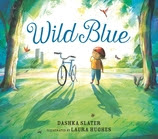
Off We Ride, on WILD BLUE!

 I'll admit that I was always enchanted by horses. (Seriously, who wasn't?) But, perhaps due to realizing that my chances of horseback riding were pretty much limited to nickel-drop mechanicals outside a grocery store, or a ride on a pony in a tethered ring at a fair. I couldn't waste obsessive longing on having a horse when there were so many other dreams I saw as having greater potential for success.

Candlewick Press, 2023
Horseback-riding wannabes abound, and they span many ages. That's why WILD BLUE: Taming a Big Kid Bike feels like it will be a just-right, book-of-my-heart discovery for countless young readers. Even as an  aged-out, unhorsed woman, I found it utterly appealing and heart-racingly compelling. Picture books deal with "next steps" stages of various kinds in childhood development, but the shift from a three-wheeler to a two-wheeler bike is a significant one that has little coverage. Author Dashka Slater and illustrator Laura Hughes have teamed up to make this one a winner.

In this case the child, Kayla, relates her adventure through first person voice. Her imagination is evident from the cover image (look at that again!) and the title page, both of which reveal that Kayla is a buckaroo, a cowgirl, a horseback-rider of unparalleled skill. She sees her red safety helmet as a western hat, and her challenge is to ride that WILD BLUE addition to her life. She has mastered and outgrown her tryke, "Pink Pony".  Language throughout incorporates "on the plains' expressions, as when Kayla reports Daddy putting pony out to pasture and taking her, lasso included, to "wrangle a new one from the herd." Daddy is at her side (with baby sibling nestled against Daddy's chest), helping and encouraging as Kayla worries, wobbles, pumps.

The scene behind this sequence shifts from contemporary to a sheriff's office and a cactus. Just as that pedal-pumping seems to pay off, a page turn reveals WILD BLUE as a bucking bronco who throws Kayla to the ground. Despite determination and encouragement, Kayla concludes that Wild Blue is too spirited and asks for pony to come back. A trip to the park, with Daddy's red stallion and baby in back-seat safety, allows Kayla to take time, check Wild Blue for injuries, sing it a little calming song, and observe countless other "riders" whizzing past on their sturdy steeds. Kayla knows what to do: mounting, pushing off, wobbling and then pumping. She and Wild Blue ride as one. I won't spoil a lovely closing spread and lines, but they resonate with this likable character, family, and situation.

I will never forget my own early attempts to ride a two-wheeler without training wheels. It was a Saturday afternoon outside our urban home, which was situated right next to St. Mary's church. A large playground with a chainlink fence separated our front door from the church entry. A wide expanse of concrete sidewalk lined that route. Solid, safe space to learn to ride a bike. Dad helped me, held the seat, and released once my legs were pumping. A very elderly woman was coming toward me from church. She was undoubtedly grateful to have gone to confession when she saw me pedaling toward her with no sign of stopping, or steering. She edged toward the fence (to avoid edging into a busy street) and I did the same. I have no doubt that Dad was running behind trying to catch me, stop me, but he couldn't reach us in time. My front tire slammed into the fence and jolted me to a stop just as the poor woman shouldered the fence and grabbed it for all she was worth. We stared into each others' eyes for what seemed like forever until I broke into tears. 

I recall being able to ride a two-wheeler after that day, but I have no idea how I managed to get back on and try again, or what that dear woman said to me or to Dad. I just remember seeing that impact coming, feeling sure that i would run right over an old woman and likely kill her! Never underrate the challenges of childhood's developmental stages. If any readers here have a story to share, I'd love to read them!


Sep 19, 2022

Drawing Outdoors: A Perfect Time of Year

 The creative pair behind a recent book are new to me, but I now have my eye out for anything else they have created and will continue to produce. Author Jairo Buitrago is an award winner and is based in Mexico City. Rafael Yockteng has been illustrating acclaimed/awarded picture books, too, and currently live sin Bogata, Columbia. I appreciate the publisher, GREYSTONE KIDS,(An Aldana Libros Book) for this deft and artful translation to English. Both the story and art reflect a  seemingly non-USA setting, but the characters, circumstances, imaginations, and inspirations are so global, so universal that every child will be able to enter the experiences fully.


GREYSTONE KIDS, 2022


So, let's get to it. This new book, DRAWING OUTDOORS, has already been widely praised. I welcome this opportunity to add my voice to those accolades. Just as the art incorporates depth, crisp lines, lush colors, and familiar details (like a dog lifting its leg on a bush), the text presents the story directly and deliciously.

"Our school has almost nothing. A blackboard, some chairs. It has a teacher. She's always there. She stands in the doorway and waits for us every morning."

Not every reader will attend school in a small, hilltop building with red tile roof, arriving on converging dirt trails, alongside a river, tucked between green mountains. (Some WILL, and they will thrill to seeing their own familiar but rarely-portrayed school setting in a picture book.) Many, regardless of urban or other experiences, will identify with those opening lines above. 

And children everywhere will be tagging along with that teacher says lessons will be OUTSIDE today, snatching up their paper, crayons, and explorers' spirits to join the fun. What might have been a delightful example of children doing open-air nature art, or science observations (as in this prior post), or even a mapping exercise, turns out to be an expansive lesson in imagination. (The more mundane possibilities had been my prediction, so I really appreciated the imaginative developments that followed.)

In fact, with continued roaming, pausing, and specific prompts, these very diverse students spend time   seeking, finding, then sketching or painting a series of dinosaurs along the river bank, weaving through boulders, roaring in a wooded area, or flying through the darkening skies. Eventually they take a snack break while resting on "a branch as big as an ankylosaurus". Even during the snack scene we see that this "group" is composed of charmingly diverse individuals, friend and sibling pairs, and personality patterns that disrupt any sense that we readers would DARE to bring stereotypes or assumptions to our perceptions of communities outside our own narrow perspectives.

And yet, just as author John Schu took a more conventional approach to "school" in his recent book (reviewed HERE), regardless of the building or location or number of staff, WHAT IS A SCHOOL? can be answered as it can be here: SCHOOL is a place to look, listen, learn. To find safety, care, and inspiration.

And it should  always a place to find ourselves connected to others from every background.

With an expanding effort to "ban" books beyond narrow parameters, books that reveal what a wide and glorious world exists outside ourselves, even such a simple book as this might find itself questioned because of its definition of "school" or "learning" or even community. If you have opted to ignore this issue or feel it is one too many straws on your overburdened life, please consider reading this article. I'll appreciate it if you do.

Picture books are as versatile and diverse as the readers who enjoy them. Join me to explore the wacky, wonderful, challenging and changing world of picture books.