Showing posts with label Beth Anderson. Show all posts

Feb 11, 2025

HIDING IN PLAIN SIGHT: Edge of Your Seat Suspense

Calkins Creek, ASTRA BOOKS, 2025

Buckle up for this thrilling account from mid-nineteenth century history, a little known tale of American suspense. HIDING IN PLAIN SIGHT: Kate Warne and the Race to Save Abraham Lincoln is written by Beth Anderson and illustrated by Sally Wern Comport. From cover to cover, each word of text and each illustration image is well-researched, compelling, and rich with details without slowing the tale down one bit.

This is yet another of the characters and events in our American history that Beth Anderson has identified, explored, and delivered with authenticity and superb storytelling. I've reviewed some of Anderson's prior releases and interviewed her in several posts, including HERE, HERE, HERE, and HERE. Her subjects range from a uniquely talented subway employee to Thomas Jefferson's science battle to Abraham Lincoln and includes a Revolutionary War hero - another woman with little-known significance. Suffice it to say that Anderson's range of interests is broad and her pursuit of the truth about compelling individuals runs deep.With this recent release readers step into a world of secrets, suspense, and sabotage.

Kate Warne was the first American woman detective, employed by the famous Pinkerton agency as an undercover investigator in high stakes cases. Warne emerges as a talented and eloquent woman who first managed to gain employment by convincing Pinkerton that, as a woman, she could access information sources that would be unavailable to men. Her acting experience allowed her to adopt various names, clothing, and regional accents to infiltrate groups, overcome assumptions of the time about women,  and convince conductors and others to take her seriously. Given the time and the nature of her/their work, finding and confirming information was no easy task, but Anderson reveals sources, complications, related history and more in fantastic back matter. 

This account of an attempted assassination of Abraham Lincoln before he could be inaugurated is the subtitle, so not a spoiler. Kate Warne became a vital player in American history during five days on Lincoln's train trip to Washington following his election. The route included a stop at the southern city of Baltimore, the site the a plot to assassinate Lincoln because of his anti-slavery stance. Each step and sequence of those days is intriguing, so none will be shared here. You really will want to read it all. 

Also in back matter is a brief note from the illustrator, Sally Wern Comport, that's worth reading. Illustrations are done in a style of the era, including collage and intricate artifacts to enhance and extend the story, a sort of scrapbook effect.. Endpapers are done in this style, too, a pictorial map of the presidential train route. Sections of that expansive map appear in other spreads to anchor complex details in correct times and places, to indicate the social and geographic aspects involved in the story. For a delightful (and exciting) YouTube trailer about the book, one that incorporates music, illustration elements, and key teaser lines, click HERE.

I am obviously a fan of this book, and its creators, but I'm not alone! Kirkus praised it in a review that included: "This expertly paced tale ratchets up the tension as readers learn that Lincoln’s life was in danger as he set out by train to Washington, D.C., for his 1861 presidential inauguration. Anderson adeptly plays with dramatic irony: Readers likely already know that he ultimately made it. But how?" And "Cleverly, Comport incorporates recurring images of timepieces, matching the sense of suspense layered into Anderson’s text—time is indeed of the essence." 

Booklist awarded this title a star and, in part, said this: "“Anderson ...weaves questions through the text to heighten reader engagement in the events and employs a succinct sentence structure that palpably conveys the mission’s urgency." 

These details reflect a note I did not make above, and that is the superb pacing. The pending danger and its history-changing consequences manage to produce "edge of the seat" attention, despite readers coming to the story with full understanding that Lincoln did survive this attempt. I hope you'll make it a point to read this, then consider young folks, schools, and teachers who might be thrilled to receive it as a gift.

I can't resist adding, for those who are PBS viewers, that I read every bit of this, several times through, with deep appreciation. I was unable to ignore my internal comparisons to the Masterpiece Series, MISS SCARLET. If this is one you know and enjoy, HIDING IN PLAIN SIGHT will resonate with everything that appeals about that series. 

Apr 16, 2024

History At Its Best: THOMAS JEFFERSON'S BATTLE FOR SCIENCE

Happy book birthday! And congrats to the winner of the giveaway @AnnieLynn215!
(Contest ended 5/14/2024)
ASTRA BOOKS/ CALKINS CREEK, 2024


I'm excited to introduce you to THOMAS JEFFERSON’S BATTLE FOR SCIENCE, Bias, Truth, and a Mighty Moose, written by Beth Anderson, illustrated by Jeremy Holmes. Following my review of the book, I'm pleased to offer an interview with Anderson. This is a longer post than usual, but I hope you'll find it worth reading! A book giveaway and other features are included there, so read on!

Of course you know that name. Thomas Jefferson is considered to be a Founding Father of this country, the  primary author of the Declaration of Independence. Like most other famous figures of his time, his name triggers conflicted responses from modern observers. As a landed, slaveholding, white man of privilege and education, Jefferson’s complex life and choices invite a closer look. In this book, superb researcher and writer Beth Anderson explores Jefferson's lifelong study of natural science and its documentation. The book cover and opening spread incorporate examples of a few of the things he observed, measured, and recorded throughout his life. Anderson’s first line is:

 “Thomas Jefferson measured his world.” 

That opening page then reveals that Jefferson's passion was not only to acquire science data, but to record it and share his love of science, one reason he founded the University of Virginia. Throughout the pages, Anderson’s informative, fascinating, and humorous text appears across illustrations that incorporate artfully rendered versions of Jefferson’s archival notes, notebooks, and objects from his collections of fossils and natural artifacts, gathered and preserved by him, and by friends who knew of his intense interests. 

Interior: Opening Spread

Interior: Jefferson Questioning

During Jefferson’s time, a French naturalist, Count Georges-Louis Leclerc de Buffon, was considered the ultimate expert on nature, proclaiming information about Europe and beyond in his multi-volume Encyclopedia of the Natural World. Jefferson’s deep admiration for that publication turned to furious indignity when he read Buffon’s “factual” accounts of North America’s nature. Buffon had never traveled there, relying instead on anecdotal reports from those who had visited the continent. His conclusions were shaped by those limitations and his bias that natural resources in Europe were immeasurably better than those in the “New World”. Buffon asserted that this new country was mainly a miserable swampy land and climate, with NO creatures or flora of significance, certainly none that could rival those found in Europe.

Jefferson’s ire led him to write his own nature study book, documenting his findings with actual measurements and confirmable observations. Spanning years of his life, his challenges to the information in Buffon’s Encyclopedia did little to overcome its wide circulation or the naturalist’s firm authority on the topic. The role of that enormous MOOSE in the subtitle played a crucial role in Jefferson’s motivation (and eventual success) at documenting the truth of his own claims, arguing against Buffon’s assertions and his biased beliefs. Packed with intensity and lighthearted moments (a rotting, one-antlered moose in a crate!) this picture book reveals Jefferson to be a devoted scientist of his day, seeking truth even when the discoveries eventually unstitched the fabric of his own beliefs (his denial of extinction, among others).


Not only is the main text a blend of compelling narrative with intriguing details of history, and personality, it is embedded with natural science. It also demonstrates the ways in which Jefferson intentionally and regularly used the scientific inquiry process (summarized in back matter). Always curious, he noticed, questioned, observed closely, collected and analyzed data, and drew conclusions based on facts, recording every step along the way. 


Anderson’s author notes are, as always, invaluable to expand resources and better understand the contents through a wider lens. In this case she directly addresses the questionable aspects of Jefferson’s life: slaveholding, errors in his science, the impact on First Nations that resulted from the westward explorations of Lewis and Clark as ordered by Jefferson while president, as well as his own confirmation bias in pursuit of science. She also explains confirmation bias and its effect on scientific studies and interpretation. The point is clearly made that science is always developing further facts and shifting our understanding of new and prior material reported as “facts”. In science, and in social/general information, it is essential to consider the reliability and intentions of the sources of data, the possible omission of related data, and other factors before accepting claims of factual content as fully correct.


Interior
Inquiry Process Graphic


The illustrations throughout, both in main text pages and back matter, are priceless in providing readers with verifiable details regarding the account of Jefferson’s life and science passion. Evidence of research (both deep and wide) using primary sources appear on every page and in every paragraph. This new release is a perfect example of my thesis that quality picture books will find eager audiences at every age. This nonfiction offering allows the youngest to expand understanding of an American icon while enjoying many animal facts and images. The portrait of Jefferson’s national pride, personal interests, love of nature and science, and passionate commitment to the truth will impress older readers, including adults. The depiction of Jefferson’s habits and personality give us an engaging and entertaining story. The science of his time and through today make this not only a STEM asset but one well-suited to social studies inclusion as well. I highly recommend it. Check out Anderson's website, and a few of my reviews of her earlier, equally informative and entertaining picture books, HERE, HERE, HERE, and HERE.


And now, on to a short conversation with Beth Anderson!

SB:  Congratulations on this recent release, Beth. Your track record for finding and sharing the stories of lesser-known historic figures took an intriguing turn with this look at Jefferson and his love of natural science. He’s among the most well-known of our national figures yet I admit to only a passing awareness of his naturalist/scientist identity. I’m anxious to know how you encountered this topic and what made you commit to the extensive research and writing involved. 


BA: Thanks so much for the opportunity to share THOMAS JEFFERSON’S BATTLE FOR SCIENCE! I saw an article about Jefferson and the moose, and it struck me as jam-packed with all sorts of good stuff: history, science, quirkiness, curricular connections, and consequential concepts of truth and misinformation that ring loud and clear in the world today. I found the topic IRRESISTIBLE! There was a lot of research to wade through—which is good, but also a challenge. While a couple other picture books about Jefferson mention this incident with Buffon and focus on exploration or measurement, I saw it as a story about misinformation and truth. Kids get it on the most basic level of truth vs lies. And they tend to think, like Buffon, that bigger means better. And there was a bit of “ew.” So there was a lot immediately relatable, but I also saw an opportunity to push their thinking a bit and provide something for the classroom. 


This incident is one piece of Jefferson’s use and misuse of science, so there was a huge heaviness with the subject, too. I started it in 2018 with the idea that, though facts seem simple things, they’re not. They can be manipulated or made up (nonfacts) and cause tremendous problems. This focus fit with curriculum standards about opinions, facts, and nonfacts, and could model and encourage essential critical thinking skills. There was just so much potential in this story—which is exciting, but also a bit daunting when trying to figure out how to shape and focus it. Once I see so much, I can’t let go and am determined to find a way. 


SB: I was impressed with the balance you achieved in discussing this conflicting use of science. Your writing is always filled with lovely language, insights, and heart. Those qualities are evident in this text, too.  Was it challenging to find a story narrative behind this science-focused and detailed topic? If so, how did you go about finding your way forward to this success?


BA: I found the basic narrative right away. A narrative with science. The question was how to use the science within the narrative. It was also a challenge to find the beginning and ending, how to make it ring today, and what to do with the negative pieces. I didn’t want to ignore the hard truths. But since those can’t always be scientifically measured, how do they fit, or not, in the story? I carried a few of the hard truths through many revisions, with the idea that larger human truths can only be measured with the heart. Though I loved that contrast, it pulled away too much. If I could share a story that helps kids understand bias and how important it is to question, then I could leave the more difficult ideas in back matter to be pondered. 


I know kids are taught to “think like a scientist” when they question and verify, so that was my first path. After I worked with the information (for nine months!), I realized that it fit the basic scientific inquiry process. In revision 23, I began to shape and word it to correspond to that. To find the ending, I went back into the research and found that Jefferson’s book had been published in various forms in the U.S. while he was away. Because of that, science made its way into the hands of everyday people…and parts were in school books. Yes! Now I knew that what Jefferson did was impacting a new generation, a way for me to carry that forward to today. And in a great quote that’s in the back matter, he said he hoped future generations would continue to move science forward, better than his generation did. That was the key to the ending, but that too didn’t come for a very long time. 


SB: I suspect that your deep research revealed plenty of surprises involving Jefferson and his extensive records and interests. Will you share one or more of your discoveries that caught you by surprise or had a powerful impact on your text development?


BA: Seeing Jefferson’s total obsession with science contributed a lot to character and how it all played out on the page. 


Here’s one of the many quotes that were cut. When Jefferson arrived at Buffon’s home for dinner, he was handed one of Buffon’s papers to read while he waited for the scientist. Buffon said, “When Mr. Jefferson shall have read this, he will be perfectly satisfied that I am right.” LOL! Quotes like that reveal attitudes. 


An interesting historical tidbit is the letter to Jefferson from James Madison in which he goes on and on about government business and then launches into meticulous details of a dead weasel which he had examined and measured. Just goes to show you how irresistibly fascinating science is and how a network of enthusiasts supported Jefferson’s efforts. 


Oh, one more good one…with an “ew” factor. The moose was already quite bedraggled when it was put in the shipping crate and placed at the dock for shipment. But then, the ship captain forgot it. Sullivan had to find another captain to take it to France. More waiting. And then of course, the long journey across the Atlantic. That’s what’s behind the “monstrous stench” when Jefferson opens the crate. So even though you can’t include all those extras, they impact word choice. 


Although many quotes and details had to be cut, I think illustrator Jeremy Holmes could read my mind! He included so many historical, (some hysterical), details in the art. His illustrations absolutely blew me away!


SB: I particularly admire your use of the author note to directly address some of the more concerning aspects of Jefferson and his role within our country’s very troubling history. You used a very balanced hand to discuss the wrongs of society and Jefferson’s place within that history without being judgmental. Can you discuss how you found that balance with readers here?


BA: Jefferson is a controversial topic, for sure. While some of the details of his obsession with science are fun and commendable, there was also flawed thinking that used “science” to support racist and damaging ideas. I don’t think it’s right to share one without the other. (If this story was written fifty years ago, most of that back matter wouldn’t be there.) This story about misinformation, mistruths, and bias is also about how we determine value. Buffon’s conclusions that “bigger” implies “better,” and that “different” is “inferior” are common with kids. We judge things through the lens of what benefits us. I have a tendency to want to share these kinds of big ideas, which creates a challenge, but I think kids are very capable thinkers. My hope is that if kids can understand this with animals and environment, that they can then move to understanding the tremendous problems with this kind of thinking about human beings. It’s also valuable for kids to see that we are complex and flawed creatures—and we all carry biases. The challenge is to recognize them and be able to admit when we’re wrong and have more to learn. Not only should we search for truth with facts, but also by considering how the consequences of our actions impact others. I tried to be straightforward and choose words carefully—words to promote thought.


SB: Naturally, there had to be MANY details left out of your final work, elements not included because they did not serve this story well. Do some of those remain unforgettable to you? Any that nag you into writing more about them in some other platform?


BA: You’re right—SO many great details had to go. One of the tidbits I found amusing, and astounding, was the inconsistent logic in Buffon’s information and how (and why) he could come to some of his bizarre conclusions. Here are a couple. North America is cold and swampy. Huh? Well, the French explored Canada and the Louisiana area, right? Yep, swampy and cold. Now I get it—a bit of over generalization. Another one: all the creatures in North America were smaller than in Europe. Except for the apparently giant mosquitos and reptiles…haha! Learning these things made me ever more certain that I wanted to impress upon kids the importance of critical thinking when reading. 


I’m going to pass on Buffon and the Giant Bugs. 


SB: As I always ask, what kinds of upcoming works should we be watching for? Any projects not yet ready to announce but ones that feel especially exciting to you? 


BA: There are two in the pipeline with Calkins Creek. One story found new life after years in the drawer. I pulled it out when recent events brought it to mind. HIDING IN PLAIN SIGHT: KATE WARNE AND THE RACE TO SAVE PRESIDENT LINCOLN, illustrated by Sally Wern Comport, is about the Baltimore Plot, when conspirators tried to prevent Abraham Lincoln’s inauguration. Warne was the first female detective in the U.S. I recently saw the sketches and WOW! It’s going to be amazing! That’s spring 2025. 


And in spring 2026…the story of a spunky teen, SCULPTING PRESIDENT LINCOLN: VINNIE REAM CARVES OUT HER FUTURE, illustrated by Jenn Ely. Clearly, I love stories of spunky young women! And a good Lincoln story! 


I have a new manuscript out on sub…..stay tuned. Another story that recent events have made newly relevant!


SB: Thanks so much for your generosity of time insights. And thank you for making THESE offerings possible:


CLICK HERE for the Educator Guide for THOMAS JEFFERSON'S BATTLE FOR SCIENCE.

Fans of BETH, SCIENCE, JEFFERSON, and TRUTH can purchase signed copies HERE, 

and preorder at any bookstore, online, or at the publisher.


As is often the case with BETH ANDERSON, special added features are developed to introduce her remarkable books to readers, like this short VIDEO CLIP.


Beth has also generously offered a copy of this new book. Any comment added to this post enters you in the giveaway. If you share the post on Insta, X(Twitter), or FB, add a link to your share in the comments for an extra entry. The winner will be chosen and announced on May 14, 2024, BOOK BIRTHDAY for this terrific new offering. The winner's name  will be added to the top of this post and also included in a new post on that day. Looking forward to sharing it with someone! 


Jan 24, 2023

CLOAKED IN COURAGE: Interview with Author Beth Anderson

Welcome to a very special visit to the blog by author Beth Anderson. I'm always excited about a new release by Anderson, since her picture books are reliably informative, entertaining, and packed with surprising facts and people who I feel I should have known about but did not. Her works always inspire me to improve my own research and writing and topics. I am especially pleased when Beth finds the time to respond to my endless questions about how she produces such wonderful and important works. (Prepare for a longer-than-usual post, but it is TOO GOOD to break into two parts! Read on!)

I had countless questions, but narrowed them down in hopes that her responses would be expansive, and she did not disappoint. I’m always informed and inspired by her interview content and urged her to proceed in whatever way allowed her to share her intentions and processes. Beth has been rigorous in her research and also in labeling of her books, often indicating that they are informational fiction rather than nonfiction. In nonfiction, every quotation, statement of fact, made and event must be verifiable from reliable sources. When a clearly authentic life or events becomes the topic of study, but sources suggest two or more versions of various details, or no content can be found to explain some details, it can be useful to weave the facts into a realistic and supportive narrative that allows for some kinds of conversations and interpretations. Then back matter can clarify the what and why of facts and fabrication or omission within the main text.

So, I'll get on without further delay.


Calkins Creek, 2023
Imprint of ASTRA Books


SB:  Welcome, Beth. your profile picture books are often categorized as informational fiction, which allows you to generate stories that are compelling and complete through narrative literary style while incorporating an astonishing amount of factual content. CLOAKED IN COURAGE: Uncovering Deborah Sampson, Patriot Soldier succeeds in that approach with a wealth of fascinating facts despite the many mysteries still surrounding your subject. As you do so well, your author note makes clear what gaps and confusions interfered with finding definitive answers, then discussing your wide range of primary and secondary sources. Were there particular gaps that caused the greatest frustration? Things you still wonder most about to this day?


BA: This is one of those stories with some conflicting information and no way to prove exactly what’s correct. Technically, I’d call it historical fiction, one type of informational fiction. The categories seem to morph these days. But like my other books that fall into this category – I’d say it’s 95% nonfiction. What appears to be the most complete account of Deborah Sampson’s life is a bio by Herman Mann. He used her input, but apparently he didn’t think it was exciting or edgy enough so he took liberties, adding parts suspiciously like another book of the time and also putting her in battles that occurred before her enlistment. Mann also wrote her speeches when she went on the road as a lecturer. So… that whole book and her speeches are unreliable. But…historian Alfred Young took Mann’s book and examined every little piece, a truly great feat of historical detective work—and a huge help to me.

Probably the one piece of information I wanted most for the story was specifics on Sampson’s war wounds. Was it one musket ball in the thigh? Or two? One in the shoulder? The thigh and shoulder wounds vary a bit in different accounts. Did she dig it out successfully? Or was it too deep? I went after all that for a very long time. Experts have differing opinions. There is ample evidence that she was wounded. And two sources independent of Mann report that a shot remained in her. Deborah received an “invalid” pension and those records would have details, but unfortunately, they’re lost. There are multiple accounts of her digging out a thigh wound. Since her injuries were important to the story, I had to do the best I could. 

 One thing I wonder about is why she allowed Mann to embellish her life according to his vision of a heroine. She was so strong in so many ways. I have to think she longed for acceptance, needed to raise her family, and that the social restraints against women made her walk a narrow line between acceptable and unacceptable. 

Oh, and I’d really like to know how she hurt her finger! 

SB: Following up, among aspects of your writing that I admire most is your capacity for incorporating verifiable facts without relying on the dreaded (and usually boring) “information dump”. An example occurs in the second full spread in which very young Deborah is seen riding away from home on a wagon with a very old man, having been “put out” to serve another family by her mother. It was necessary to avoid starvation and have “a chance” at surviving. Within that one paragraph and a single line that follows, readers are introduced to that process, and come to understand that her mother was assumed to be widowed with many small children, that she was struggling with sadness (possible depression?), and desperately lacking in money and food. What dramatic and jarring truths about historic practices this reveals, and yet remains a very personal and nonjudgmental element of Deborah Sampson’s personal history. I’m trying to imagine how many pages of sources you must have read to reach these few effective words on the page, and how you do it! Any insights on how you determine what matters most and how to frame it within personal stories?

BA:  I’ve been realizing lately, as I revise another manuscript, that I have an aversion to long paragraphs on the page.  ðŸ˜†  Exactly what you said. Danger! Info dump! One of the major challenges is weaving in needed context without dumping a bunch of information that stalls the narrative. I try to embed it with action but it’s always difficult. 

 I learned a lot researching this story! I knew about the beginning of the Revolutionary War before I started REVOLUTIONARY PRUDENCE WRIGHT, however with Sampson’s story, I knew very little about the period of her enlistment from 1782-83. I had to dig into the Continental Army, traditions about women, media of the time, social customs, and so much more. Searching far and wide deepens my understanding of the character, motives, and stakes. The custom of children being “put out” or “bound out” was overwhelmingly sad from Deborah’s POV until I asked the questions WHY? and WHAT DOES THAT MEAN FOR THE CHILD, EXACTLY? And then, how does this serve the story? To find that, I had to look through her mother’s eyes. I had to make this harsh reality comprehensible while keeping the story moving. The challenge becomes what to use and what to leave out. TMI (too much information) slogs and loses focus. No enough confuses.


Interior spread, Cloaked in Courage, Calkins Creek, 2023


As you guessed, there’s a lot more, from multiple sources, that’s not on the page, so here’s a bit of background info and my goals line by line. This was a TOUGH spread, the inciting incident. 

·      Deborah watched Mama slip into sadness. I needed to look from Deborah’s eyes and not make her mother the villain when she was going with her only option. I have to say it took a long while to get to this line.

·      Too little money. And never enough food. These are realities a child can understand. Many complicating factors and details really aren’t necessary. This sets up Deborah leaving as giving her a chance for a better life. I used phrases to hit hard and slow the reader to take it in. And the previous spread, with its absolutely gorgeous and perfect illustration, just hinted that Deborah wants more from life and is looking to the future. 

·      And Papa hadn’t returned from the sea. The reality of her father “lost at sea” was that he had deserted the family. TMI. All Deborah would’ve known is that he never came back. Now Mama’s situation is clearer. 

·      With no way to earn a living, Mama offered her children what she could—a chance.   Women were basically unable to raise children on their own because the only skills they were taught were to care for children and run the home. Most women had no way to earn a living. It’s also the beginning of the idea that hardship can have hidden value.

·      Following tradition, she scattered them to different homes, “putting them out” to earn their keep. Mom was doing what was expected or normal—tradition. “Putting children out” was basically the foster care system of the time. It provided a way for kids to be cared for and, in some cases, to pay a debt. In the first two homes, Deborah provides help for elderly women, and in exchange, they provide food, shelter, and (lucky Deborah) teach her to read and write.

·      Including five-year-old Deborah. Putting her age (needed info) here is impactful and pushes the reader forward to see what happens to her. (And the illustration is so perfect!) 


I appreciate that you said this was “nonjudgmental” because my goal was to let the reader take in the historical truth and not tell them what to think. There’s no blaming, just the reality. This scene is about sympathy. And while it’s a terrible situation to think about, it was an important piece of Sampson’s story. The reader will root for her as she finds her way! Upon reflection, a reader can see how this scene supports Deborah’s choices to be independent and able to earn a living. 


SB: I loved the ways in which you laid the groundwork within Deborah’s background, ways in which her personal development serving in several homes built her physical and mental strength, her reading ability, and important awareness of the political movement toward rebellion and revolutionary war. Of course, the illustrations contributed greatly to your lively text, providing a sense of her as prepared to take a stand as a woman on her own, not following societal routines of marriage by age eighteen. Her recognition that common gender roles should not, would not limit her choices in life is so deftly revealed. It sets the stage for her superior achievements while serving as a revolutionary soldier, cloaked not only by her uniform but by her successes. Are there particular aspects of her lifetime of accomplishments that you most admire?  

BA:  I was driven by the question What makes us who we are? Getting into the details of her indentured servant years, it became easy to see how she develops the skillset for her future. I really enjoy the pre-writing process when I try to “build” the story with pieces found in the research—a puzzle! She did “male” and “female” work, was surrounded by the call for independence, and, when I looked at the books available to her, wow! Certainly all us know that we’ve been shaped by our experiences, the social conditions, and what we read and hear. I had so much for that section, but had limited space. I was thrilled that Anne Lambelet was able to show so much in the art. I loved offering up a chance for readers to consider the impact of the Boston Tea Party and Declaration of Independence from the POV of a teen girl!

The idea of excellence and integrity as a shield was really interesting to me. My understanding is that it started in her childhood, and it amazes me that a child that was “put out” pushed herself forward so tenaciously. I admire her boundless spirit and how she was able to serve for seventeen months without being discovered. One of my favorite moments in the story is when she returns from Philadelphia to face her commanding officer with the truth of her gender inside the envelope she carries. She faced severe punishment, a fine, and imprisonment for dressing as a man and lying about her identity. Male soldiers deserted all the time. She easily could have, too. But she didn’t. When I look at a character who accomplishes something outstanding, I’m impressed and inspired. But what really intrigues me are the decisions. Why?

 And for all her strengths, an important part of her story is her weaknesses. She lied. She took a bounty and then chickened out. That makes her story all the more powerful to me. 

SB: The trajectory of Sampson’s life after serving is left open to the reader’s imagination. By that point in this account you have offered enough information for readers to have opinions about what Deborah might encounter in the way of obstacles, and also in potential support among open-minded individuals, as she set out alone. She intended to make the most of herself, seeking “a chance”, as her mother had done for her so long ago. We readers certainly anticipate that Deborah Sampson would not let obstacles stop her. Did this ending reveal itself to you all along, or were there other options you considered? I’ll admit this one feels perfect to me, yet I can’t help but wonder what other approaches might have made a case in your mind before finally deciding.

BA: Originally, I took the story further to include her return, starting her own family, her lecture tour, being her own business manager, and fighting for her pension. I kept shortening that section, and by the time I got to editorial revisions, those extras were cut way back and what Sampson did in the future went to back matter. As the manuscript was fine-tuned and the “heart” thread sharpened, it just sort of popped that there was a natural ending when her enlistment was over. She had broken free, proved herself, and we know she’ll face anything. Going on to include more loses something and doesn’t resonate in the reader’s mind. 

 SB: I must always ask you to share what you can about other upcoming books, maybe including hints about ones that must still remain unrevealed.

 BA:  I have three books with editor Carolyn Yoder coming!

THOMAS JEFFERSON’S BATTLE FOR SCIENCE: BIAS, TRUTH, AND A MIGHTY MOOSE is in final art with illustrator Jeremy Holmes. What I’ve seen so far is AMAZING! The story is history + science + humor—all my faves. (Spring 2024)

 Illustrator Sally Wern Comport is working on sketches for HIDING IN PLAIN SIGHT: KATE WARNE AND THE RACE TO SAVE PRESIDENT LINCOLN. I’m looking forward to those—always an exciting moment!  No doubt inspired by all the Nancy Drew books I read, this is about Warne’s role in foiling the Baltimore Plot as the first female detective in the US. (Spring 2025)

As yet unannounced is the story of another spunky female who “exceeds expectations” and has connections to Madison, WI; Illinois; and Washington, D.C. (I know that Madison connection got your attention, Sandy! HA!) By the time this posts, I should have editorial revisions finished and the manuscript moving on to an illustrator…..Can’t wait to share!

And always…a WIP!  (SB: Work-in-Progress)                                                                  

Thanks so much for your insightful and dig-deep questions, Sandy! And for all your heartfelt support!

SB: Beth, thank you so much for this opportunity to join in support of your book. It is truly a marvel and one that must have Deborah grinning from whatever “beyond” she might be in!  I wish she had left even more of her story available to you, and to all of us, but you made masterful work of extensive evidence. Your treatment of her impressive and inspiring life deserves wide support and awareness. I’m delighted to offer that.

My full review of the book was in a recent post, and you can read it HERE. I'm not alone in praising this offering. To read other reviews and interviews about this book click HERE or listen to this terrific podcast/interview with Beth on "Confetti Moments", HERE. (It's episode 74 or you search without the link.)

I’m delighted to say that the publisher sent me an actual copy of CLOAKED, and the physical object is simply incredible. 


Jan 21, 2023

Meet Beth Anderson's Remarkable, Revolutionary Deborah Sampson-- CLOAKED IN COURAGE


CALKINS CREEK, 20232
Imprint of Astra Books

CLOAKED IN COURAGE: Uncovering DEBORAH SAMPSON, Patriot Soldier is written by Beth Anderson (longtime fan here!) and illustrated by Anne Lambert  (new fan here!).

This latest offering by a talented researcher/author reveals information about an unknown/unsung woman of the American Revolutionary War. Anderson's writing provides efficient, lyrical narrative, rich with authentic details. Research from a range of sources is woven into a reliable and compelling portrait of the life of Deborah Sampson. Because data gaps and conflicting information left three details unverifiable, Anderson clearly states that this account is informational (or historical) fiction and that the most accepted versions of those details was used.

From the the first pages, readers learn of Deborah's early life challenges, with illustrations suggesting that even as a young child in deep poverty she dreamed of a better life, and a wider world.  

On that opening spread, in large font, a central thesis is stated: Maybe it was just Deborah. 

Interior Spread: Cloaked in Courage


Hard facts of life surface on the next spreads leading to Deborah spending her youth without family, in service (and heavy labor) to a variety of other families. In each circumstance she worked hard, learned all she could (including to read and write), built confidence and strength in her mental and physical potential, and also notes impacted by the events and  principles of the growing colonial rebellion leading to the Declaration of independence and the Revolutionary War.

At eighteen she refused the traditional path of marriage, made a living with trade skills often reserved for men, and then disguised herself as a man and enlisted in the army to fight for freedom. But when her ruse was discovered, she ran away before she could be arrested. In another area where she was not known, she tried again and enlisted as soldier Robert Shurtliff. The following spreads show her as managing every challenge effectively, translating skills from her early service years to those required of soldiers, including taking part in battles. After being wounded, she attempted to dig out the bullet herself to avoid discovery in a medical examination.


She gained respect and was advanced to service for officers, chosen for her outstanding performance in active service. 

With the war nearly over, she had one last mission. But when Sampson fell ill and lay unconscious in the hospital on the brink of death, a doctor discovered her gender.  Stay tuned, there's more to come.

Gorgeous illustrations incorporate information and details that expand the compact text and the landscapes of Sampson's life at every stage. Those are physical, emotional, social, and political. Look closely at that cover art, so evocative of the time, of the complex roles Deborah chose to assume, and the radiant quality of her heroic decisions. This approach both equates and elevates her role compared to those of other soldiers of the revolution. Throughout, we see her full authentic self, the one who grew strong through adversity and hard labor, as well as a limited reflection of that within the career and service she chose despite restrictions that should have locked her into more traditional roles. 

No spoilers are offered here, since I've already revealed much about this remarkable woman and book. Just know that there are substantial and exciting surprises throughout, as well as some questions raised. The important author note in back matter provides readers with some answers  and explains why others don't have easy answers. 

I highly recommend this new title and urge you to read the post that will follow in a few days. Beth kindly agreed to respond to my questions about her research and writing for this important new picture book which you can read then. If the wait has you eager to know more (as I was) I guarantee it will not disappoint. While waiting, check out her interview about previous titles HERE.


Jun 1, 2022

Beth Anderson Writes... So Well!

KidsCanPress, 2022

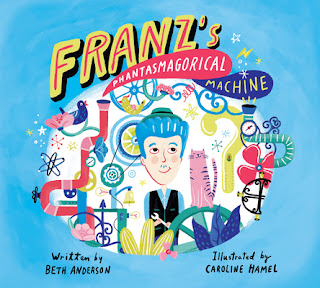
I'm so  excited about the informational fiction picture book FRANZ'S PHANTASMAGORICAL MACHINE, written by Beth Anderson and illustrated by Caroline Hamel. I shared some of my detailed thoughts about it in a recent interview, HERE. I’ve also enjoyed reading interviews with Anderson by other bloggers, HERE and HERE, involving the origin/creation story behind this book. She wrote reflections on the heart and power of this particular book on her own blog, HERE, which I highly recommend. 
 

I've had the pleasure of interviewing Beth about her previous books, HERE and HERE. I'm excited that she found time to respond to my questions again, so I tried to make them count! What I most wanted to ask about is her skill with the craft of writing, particularly word choice and word play.


SB:  Beth, welcome back! Thank you so much for joining my readers again to share your time and talent with us. 


Beth:

Thanks so much for inviting me back to talk about FRANZ! 


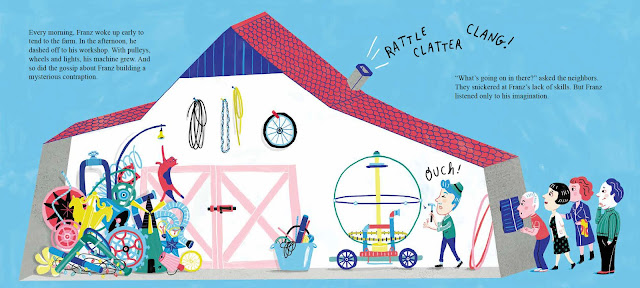
SB: Your educational background and prior professional career focused on languages and communication, so it’s not surprising that the texts in your books feature word play, apt word choices, and text structures and patterns that strengthen storytelling. The opening text for FRANZ’S PHANTSASMAGORICAL MACHINE uses sparks of questions when we meet young Franz as he encountered a cuckoo clock on the wall of his home:

“He put his ear close to the chirping bird. What makes that sound?

He peered at the gears. What makes them move?

He peeked behind the small door. What’s going on in there?”


None of these are remarkable or phantasmagorical words, but the astonishing magic of curiosity and questioning in a child-mind (of any age) shines through and sets the stage for a satisfying resolution phrase all the way at the end of the book. It does so by presenting a familiar situation in light, lyrical language. 


These are three memorable and inviting lines. Those few words include internal rhyme, assonance, and alliteration, despite being seemingly simple. The call/response format of observation and italicized inquiry requires no dialogue marks or tag lines. They are beautifully direct.


With that lengthy introduction, here’s my question-- How’d you do that? And then sustain such skill throughout the text? Please share your approach to first stage drafts and refinements. Any insights will be welcome.


BETH:

The beginning of the story went through many changes. The early versions were more about Franz Gsellmann’s love of tinkering and building and were definitely more “telling.” Then, since I had read how he was fascinated by nature, I tried out some tree imagery, and this is where I began moving more toward establishing his curiosity as a young child. I was learning to go to the emotional level, I think. And I was also discovering the “heart.” 


Then instead of dual imagery of nature and mechanical objects, I focused solely on the mechanical. When I submitted it, I think I had three images—a light bulb, a music box, and a clock—all paired with the question What’s going on in there? That question drove me through the story, I suppose because it’s kind of a joke in my family. That was the singular question I had throughout. I loved the ordinariness of it, the fun of it, and how it applies to so many things. [Think about it…it’s good for when the kids lock the bathroom door and you hear all kinds of shrieking and splashing. Good for when you witness strange comings and goings. Good for when you listen to a music box.] That question was my signpost of curiosity throughout the story for Franz and others, a way to show that we are all naturally curious, and…it could carry many different emotions with it. 


But…when we began editorial revisions, the editor wanted more specific STEMish questions. And somewhere in that process, I came up with the absolute best, most perfect opening line EVER (for me)! Unfortunately, it didn’t work with illustration as it required too much time in childhood growing from baby to young boy. Talk about killing a darling! OUCH! That was hard. (But I’m holding onto it in case I can ever use it for another story.) Moving through revisions, we did a lot of experimenting with questions. Too technical didn’t sound right. I wanted ordinariness, questions every child might ask, as the base so the move to extraordinary would be more interesting and show we all have that capacity. Of course, I had to play with sound and rhythm for a while, too, until I got that just right.  


The creativity and whimsy in the story drove some of my word choices, as well as the machine itself. I watched videos of the machine over and over, noting sensory details like shapes, movement, colors, and sounds. I played with those on slips of paper as I wrote. I used the list of items in the machine (1,960!) and sorted them different ways as I experimented with them in the text. The details of the machine were an aspect of what I loved about the story and essential to the fun. Being able to organize the details in different ways helped make it all manageable. In the end, I lost a portion of all that word nerd fun to serve pacing. But I think you have to go bigger before you can cut back, because often the cutting back is more like “compression,” finding ways to include more in fewer words. 


Aside:  DANG, I am so curious about that perfect opening line, but I am certain I will get the fun and satisfaction of reading it eventually. And for readers who haven't heard the expression "killing your darlings". This is the figure of speech writers use when a particularly FAVORITE line, or chapter or character or ending or...anything!!! must be removed for the good of the overall story. It is difficult to do when an editor or agent or critique partner urges that choice, but it is clearly wisdom and growth when the writer herself recognizes that sacrifices must be made for the good of the story.


SB: Thank you for such clarity and insight! That felt like a mini-masterclass in how excellence emerges with continued reflection and wise revisions, not to mention the editorial process AFTER a work is under contract. 


After such a demanding question, let’s deal with some fun facts that give your thinker a rest! In several places I learned that you tinkered in your dad’s workshop with your own creations. Will you tell us about some of the things you constructed, fixed, designed, etc.? Do you still have any of them? Any that you wish you DID still have? Any that later came into our world to make you feel you missed out on a valuable patent? Where did your own ideas come from? Did you have a cuckoo clock in your home (or other curiosity-sparker?)


Beth:

I was raised a “maker,” though no one used to call it that. For generations before us it was about survival and “making do.” Both of my parents were always ready to tackle any project, and I’m thankful that I was raised with that attitude of trying and learning.  (I could go on endlessly about their projects and creations!) The solo tinkering endeavor which I distinctly remember over all the others was making a “mixer” in the basement workshop. I made a stand with a crank that turned a plastic scoop. In actual use it would have been a disaster, but that didn’t dampen the fun of making something mechanical. (I “invented” crude versions of things that were already invented, so no patents for me—though my great-grandfather had a few!) My tinkering projects are long gone, probably due to the quality of the workmanship. (HA!) Some of my early craft items are still around. I continue to enjoy various kinds of crafts, and I think I was drawn to weaving because it’s mechanical, too. I see the same love of “making” in my grandchildren. Allowing kids to experiment and create builds an array of life-skills along with a sense of capableness and independence. I wish all kids could have that experience. I hope FRANZ’s story will provide an invitation without intimidation.


I remember being fascinated by an aunt and uncle’s player piano, as well as the inner workings of our own piano. I’d peer inside to watch the hammers as I tried to play at the same time. And yes, we did have a cuckoo clock! So amazing with the little bird, the door that opened, the sounds, the mechanics of the clock, the chains and weights that worked their way down. A feast for curious eyes and minds! It fit perfectly into FRANZ’s story, and I ended up down a rabbit hole examining cuckoo clocks!


Aside: Beth mentioned weaving, and during the time I've come to know her (virtually) I realized she is quite the accomplished weaver. As a child I had a small tabletop loom and can tell you this about weaving:

A) I loved it!

B) It requires enormous patience in planning, setting up the loom, managing the many strands and directions and elements with an even hand, and EVEN MORE patience. 

C) All of the traits in "B" form an analogy for the writing process Beth described in my first question.


SB:  Thank you for revealing how deeply connected you are to that analytical inner process. Your craft advice is priceless and you  offered delightful insights into your own creative/constructive childhood. Now I’d like to ask about sustaining confidence in yourself. You referred to the value of that in children, but as adults we often lose the self-confidence we had as children. Franz certainly had a knack for believing in his dreams. You’ve written about this original text being rejected, then eventually helping you find, then partner with an agent who appreciated Franz, and YOU, and the magic of a creative spirit. (Curious readers can read about that HERE, and in your dedication to your agent for this book.) But then, as seems to happen so often, this story did not sell right away, even with a dedicated agent. Would you share some tips for sustaining faith in yourself and your stories during the all too familiar rejections that precede success, and even continue after your well-earned recognition and great reviews for other work? What keeps you going?
 

Interior spread: FRANZ'S PHANTASMAGORICAL MACHINE
 

Beth:

I think many of us have our own whisper that urges us on. But it’s also the encouragement of others like critique partners and those you’ve dared to share a manuscript with. Those are the people who keep pushing you forward to learn and improve. (The generous  and supportive kid lit community is a blessing!) The fact that FRANZ opened the door to representation was huge. Having an agent who believed in FRANZ sustained me, as well as the sale of other manuscripts. In a school visit several years ago, a child asked me if I had any “encouragers.” I loved that! “Encouragers” are so vital to us at every age! I see many stories, too, as another kind of encourager! 


When I first started subbing, I didn’t understand rejections as well as I do now. Submission isn’t the end of the process and doesn’t mean you’re done. One of the lessons from subbing FRANZ was to pause after each round of submissions, glean anything we could from the feedback, and revise more. That keeps you actively in the process and moving forward. Also, if we use the word PASS instead of REJECTION, as editors do, it seems more healthy. (Yes! Word choice is powerful!) 


Honestly, I think age helps, too. With more life experience, you’ve withstood some of life’s rejections, faced a variety of challenges, and probably gained some confidence along with an ability to persevere. Though writing can be very personal in ways people can’t imagine, we have to be able to detach a bit and know the “pass” isn’t a rejection of us as human beings. I’ve learned that editors pass for all sorts of reasons. And after you’ve experienced the publishing process you understand that editors have to truly love your story to work on it for several years to make it the best it can be. After all you’ve invested in a manuscript, you don’t want anything less than that.


SB: Every word rings true, Beth, including the impatience of youth and a growth as we age. Your comments also called to mind some lyrics that are universally true- "to everything there is a season and a time for every purpose under heaven".

You've been so generous in your responses, so this is the bonus, for you and for readers here. Please, please, please update us on any upcoming releases that you are allowed to discuss.


Coming November, 2022  

BETH:

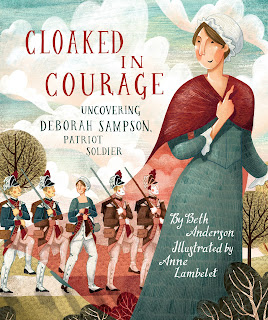
I’m really excited about sharing CLOAKED IN COURAGE: UNCOVERING DEBORAH SAMPSON, PATRIOT SOLDIER in November. The illustrations by Anne Lambelet are fabulous! It’s a story of courage, perseverance, possibility, and how we find strengths in our challenges that ultimately make us who we are.


And then in 2023, THOMAS JEFFERSON’S BATTLE FOR SCIENCE: BIAS, TRUTH, AND A MIGHTY MOOSE has all that I love in a story—history, science, and humor! It’s in the final art stage right now and, oh my, oh my, Jeremy Holmes has brought soooo much to the story with his amazing illustrations. I am thrilled that some of what I had to leave out of the text, he has brought into illustrations after his own extensive research. 


Aside: I love that your note makes clear the need to TRUST your work to an illustrator without trying to direct or take charge. I'm sure that both illustrators were inspired enough by the work to invest research and talent to bring the full story to the page. This is a perfect example of developing your work, then believing in yourself and your story.


Beth Anderson: writer, weaver, tinkerer


SB: These upcoming titles are so exciting to anticipate. In one case you've found a sadly neglected historical figure to spotlight, and in the other you took a VERY familiar historical figure but pursued information about him that most readers will find entirely new and revealing-and fun! What's more, I know that you have others "in the pipeline" (more figurative language from the publishing world!) that will be equally exciting, informative, and entertaining. All of this makes your participation in these interviews even more generous with your time and attention.


And thank you so much for letting me join the release celebrations for FRANZ'S PHANTASMAGORICAL MACHINE!  The book is terrific and I can easily imagine Franz, in some other dimension, grinning at his newfound fame! He would be thanking you, too, I'm certain. And I'm also certain that I'll be reading your new books and hoping to ask you a few more questions with each!

Picture books are as versatile and diverse as the readers who enjoy them. Join me to explore the wacky, wonderful, challenging and changing world of picture books.