Showing posts with label historical fiction. Show all posts

Aug 21, 2026

BOOKS UP THE MOUNTAIN: A Packhorse Librarian Story

 Let's hear it for LIBRARIANS! (Pause for applause.)

For LIBRARIANS PAST AND PRESENT! (More applause, please.)

For LIBRARIANS matching readers to the materials they want, need, and love! (ROAR of applause!)

(Pause to recover.)

WAXWING BOOKS, 2025

BOOKS UP THE MOUNTAIN: A PACKHORSE LIBRARIAN STORY
is the lyrically told account of an unnamed librarian tagged Book Woman. But Book Woman does not work from a library building. Or a bus. Or even on a road. 

Talented author Caroline Starr Rose brings concise and compelling prose that contributes a lyrical tone to this history. Illustrations by Gabrielle Grimard are slightly stylized but offer the natural colors, familiar figures, and subtle finishes of a landscape from earlier times. The visual narrative reveals the joyful transactions as well as the challenging struggles of Book Woman and her clients. In this case Book Woman represents the many women who took on this important role, had a limited range of printed items to circulate, and adhered to their mission despite serious challenges. 

On sprawling spreads of soft-edged landscapes across changing seasons, Book Woman follows her route through valleys and hollows, around mountain trails and ridges, knocking at doors and windows. Children and adults alike know her schedule and watch for her, welcoming pamphlets, series books, recipes, and news from far beyond their view. Brief but beautiful lines read descriptively but as poetically as a psalm:

"A cluster of clouds crowds the skies.

Streams surge. Waters rise."

Combined with images of gusting willow limbs and a shift of emotion on her face, those lines let readers feel the tension of being isolated far from home, committed to her mission but aware of impending storms. Along the way Book Woman keeps company with the ill and aging, offers suggestions and readings for the young ones, and notates requests, observing needs. On weekends, Book Women gather to exchange inventory, repair books, stitch bindings, and discuss the needs of their mountain readers. They were hired during the depths of The Great Depression and crippling unemployment by the Works Progress Administration to infuse modest income into families in Appalachia while uplifting literacy and community.

This well-researched, lovingly written, and entertaining picture book is a treasure at any time. In our present world, librarians are under siege while information and entertainment access is a click away for kids of any age. This story from history offers an engaging invitation to recognize the value of literature and its delivery. It provides a step back in time with a nod to the dramatic change in circumstances, slowing down the absorption of the story and its impact through the power of poetic pacing and phrasing combined with lush expanses of nature's best views.

If you aren't familiar with other books by Caroline Starr Rose, do yourself a favor and check out her award-winning middle grade titles, verse novels, and picture books.


Some prior posts featuring picture books about extraordinary efforts of  librarians are available HERE, HERE, and HERE, with a link to a PBS documentary on the packhorse librarians HERE.


Jul 17, 2023

RIVKA'S PRESENTS: Laurie Wallmark's Gift To All

 If you read this blog you'll know that I've sung the praises of author Laurie Wallmark's nonfiction picture books, particularly her masterful research and presentation of Women in STEM from the past. If you missed those reviews, I hope you'll take a look HERE, HERE, and HERE (giveaway ended). You can also read an interview with her HERE. If you do, you'll note that in addition to her proficiency with research and writing about WOMEN IN STEM, she has a flair for writing fiction picture books, too. 

Random House Studio, 2023

In RIVKA'S PRESENTS, Wallmark's talent turns to a fictional family living in an  immigrant tenement neighborhood in New York City in 1918, the year of the first flu pandemic following the First World War. The opening spread reveals Rivka shouting out her window to the iceman below, sharing her excitement that this would be her first day of school. Her eagerness to read and write and learn about the world is recognizable and infectious, but one page-turn readers find that her mother was listening, then gently reminds Rivka that she is needed in the family and can't go to school. Papa is still very ill, Mama needs to go to work to support the family, and Rivka will need to stay home to care for little sister Miriam. 

In her sorrow, Rivka races outdoors and realizes that the nearby shopkeeper works with letters, the tailor works with numbers, and an older neighbor woman, studying for her citizenship test, was learning about this new country in which they lived.

In each case clever Rivka bargains for her learning by assisting at shop or home chores while tending to little Miriam. I especially appreciated that little sister was learning along the way, not just about numbers but about the value of other generations, hard work, and community support. The gentle and straightforward text enfolds hints of the passing of seasons, also revealing that Papa is gradually recovering. 

As a traditional school year would be winding down in late spring, Rivka, too, has completed nearly a year of individual learning. One day she is met with a delightful and satisfying surprise-- her neighbors bearing small gifts. Their presence, and presents, celebrating the accomplishments of this bright, determined, and responsible young girl. There's a satisfyingly joyful conclusion without a tiny bit of saccharine in it. Rivka's gift to readers is her examples of curiosity, eagerness to learn, work-around mentality, and devotion to her family without sacrificing personal goals. Her strength is a blessing.

Images by illustrator Adelina Lirius are layered with color, detail, and meaning. The tones evoke a prior century, incorporating historic elements like fire escapes, clotheslines, horse-drawn carts, and clothing styles that inform and endear. They seem strongly authentic rather than "quaint". There are indicators of  the economic status and Jewish identity of Rivka's family without referencing those directly. The endpapers suggest the studies Rivka pursues, the seasons passing, and the art styles of this earlier era. While text also reinforces the cultural values of Rivka's Jewish family and neighbors, the universal themes of family love and loyalty, learning, hard work, and struggles regarding health and economic hardship will resonate across cultures and centuries. The color palette edges away from sharp lines or bright contrast to a softened, aged tone throughout foreground images and backgrounds. The individuals pictured provide identifiable emotional reactions without resorting to caricature or exaggeration. The overall impact is a highly readable story for audiences of many ages, and a very admirable but realistic lead character, Rivka.

Wallmark is a leader in writing accessible and important back matter for her nonfiction titles. Here she follows the main text with an author's note that enhances information about this era and location in American history as well as traditional Jewish culture regarding the value of learning. I highly recommend it for any time of the year, but especially at the beginning or end of a school year. It is certainly a delight at any time of year.

Jan 24, 2023

CLOAKED IN COURAGE: Interview with Author Beth Anderson

Welcome to a very special visit to the blog by author Beth Anderson. I'm always excited about a new release by Anderson, since her picture books are reliably informative, entertaining, and packed with surprising facts and people who I feel I should have known about but did not. Her works always inspire me to improve my own research and writing and topics. I am especially pleased when Beth finds the time to respond to my endless questions about how she produces such wonderful and important works. (Prepare for a longer-than-usual post, but it is TOO GOOD to break into two parts! Read on!)

I had countless questions, but narrowed them down in hopes that her responses would be expansive, and she did not disappoint. I’m always informed and inspired by her interview content and urged her to proceed in whatever way allowed her to share her intentions and processes. Beth has been rigorous in her research and also in labeling of her books, often indicating that they are informational fiction rather than nonfiction. In nonfiction, every quotation, statement of fact, made and event must be verifiable from reliable sources. When a clearly authentic life or events becomes the topic of study, but sources suggest two or more versions of various details, or no content can be found to explain some details, it can be useful to weave the facts into a realistic and supportive narrative that allows for some kinds of conversations and interpretations. Then back matter can clarify the what and why of facts and fabrication or omission within the main text.

So, I'll get on without further delay.
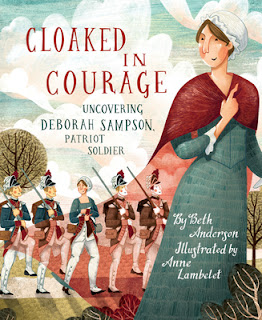

Calkins Creek, 2023
Imprint of ASTRA Books


SB:  Welcome, Beth. your profile picture books are often categorized as informational fiction, which allows you to generate stories that are compelling and complete through narrative literary style while incorporating an astonishing amount of factual content. CLOAKED IN COURAGE: Uncovering Deborah Sampson, Patriot Soldier succeeds in that approach with a wealth of fascinating facts despite the many mysteries still surrounding your subject. As you do so well, your author note makes clear what gaps and confusions interfered with finding definitive answers, then discussing your wide range of primary and secondary sources. Were there particular gaps that caused the greatest frustration? Things you still wonder most about to this day?


BA: This is one of those stories with some conflicting information and no way to prove exactly what’s correct. Technically, I’d call it historical fiction, one type of informational fiction. The categories seem to morph these days. But like my other books that fall into this category – I’d say it’s 95% nonfiction. What appears to be the most complete account of Deborah Sampson’s life is a bio by Herman Mann. He used her input, but apparently he didn’t think it was exciting or edgy enough so he took liberties, adding parts suspiciously like another book of the time and also putting her in battles that occurred before her enlistment. Mann also wrote her speeches when she went on the road as a lecturer. So… that whole book and her speeches are unreliable. But…historian Alfred Young took Mann’s book and examined every little piece, a truly great feat of historical detective work—and a huge help to me.

Probably the one piece of information I wanted most for the story was specifics on Sampson’s war wounds. Was it one musket ball in the thigh? Or two? One in the shoulder? The thigh and shoulder wounds vary a bit in different accounts. Did she dig it out successfully? Or was it too deep? I went after all that for a very long time. Experts have differing opinions. There is ample evidence that she was wounded. And two sources independent of Mann report that a shot remained in her. Deborah received an “invalid” pension and those records would have details, but unfortunately, they’re lost. There are multiple accounts of her digging out a thigh wound. Since her injuries were important to the story, I had to do the best I could. 

 One thing I wonder about is why she allowed Mann to embellish her life according to his vision of a heroine. She was so strong in so many ways. I have to think she longed for acceptance, needed to raise her family, and that the social restraints against women made her walk a narrow line between acceptable and unacceptable. 

Oh, and I’d really like to know how she hurt her finger! 

SB: Following up, among aspects of your writing that I admire most is your capacity for incorporating verifiable facts without relying on the dreaded (and usually boring) “information dump”. An example occurs in the second full spread in which very young Deborah is seen riding away from home on a wagon with a very old man, having been “put out” to serve another family by her mother. It was necessary to avoid starvation and have “a chance” at surviving. Within that one paragraph and a single line that follows, readers are introduced to that process, and come to understand that her mother was assumed to be widowed with many small children, that she was struggling with sadness (possible depression?), and desperately lacking in money and food. What dramatic and jarring truths about historic practices this reveals, and yet remains a very personal and nonjudgmental element of Deborah Sampson’s personal history. I’m trying to imagine how many pages of sources you must have read to reach these few effective words on the page, and how you do it! Any insights on how you determine what matters most and how to frame it within personal stories?

BA:  I’ve been realizing lately, as I revise another manuscript, that I have an aversion to long paragraphs on the page.  ðŸ˜†  Exactly what you said. Danger! Info dump! One of the major challenges is weaving in needed context without dumping a bunch of information that stalls the narrative. I try to embed it with action but it’s always difficult. 

 I learned a lot researching this story! I knew about the beginning of the Revolutionary War before I started REVOLUTIONARY PRUDENCE WRIGHT, however with Sampson’s story, I knew very little about the period of her enlistment from 1782-83. I had to dig into the Continental Army, traditions about women, media of the time, social customs, and so much more. Searching far and wide deepens my understanding of the character, motives, and stakes. The custom of children being “put out” or “bound out” was overwhelmingly sad from Deborah’s POV until I asked the questions WHY? and WHAT DOES THAT MEAN FOR THE CHILD, EXACTLY? And then, how does this serve the story? To find that, I had to look through her mother’s eyes. I had to make this harsh reality comprehensible while keeping the story moving. The challenge becomes what to use and what to leave out. TMI (too much information) slogs and loses focus. No enough confuses.


Interior spread, Cloaked in Courage, Calkins Creek, 2023


As you guessed, there’s a lot more, from multiple sources, that’s not on the page, so here’s a bit of background info and my goals line by line. This was a TOUGH spread, the inciting incident. 

·      Deborah watched Mama slip into sadness. I needed to look from Deborah’s eyes and not make her mother the villain when she was going with her only option. I have to say it took a long while to get to this line.

·      Too little money. And never enough food. These are realities a child can understand. Many complicating factors and details really aren’t necessary. This sets up Deborah leaving as giving her a chance for a better life. I used phrases to hit hard and slow the reader to take it in. And the previous spread, with its absolutely gorgeous and perfect illustration, just hinted that Deborah wants more from life and is looking to the future. 

·      And Papa hadn’t returned from the sea. The reality of her father “lost at sea” was that he had deserted the family. TMI. All Deborah would’ve known is that he never came back. Now Mama’s situation is clearer. 

·      With no way to earn a living, Mama offered her children what she could—a chance.   Women were basically unable to raise children on their own because the only skills they were taught were to care for children and run the home. Most women had no way to earn a living. It’s also the beginning of the idea that hardship can have hidden value.

·      Following tradition, she scattered them to different homes, “putting them out” to earn their keep. Mom was doing what was expected or normal—tradition. “Putting children out” was basically the foster care system of the time. It provided a way for kids to be cared for and, in some cases, to pay a debt. In the first two homes, Deborah provides help for elderly women, and in exchange, they provide food, shelter, and (lucky Deborah) teach her to read and write.

·      Including five-year-old Deborah. Putting her age (needed info) here is impactful and pushes the reader forward to see what happens to her. (And the illustration is so perfect!) 


I appreciate that you said this was “nonjudgmental” because my goal was to let the reader take in the historical truth and not tell them what to think. There’s no blaming, just the reality. This scene is about sympathy. And while it’s a terrible situation to think about, it was an important piece of Sampson’s story. The reader will root for her as she finds her way! Upon reflection, a reader can see how this scene supports Deborah’s choices to be independent and able to earn a living. 


SB: I loved the ways in which you laid the groundwork within Deborah’s background, ways in which her personal development serving in several homes built her physical and mental strength, her reading ability, and important awareness of the political movement toward rebellion and revolutionary war. Of course, the illustrations contributed greatly to your lively text, providing a sense of her as prepared to take a stand as a woman on her own, not following societal routines of marriage by age eighteen. Her recognition that common gender roles should not, would not limit her choices in life is so deftly revealed. It sets the stage for her superior achievements while serving as a revolutionary soldier, cloaked not only by her uniform but by her successes. Are there particular aspects of her lifetime of accomplishments that you most admire?  

BA:  I was driven by the question What makes us who we are? Getting into the details of her indentured servant years, it became easy to see how she develops the skillset for her future. I really enjoy the pre-writing process when I try to “build” the story with pieces found in the research—a puzzle! She did “male” and “female” work, was surrounded by the call for independence, and, when I looked at the books available to her, wow! Certainly all us know that we’ve been shaped by our experiences, the social conditions, and what we read and hear. I had so much for that section, but had limited space. I was thrilled that Anne Lambelet was able to show so much in the art. I loved offering up a chance for readers to consider the impact of the Boston Tea Party and Declaration of Independence from the POV of a teen girl!

The idea of excellence and integrity as a shield was really interesting to me. My understanding is that it started in her childhood, and it amazes me that a child that was “put out” pushed herself forward so tenaciously. I admire her boundless spirit and how she was able to serve for seventeen months without being discovered. One of my favorite moments in the story is when she returns from Philadelphia to face her commanding officer with the truth of her gender inside the envelope she carries. She faced severe punishment, a fine, and imprisonment for dressing as a man and lying about her identity. Male soldiers deserted all the time. She easily could have, too. But she didn’t. When I look at a character who accomplishes something outstanding, I’m impressed and inspired. But what really intrigues me are the decisions. Why?

 And for all her strengths, an important part of her story is her weaknesses. She lied. She took a bounty and then chickened out. That makes her story all the more powerful to me. 

SB: The trajectory of Sampson’s life after serving is left open to the reader’s imagination. By that point in this account you have offered enough information for readers to have opinions about what Deborah might encounter in the way of obstacles, and also in potential support among open-minded individuals, as she set out alone. She intended to make the most of herself, seeking “a chance”, as her mother had done for her so long ago. We readers certainly anticipate that Deborah Sampson would not let obstacles stop her. Did this ending reveal itself to you all along, or were there other options you considered? I’ll admit this one feels perfect to me, yet I can’t help but wonder what other approaches might have made a case in your mind before finally deciding.

BA: Originally, I took the story further to include her return, starting her own family, her lecture tour, being her own business manager, and fighting for her pension. I kept shortening that section, and by the time I got to editorial revisions, those extras were cut way back and what Sampson did in the future went to back matter. As the manuscript was fine-tuned and the “heart” thread sharpened, it just sort of popped that there was a natural ending when her enlistment was over. She had broken free, proved herself, and we know she’ll face anything. Going on to include more loses something and doesn’t resonate in the reader’s mind. 

 SB: I must always ask you to share what you can about other upcoming books, maybe including hints about ones that must still remain unrevealed.

 BA:  I have three books with editor Carolyn Yoder coming!

THOMAS JEFFERSON’S BATTLE FOR SCIENCE: BIAS, TRUTH, AND A MIGHTY MOOSE is in final art with illustrator Jeremy Holmes. What I’ve seen so far is AMAZING! The story is history + science + humor—all my faves. (Spring 2024)

 Illustrator Sally Wern Comport is working on sketches for HIDING IN PLAIN SIGHT: KATE WARNE AND THE RACE TO SAVE PRESIDENT LINCOLN. I’m looking forward to those—always an exciting moment!  No doubt inspired by all the Nancy Drew books I read, this is about Warne’s role in foiling the Baltimore Plot as the first female detective in the US. (Spring 2025)

As yet unannounced is the story of another spunky female who “exceeds expectations” and has connections to Madison, WI; Illinois; and Washington, D.C. (I know that Madison connection got your attention, Sandy! HA!) By the time this posts, I should have editorial revisions finished and the manuscript moving on to an illustrator…..Can’t wait to share!

And always…a WIP!  (SB: Work-in-Progress)                                                                  

Thanks so much for your insightful and dig-deep questions, Sandy! And for all your heartfelt support!

SB: Beth, thank you so much for this opportunity to join in support of your book. It is truly a marvel and one that must have Deborah grinning from whatever “beyond” she might be in!  I wish she had left even more of her story available to you, and to all of us, but you made masterful work of extensive evidence. Your treatment of her impressive and inspiring life deserves wide support and awareness. I’m delighted to offer that.

My full review of the book was in a recent post, and you can read it HERE. I'm not alone in praising this offering. To read other reviews and interviews about this book click HERE or listen to this terrific podcast/interview with Beth on "Confetti Moments", HERE. (It's episode 74 or you search without the link.)

I’m delighted to say that the publisher sent me an actual copy of CLOAKED, and the physical object is simply incredible. 


Jan 23, 2023

INTERVIEW: Author, Textile Artist, Quilter, Kim Taylor

Neal Porter Books, 2023


A few days ago I shared my thoughts and praise about a recent historical fiction picture book, A FLAG FOR JUNETEENTH, created by Kim Taylor. (If you missed it, I hope you will click to read about this remarkable book.)

It is my great honor and pleasure to share Kim Taylor's responses to a few questions about her process in creating this terrific new title.

SB:  First, thank you for taking the time to respond to my questions. Your life seems to be extremely full of responsibilities and challenges, as well as creative outlets. I'm very grateful to have this chance to share so many intriguing elements behind the gorgeous pages and text for this important new picture book.

Will you tell our readers a bit more about your creation process, especially for the “scene” pages (cabin interior, soldiers arriving, cabin doorway, etc.). I feel I'm seeing textile art using paints or other color media, combined with applique, quilting, and … more? I am in awe of the subtlety and power in you results.


Interior: A Flag for Juneteenth (Taylor)

KT: I remember when I was creating the interior cabin scene. It was the first illustration that I worked on. I knew what I wanted it to look like but wasn’t sure how I was going to get there using fabric alone. I decided to use watercolor paint to create the scene, and then use fabric collage and rough edge applique to build the characters, furniture, and decor. 

It was a disaster! 

I really had to teach myself how to manage the amount of water to mix with the paint because the colors bleed and spread fast on material! I was patient and kept practicing until I got it right. My daughter bought me watercolor pencils to use when I needed to be more detailed. I used watercolors for several of the beginning illustrations and love how the paint enhanced those scenes. 

Each illustration is built on a 15x15 inch square of fabric. I use many very small pieces of material to build people and other aspects of each scene. I love the beginning of the creation process because nothing is sewn down yet, and I can easily move material around until I am happy with the result. I use a little glue to tack down the pieces so that they don’t move when I am sewing.

Interior: A Flag For Juneteenth (Taylor)

When planning the illustrations, I tried to keep the text in mind, and made decisions about what aspects of the text I thought needed to be enhanced. For example, the first page describes tea cakes, a type of traditional cookie that enslaved people made using simple pantry ingredients. I thought that it was important to help my readers visualize a teacake, so I set out to create them using one of the brown fabrics from my stash that had some color variations. Teacakes were not fancy back then, but they were delicious and smelled amazing, so I used hand embroidered lettering to show the movement of the scent wafting through the air. I taught myself embroidery for this quilted illustration project. 

I chose fabrics that I felt would have matched the period. Nothing flashy or too modern. I did want to depict a difference in how my characters were dressed before and after the announcement about freedom was made. Some of the clothing was inspired by my love of African fabric and styles. I use a regular Juki sewing machine and lower the feed dog for free motion quilting after everything is in place for each panel. Quilting really brings out the texture and gives the illustrations a 3D effect. I did not go to art school, so much of this experience was a leap of faith and a learning process. A journey that I have totally enjoyed. 


SB: I appreciate your notes about the embroidery. I loved that aspect of the opening, especially, and hope it had been not been computer generated, but was your actual handwork. You certainly mastered embroidery with such fluid but precise stitching! 

Does each illustrated page represent a square in a completed quilt? How did you approach the sequencing and layout for that eventual full quilt?


KT: I created 26 individual quilted panels for this book. Unlike other quilts that I have created, each block is a separate illustration. 


They are not sewn together to form a larger quilt. 


SB: Were there any moments in the process of producing this book that felt particularly challenging, or especially satisfying?


KT: When it was first suggested that I illustrate this book using quilts, I was certain that I could not accomplish such an enormous endeavor. It takes quite a bit of time to make even one small quilt. It took 14 months to make all 26. I am very proud to tell the story of Juneteenth in a way that I hope will encourage children to want to learn more about this historic event. I felt it critical to highlight the beauty and resilience of African and African American people during their enslavement, as well as to showcase the importance of strong family and community ties. I am also incredibly proud to have illustrated this book with an art form that was used by my West African ancestors to tell their own stories.


SB: You certainly earned that feeling of pride, and I hope you have many opportunities to share the book and your process of creating it with audiences throughout the world, but especially with young children in this country. I had been imagining that someone who views the completed full quilt would be in awe of your artistry and storytelling, but that reaction will certainly be equally true for readers who open the pages of your book. If you could be a shadow on the wall and listen in to their reactions, what are some things you would most hope to hear them saying?


KT: I would love to hear my readers say that my book is unique and that they were moved by the story as well as the artistry. I want them to feel excited to learn more about Juneteenth. More than anything else though, I want to hear my readers say that they empathize with and feel connected to my characters. One of the most beautiful compliments I have received was when an adult reader told me that they cried when Huldah reached out and bravely put a sunbeam in her little jar. They understood the symbolism and it was meaningful to them.


SB: If there are other things you'd like to share with readers, please add them, as well as any info you are free to share about upcoming projects.


KT: When I finally finished writing my story, I realized that the last scene felt like a beginning rather than an end to me. I have been seriously considering a sequel, perhaps even more than one. I have often imagined what happened to this family after that momentous day. I am hoping that my readers are curious too!  

SB: I certainly am, and that was exactly my reaction when I first compelled reading your book,  and continued to make me wonder and worry about all of your characters each time I returned to the story. It's thrilling to know that we might learn more about them in the years ahead!

Thank you so much, Ms. Taylor, for sharing these insights and details with us. And thank you even more for such unimportant and gorgeous book with unforgettable characters living through a nearly forgotten history. I'll be eagerly awaiting the subsequent stories of their lives.


Apr 23, 2012

TERSE VERSE AND OTHER WORD WONDERS

Last week's spotlight on Brian Lies demonstrated the power of illustration not only to tell, but to swell a story to (and even beyond) its potential.

This week let’s take a closer look at some picture books in which the words can be just as potent. In every quality picture book the illustrations can and must carry their weight, but some books have a Suess-like capacity to intrigue and rivet our attention with the words themselves.

For a challenge of those proportions we can turn to Verla Kay’s books. Her series of historical fiction picture books are densely packed treasures of information delivered in the signature style she labels “cryptic rhyme”. Using tightly metered and rhymed short passages, her words tell childlike stories yet depict fascinating details about times and places in the past.

HORNBOOKS AND INKWELLS, illustrated by S. D. Schindler, provides examples. Her “terse verse” combines with Schindler’s double page spread of the interior of a colonial one room schoolhouse to plunge the reader back in time, costume, custom, and standards:

“Sternly standing, master greets. / Pairs of children, taking seats.
Hardwood benches, musty smell. / Children scurry, final bell.
John Paul bristles,/ ‘Take that back!’/Brothers bicker, / Thick rod, THWACK!”

Schindler's illustrations temper the ominous quality of the text, and each page unveils further aspects of a child’s life at that time, many of which are quirky and appealing (hornbooks, inkwells), many quite familiar (struggling to read, recess, daydreaming). Verla Kay’s cryptic verses require making inferences, using context, managing unfamiliar vocabulary, and visual literacy. This text can raise as many questions as it answers, but endnotes provide background and further factual snippets. These are books that trigger investigation, discussion, and imagination.

After reading HORNBOOKS AND INKWELLS you'll want to read WHATEVER HAPPENED TO THE PONY EXPRESS?; ROUGH, TOUGH CHARLEY; COVERED WAGONS, BUMPY TRAILS; GOLD FEVER; IRON HORSES, TATTERED SAILS; and just released in 2012- CIVIL WAR DRUMMER BOY.

Since the subject is the power of a few well-chosen words in picture books, let’s wrap up here with a brief mention of picture books specifically focused on figurative language, word play, and tongue-twisters. Here are some you'll want to know about:

Find a review of RAINING CATS AND DOGS: A Collection of Irresistible Idioms and Illustrations to Tickle the Funny Bones of Young People. by Will Moses at BooksForKidsBlog.


Check here for a Kirkus review of MUDDY AS A DUCK PUDDLE And Other American Similes by Laurie Lawlor, illustrated by Ethan Long.


TEN SECOND TONGUE TWISTERS by Mike Artell, illustrated by Buck Jones.


Finally, for some laugh-out-loud (overused, I know, but it is the best description here) word blunders, be sure to read an old favorite, DON’T FORGET THE BACON by Pat Hutchins.

That only scratches the surface of possible picture books in which the language invites repeated readings, sharing, investigation, and imitation. More proof that picture books are NOT only for babies!
Picture books are as versatile and diverse as the readers who enjoy them. Join me to explore the wacky, wonderful, challenging and changing world of picture books.