Showing posts with label theme months. Show all posts

Apr 13, 2022

Meet Benjamin Giroux- He Introduces Himself

 April is jam-packed with themes and recognition days: Poetry Month, School Library Month, Volunteer Appreciation Month, Autism Awareness Month, not to mention WORLD HEALTH DAY, EARTH DAY, and ARBOR DAY!  It takes a unique and powerful voice to stand out from among so many important themes and causes, but Benjamin Giroux has such a voice. 

If you click the many links above, including Benjamin's name, you'll be gone for a while. Stick with me and do that at the end, okay?)

Schiffer Kids, 2021

Let's begin with a quick and close look at Benjamin's picture book, the one that developed after he wrote a poem at ten years of age. I AM ODD I AM NEW. is written by Benjamin Giroux and illustrated by Roz MacLean. 

In response to a fifth grade writing assignment, Benjamin poured his innermost thoughts onto the page in the very text that later became this book.He thought it wasn't good enough despite his parents' praise. Perhaps that feeling reflected his lifelong experience of others indicating that he, as an individual on the autism spectrum, was not "good enough". 

Using social media, his parents shared  the poem exactly as he wrote it, and you can read a replica of his original work on the endpapers of this book. His words were embraced, globally, and many who read or heard them recognized themselves in his writing. Not so much because they, too, are on the autism spectrum, but because they feel "other", not able to fit in with a presumed "normal" or sameness. Benjamin's poem shares his feelings of isolation, but also his hopes that differences might one day be celebrated rather than disdained. 

His poem not only became the text for this picture book, with an introduction by the National Autism Association, citing Temple Grandin's advocacy for not just acceptance but appeciation of individual differences. His poem became the lyrics for songs, has been featured in videos. A saying of the NAA suits this poem, book, story, boy, and voice well: 

"No one has ever made a difference in the world 

by being the same."

The illustrations allow readers to empathize and connect, while revealing the diversity among the  population surrounding Benjamin. With comic-style simplicity and a deft use of blue/gray tones versus vibrant colors, the hopes and possibilities of full participation, satisfaction, and success for EVERYONE carries readers to a satisfying conclusion. Widening our circles of social acceptance is not just good for Benjamin but for each and all of us.

The symbolic flying paper airplanes might make skeptics call such a goal "pie in the sky". The truth is easy to recognize, though, through this simple picture book and the direct impact it can have on readers of any age. There are plenty of picture books that engage differences and specifically autism, but this is the best one to use to launch discussions that will move us toward that better future.


Mar 3, 2022

MARY SHERMAN MORGAN: An Inspiring but Overlooked Woman of Science


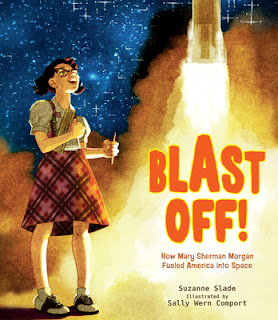
Calkins Creek/Astra Books for Young Readers
2021

We're already three days into our current "THEME MONTH", Women in History.

BLAST OFF! How Mary Sherman Morgan Fueled America into Space is written by Chicago area author Suzanne Slade and illustrated by Sally Wern Comport. When it comes to women in history whose stories are underreported, particularly those in science, Mary Morgan takes the cake. 

 Born in 1921, one year after women were legally allowed to vote, she was eight years old before the truant officer forced her family to let her go to school.  On a family farm, chores were not subject to a vote and even though she had to work overtime on studies to catch up for her late start, Mary completed her chores. Somehow, she found time to read, and read she did! 


By high school she proved herself to be a superior student, one who realized that chemistry was endlessly fascinating. Since her parents expected her to continue living at home and helping with chores, she worked multiple jobs, studied, saved, and applied for scholarships t go off to college. Her first two years of study gave her a good foundation, but her money had run out and she needed to stop school to work. At that time businesses hired women to do the work of men who had gone off to fight in the war, and Mary learned while earning money in an explosives factory making munitions for the war effort.


A few years later those men were back to compete for the job she wanted, and the boss at her dream company had 900 employees working on chemical fuels- all men! Mary made her case for being fully qualified, that man gave her a chance, and she was off to learn and develop advanced fuels and chemical combinations. I loved reading that her trusty sliderule was always on hand, her formulas were precise, and she double-checked every calculation. I celebrate her ability to VERIFY and CONFIRM computations, especially for a generation of readers who turn to handheld devices for math calculations, 


That proficiency and accuracy made her the lead scientist in a secret project to develop rocket fuel that could launch America’s first satellite. The pages detailing her thinking, experiments, failures and ultimate success are action-packed and compelling. Her determination was fueled by her fear that too many failures or false starts might make the public want to abandon space travel as too expensive. So she never gave up, and she led her teams to a successful launch, on schedule, with a promise that many more space adventures would follow. Back matter includes a timeline and extended details that provide curious readers with more about Mary’s life, American space programs, the Explorer 1 and Juno 1 rockets, and further readings. 


Mary Sherman Morgan was a woman who saw and pursued the potential within her and the potential beyond what she already knew. Her faith in science, in math, and in the uncharted opportunities of space should have been dramatized in film and books long before this, but it was worth the wait to read about her life and contributions now. Don’t let another day go by without reading her story. 

Apr 4, 2021

Earth Day? A Single Day? Even a Weekend? No Way!

 I'll repeat something I've included in many prior posts: I am seriously ambivalent about the value of THEME MONTHS or "Designated Days". April 20-22, 2021, are the official EARTH DAY/weekend and signal global action to raise awareness and sponsor actual efforts to improve/protect our Earth. As i write these words, a stack of picture books related to this theme is at my side, and I will celebrate them in coming days, along with poetry books, since this is also POETRY MONTH, (the 25th anniversary of that designation), among other overlapping themes. 

Today, though, I feature a single picture book that combines tragic warnings with a celebration of our potential to redirect the outcome of our planet. That change begins with awareness.

If our eyes have not yet opened to the reality that planet EARTH is on a course to disaster, there is an enormous need for more attention to actual, verifiable news. For example, if you are generally aware that whales are threatened, but not clear about the dangers to and status of particular species, check out these updates on Atlantic Right Whales, HERE, HERE, and HERE. 

Blue Dot Press, April, 2021

The release this month of WELCOME HOME, WHALES, written and illustrated by Christina Booth, is timed to provide a deeply emotional and gorgeous embrace of the present and the past lives of Atlantic Right Whales. It is also a warmhearted story about a sensitive boy (although the art is wonderfully open to interpretation of that gender) whose inner radar senses the presence, and past, of a welcome visitor. Using dreamy and fluid tones and lines the author/illustrator combines ethereal images of whaling history and practices that brought Atlantic Right Whales to the brink of extinction. Within those swirling pages are  dramatic images of the intelligent life of an ocean creature who carries a genetic memory of the damage done to her species. 

The child imagines the whale's message in actual dialogue. Whale's minimal communication and questions present a challenge to the listener/reader. There is awareness that the child is not personally responsible and yet together we experience a sense of human accountability for the harm done in the past. In the course of this very gentle but powerful encounter, the surrounding community gradually recognizes the reality of and importance of the return of this whale and her calf. 

To understand a broader significance to the situation portrayed, take a few minutes to listen to this piece on NPR about environmental observers have spotted Right Whales in their traditional south Atlantic coastal breeding grounds with calves after their extended absence. An even more recent piece about these developments can be heard HERE. 

Within the swirling, dreamy illustrations are accurate depictions of the boy's perceived whale, including characteristic crusty white patches on the skin, called callosities. The whale's images  include the "V"-shaped spray of its spray (tail), its relative size, behaviors, and calving patterns. A double spread in back matter incorporates scientific details about the three species of Right Whales, their feeding patterns, a habitat map, and more.The final page includes resources and suggestions for more information as well as ideas for things that even young people can to do help support the recovery of this species.

There are many reasons I love this book, including the bottom line: It is gorgeous in text and illustration with a theme that is not timely and timeless. In addition, it offers reliable and current information about this seriously endangered species with emotional power while not fantasizing or trivializing the reality of our global environmental dangers. It has enormous potential for use with learners, in science, social studies, and also as mentor text for writing.

Here's hoping it makes its way into your lives and the lives of young people you know, and not just during a theme month or weekend. Children should not be saddled with undoing the harm of past generations, but the fact is that they are our greatest hope of restoring ecological balance on this amazing planet. Books like this one can provide life-changing experiences.


Nov 12, 2016

Women (and Girls) and Glass Ceilings: Part One

"Kids are curious about the world around them and nonfiction is the perfect way to introduce them to that amazing world. History? Biography? Art? Science? Math? Animals? Sports? It's all here and more besides!" 
(From the Cybils Awards description of Elementary and Juvenile nonfiction)

After more than a month of reading, relishing, and examining Cybils nominated titles, I've moved along to the sorting and comparing stage. With such a variety of topics and types to consider, I've been grouping into related stacks of outstanding books: quirky animal books, straightforward animal books, inventors/inventions, history... you get the drift.

My eyes locked onto the perfect stack of books for this post, for this week. Each presented a young girl who had defied expectations of her place, time, or gender to pursue her dreams.  

Until recently, one of my most frequently-viewed posts ran in the early days after I launched this blog. WHAT'S SO SPECIAL ABOUT FEBRUARY was the first of many references I've made over the years to the dual-edged sword of theme months. My concern has always been that flooding a specific month with attention and featuring books on a particular theme (Black History, Women's History, Hispanic Heritage, even Poetry) is dangerous. That goes beyond the obvious message that such narrowed awareness and exploration isn't "real" learning, that each only merits one-twelfth the attention of all our "more important" studies. Too often this approach also results in unpacking a "theme" collection of books for use, then packing them away again until the next year.
I'll climb down from my soapbox and urge anyone who cares to read more of my eloquent arguments on this thesis in the original post, here.

Assigning such a secondary significance means that the history-making stories of half the population of the world get about 8.5% of the annual educational focus. "HER-story" is stuffed into the month of March then buried under another box of books for a year. That's why November (and every other month of the year) offers a perfect opportunity to celebrate young females who faced challenges and barriers without flinching.


Let's start with THE FIRST STEP: How One Girl Put Segregation on Trial. Written by Susan E. Goodman and illustrated by E. B. Lewis, the story of equal-education-seeking young Sarah Roberts couldn't be in better hands. Many young readers have come to know Ruby Bridges and her solitary studies during the civil rights school integration enforcement in the 1960's. The little-known case of Sarah Roberts, though, set the groundwork for establishing desegregation through the courts those many years later.

Back in 1847, four-year-old Sarah was escorted out of her all-white classroom by a police officer. This launches the heartbreaking story of her family's legal, political, and social battle to gain equal educational opportunities for Sarah and all children of color.
Despite set-backs and disappointments, in 1855, before the Civil War, Boston became the fist major American city to integrate its schools. That was more than a hundred years before the BROWN vs. The BOARD of EDUCATION case that finally established "separate is NOT equal". As Goodman says midway through Sarah's process, 
"Every big change has to start somewhere".

The back matter in this picture book is particularly well-suited to close reading and discussion. As she often does, author Goodman doesn't shy away from significant truths. (After all, she's the author of The Truth About Poop and Pee.) In this case she addresses her remarks to young readers, discussing reliable research sources, making decisions about depicting "cloudy" aspects of history, and using modern language within historical context (when the words used for people of color at the time were insulting and demeaning). She provides a timeline of desegregation landmark events with a challenge to readers to decide for themselves which ones are steps forward and which were set-backs.

Stay tuned in coming days for reviews of other outstanding books in which young girls are depicted rocking the boat, making waves, rattling at doors, pushing envelopes, and otherwise cracking, sometimes breaking, those glass ceilings.

And don't you dare put those books in a box and save them for March.


Feb 1, 2016

THEME MONTHS: Black History and Others

I've long considered Theme Months to be double-edged swords, including BLACK HISTORY MONTH, right through to POETRY MONTH and beyond. I addressed the question, here, in one of my earliest posts on this blog. 
Some tools and strategies can do as much harm as good.

The double-edged sword, to me, springs from the fact that a spotlight is long overdue for many topics. Certainly theme months are a step to correct that situation. That's better than nothing, one might argue.
 True, a month of attention is more than those topics might otherwise receive, but then the calendar page flips and the spotlight moves on to the next topic. 
Why would I view that as a curse? Doesn't fairness count for anything?

My concern comes from years of experience in classrooms, at many grade levels. When a month is designated it is all too easy (and often happens) that a limited collection of books, poster images, and activities is "brought out" to be displayed and shared, then packed away again when the next topic rolls around. The very fact that topical themes, especially in history, gain such designations reflects the absence (or disproportionately small amount) of attention devoted to those subjects throughout the rest of the year. 


A fairly recent development has begun making inroads to changing that pattern. Just last week Multicultural Children's Book Day celebrated a vast array of books that feature our world-- our REAL world. By that I mean a world of diverse and unique people. When you click the link you'll connect to multiple posts with outstanding recommendations by teachers, librarians, parents, and kids. These books span genre, topics, and target audiences. What they have in common is that they are appealing, engaging, and thought-provoking books in which readers can find themselves and the people who surround them without waiting for an event or occasion to do so.

That is, indeed, a blessing. It's also sending the message we want readers to receive- that people (and books) offer world-views that defy categorization or limitation to a single day, week, or month of our attention. The deepest cuts of that double-edged sword come when a theme-month offers unstated but implied messages of "otherness". It arbitrarily declares  that certain topics or books offer nothing of merit apart from those designated periods, nothing that would engage our attention when offered freely throughout the year.

As you read in my opening lines, this isn't the first time I've raised the issue on this blog. As I was about to add "nor will it be the last", I stopped to reflect. Could the day actually dawn when the need for THEME MONTHS disappears? Yes, I believe it could. When multicultural, diverse children's literature is so ubiquitous, when books fully represent ALL people, a "history month" would suffice. 
We're a long way from that day, but we're closer than we've ever been before.
This is no time to rest. I've linked to just a few previous posts in which I celebrate books without an eye on the calendar. If you're new to this  blog, I hope you'll check them out.
Folk Tales and Facts: Marvelous Cornelius

Heather Lang and Floyd Cooper Launch a Winner: Queen of the Track 

Drum Dream Girl: A Trio of Titles
and
NON-Fiction Notes: Kid Athletes and Other  Biographies

If you have other titles to recommend, or other posts to suggest, please add your comments!

Mar 20, 2014

Don't Miss This Resource: Women's History Month

For a variety of reasons I chose not to post titles related to "theme months" this spring (Black History in February, Women's History Month in March, and Poetry Month in April). I've shared my attitude about theme months in several prior posts, but always tried to feature at least a few of my favorites during these months in the past.

One reason is that this blog now has a reasonable stock of archived titles readers can draw on for a variety of topics, all year long. 

Another reason for temporarily cutting back on new posts to this blog is because of time commitments for the pending release of my middle grade historical novel, Odin's Promise. 

In addition, I felt confident that readers would be able to locate current and classic titles for theme months in other high quality blogs. If you missed my recent post in which I pointed out Anita Silvey's Book-A-Day Almanac  be sure to check out its rich resources and superior insights.  
Official blog banner  for Kidlit Celebrates Women's History Month

This month in particular (Women's History Month) I've been utilizing a blog co-hosted by west coast librarian Margo Tanenbaum and her east coast librarian friend. It shows up in my inbox several times each week, providing me with a squeak of happy recognition for titles I know and may even have featured in the past. Even better, it points me toward titles I haven't yet read, and they're immediately added to my library hold list and eventually land in my bedside stack of books to read.

Sure, I know what I said above about reserving time for posts, web development, and prep work for the release day next month. Still, I'm willing to cut back just so far, and that does NOT include doing less reading, especially when titles come highly recommended from trusted sources. 

So, thank you, Margo & Co., for offering readers those recommendations. As for readers here, I hope you'll click on over to bookmark her site and even consider subscribing. You won't be disappointed.

Full disclosure: In a few weeks it will be my pleasure to respond to an interview with Margo about the release of Odin's Promise and she plans to post a review. I've followed her blog posts for a long time and that's how I first became aware of her. This recommendation of her blog was not a condition of her blog posts about my book. I'm proud and confident to recommend her suggestions to you.
Picture books are as versatile and diverse as the readers who enjoy them. Join me to explore the wacky, wonderful, challenging and changing world of picture books.