Showing posts with label Space. Show all posts

Mar 3, 2022

MARY SHERMAN MORGAN: An Inspiring but Overlooked Woman of Science


Calkins Creek/Astra Books for Young Readers
2021
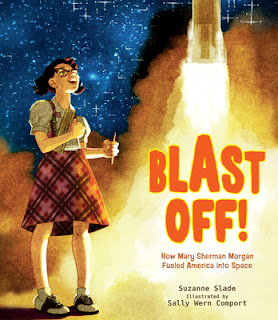
We're already three days into our current "THEME MONTH", Women in History.

BLAST OFF! How Mary Sherman Morgan Fueled America into Space is written by Chicago area author Suzanne Slade and illustrated by Sally Wern Comport. When it comes to women in history whose stories are underreported, particularly those in science, Mary Morgan takes the cake. 

 Born in 1921, one year after women were legally allowed to vote, she was eight years old before the truant officer forced her family to let her go to school.  On a family farm, chores were not subject to a vote and even though she had to work overtime on studies to catch up for her late start, Mary completed her chores. Somehow, she found time to read, and read she did! 


By high school she proved herself to be a superior student, one who realized that chemistry was endlessly fascinating. Since her parents expected her to continue living at home and helping with chores, she worked multiple jobs, studied, saved, and applied for scholarships t go off to college. Her first two years of study gave her a good foundation, but her money had run out and she needed to stop school to work. At that time businesses hired women to do the work of men who had gone off to fight in the war, and Mary learned while earning money in an explosives factory making munitions for the war effort.


A few years later those men were back to compete for the job she wanted, and the boss at her dream company had 900 employees working on chemical fuels- all men! Mary made her case for being fully qualified, that man gave her a chance, and she was off to learn and develop advanced fuels and chemical combinations. I loved reading that her trusty sliderule was always on hand, her formulas were precise, and she double-checked every calculation. I celebrate her ability to VERIFY and CONFIRM computations, especially for a generation of readers who turn to handheld devices for math calculations, 


That proficiency and accuracy made her the lead scientist in a secret project to develop rocket fuel that could launch America’s first satellite. The pages detailing her thinking, experiments, failures and ultimate success are action-packed and compelling. Her determination was fueled by her fear that too many failures or false starts might make the public want to abandon space travel as too expensive. So she never gave up, and she led her teams to a successful launch, on schedule, with a promise that many more space adventures would follow. Back matter includes a timeline and extended details that provide curious readers with more about Mary’s life, American space programs, the Explorer 1 and Juno 1 rockets, and further readings. 


Mary Sherman Morgan was a woman who saw and pursued the potential within her and the potential beyond what she already knew. Her faith in science, in math, and in the uncharted opportunities of space should have been dramatized in film and books long before this, but it was worth the wait to read about her life and contributions now. Don’t let another day go by without reading her story. 

Jun 20, 2019

Start Summer with STEM Books!

It's an old fashioned concept that summer vacation for kids is a wide-open, free-wheeling, choose-your-own-adventure time. If I were decades younger I'd might even doubt that it was ever true. But I lived that kind of summer. Sure, there were chores, family outings, even some short half-day camps sponsored by church or scouts or whatever. But the bulk of our long sunny days were ours to plan and execute.

Truth be told, I spent lots of my free time reading. But countless hours of summer were improvised, spur of the moment adventures with friends. That might involve cooking, camping out in the the back yard, making up new rules to old games, or packing a lunch for an all day bike trip of undetermined route or destination. (These explorations launched without today's ubiquitous cell phones, just a dime in a pocket in case we needed to use a phone booth.) 

That's certainly not the way of the world today, but here's my suggestion to salvage at least the spirit of what those days were like. Both are STEM books, and both are semi-non-fiction, relying on real events and back matter to blend exciting and fun stories into actual space-based science. 
Penguin Workshop, 2019

First, a suitably small book features little Mars Rover Curiosity as the central character. BIRTHDAY ON MARS is written by Sara Schoenfeld and charmingly illustrated by Andrew J. Ross. In wonderful dusty, rusty tones with a Rover-eye-view, Curiosity voices a first person account of why it is there, an awareness of its friends on Earth, and a sense of purpose. The clever small moments (taking a birthday selfie, peeking under rocks) make it a winning intro to space science for even the youngest. The topper is the blend of humor and fact in the story when it sings HAPPY BIRTHDAY to itself. Then back matter reveals that this little explorer did, in fact, sing happy birthday to itself on it's first anniversary on Mars. 
Roaring Book Press, 2019
I can't imagine a more appealing way to interest kids in space science, unless it is this next book. GO FOR THE MOON: A Rocket, a Boy, and the First Moon Landing is a big, bold opposite to the sweet little Rover book.Chris Gall wrote and illustrated this oversized, heavyweight, photo-realistic story of a space-enthralled little boy whose life mirrors the first moon launch and landing. 
With white-framed, double-spread illustrations readers open to a rear view of a young boy staring out his bedroom window. His walls, shelves, and toys all reveal a childlike but obsessive interest in space. Text is white on the night-darkened scene, emphasizing the full moon glow and the substance of the text:


"In the morning, three brave men will climb inside a giant rocket, blast off into space, and fly to the moon. ... The astronauts are ready for the mission and so am I."

From that page forward this lad duplicates each stage of the process, from his Tang breakfast, to launching his self-built rocket, to suiting up for the moon landing, to entering his cardboard landing capsule. Soon he and family are pictured stretched out in front of their black-and-white, grainy, scratchy console television. I was right back in my own living room, home from college and working a night shift at the hospital. I was able to stay long enough to see the lander touch down and hear the astronauts' voices in the capsule, I saw the door open, and watched that first footstep before needing to leave for work and follow the progress of the landing on the car radio. 
What a night that was. I was overwhelmed as an adult, but viewing it through the eyes of a space-struck boy in this book felt even more powerful. That little boy was the author/illustrator, Gall, and he details his own engagement with rockets and space in the back matter. 
That genuinely portrayed first person insight to the magnificent adventures of  those days is matched by this book's ability to make superlatives kid-friendly. Gall describes the skillful expertise demanded of the rocket-crane operators. (It has to do with raw eggs, but I won't spoil your reading with further details.) He compares massive weights and heights to stacks of elephants, the Statue of Liberty, and other familiar touchpoints.  Inserting science content and accurate descriptions provides informative facts to kids and to the adults who share this with them. 
There is much about Gall's illustrations that remind me of Chris Van Alsburg (JUMANJI, POLAR EXPRESS, and many others). There is much in these two new picture books, one tiny and clever the other massive and moving, to spark curiosity and challenge in young readers' minds. 
10 -9 - 8 -  Let  the summer explorations begin!


Picture books are as versatile and diverse as the readers who enjoy them. Join me to explore the wacky, wonderful, challenging and changing world of picture books.