Showing posts with label kindness. Show all posts

Oct 17, 2025

WE ARE DEFINITELY HUMAN Swells with Heart and Humor


TUNDRA BOOKS, 2024

Be prepared to suspend your inner cynic to embrace a naive and welcoming attitude in WE ARE DEFINITELY HUMAN by X. Fang. That's what the humans (the ones we recognize as human) do in their chance encounter with three folks whose "car" lands in the middle of the night. These beings find themselves in need of serious help. That serious dilemma doesn't diminish the over-the-top humor or the genuine heart of the story itself.

This quirky and clever story features "strangers" who instantly declare, when asked, that they are human, definitely, though clearly they are not. Definitely human. Yep. Despite their obvious differences, the kind family who locate their crashed transport vehicle open their hearts and doors to the outsiders. They are willing to take their declaration of being humans at face value and overlook unfamiliar appearances, odd behavior choices, and stilted language patterns.

The humor and vivid differences throughout allow readers to laugh at such silliness while digesting the choices being made with kindness and a gentle underlying message. This is a perfect example of my assertion that picture books are meant to be consumed as a whole, beginning to end, as an art form and story in their own right. This book, read aloud to a group or on a lap, will have everyone of many ages chuckling and likely laughing aloud. But the best books, as this one is, invite readers to go right back to page one and begin again, discovering what is lurking in the nuances and corners of the pages. 

The thoroughly simple premise opens plenty of opportunities for potential skepticism, or even a condescending assessment of the locals folks who seem clueless about being obviously misled. Instead, the readings of the story,  from first through multiples, leads to a sense of what it means to be human, definitely. Even the youngest will identify and appreciate the warmth and rightness of kindness, finding balance and truth in the impact such kindness can have on others, directly and as a ripple effect into the future. Definitely.


Aug 15, 2023

INTERVIEW: Liza Wiemer, Author of OUT AND ABOUT: A Tale of Giving


KALANIOT BOOKS. August, 2023


Happy Book Birthday 

 OUT AND ABOUT: A TALE OF GIVING

It's my pleasure and honor to introduce you to LIZA WIEMERthe author of  a wonderful new picture book that released today: OUT AND ABOUT: A Tale of Giving.

As you no doubt noticed, the cover looks like this is a winter/holiday offering, perhaps getting a jump on the season. But don't be fooled. Let the chilly scene wrap itself around you during these hot-weather days, but also cuddle into the underlying story. It is one that will warm your heart and also make clear that the family's spirit and grace are practices suited to every day, every way, every season, every climate.

Last week I offered my review of the book itself, HERE. I was not alone in praising this important story. Kirkius review had this to say about it, in part: (Click to read more.)

"A beautiful and thoughtful message woven into 

a brief yet poignant story."

Liza was kind enough to make time on this exciting release day to share some thoughts about this career achievement and her insights about the story. 

SB: Liza, your work quality and voice for teen readers (and adults!) has been firmly established. What made you want to write a picture book for younger readers and their families? 

LW: Thank you so much, Sandy, for the opportunity to be on your blog and to answer these outstanding questions.

This picture book was inspired by a story my grandfather told me about his childhood and took me over 20 years to get published. The value of giving to others in need is one that is deeply important to me, one that I have shared with my children. When I taught preschool, I used to tell this story to my students, and they loved it. That motivated me to write it.


SB:There is a fine line between writing a book to “teach” a lesson and writing a book that touches hearts to reveal important ideas and values. With the thousands of words available to a novelist, writers have room to finesse that line. In writing picture books, your word count is drastically less. This is not unlike writing poetry, even when not rhyming. Missteps between telling readers what to think or feel and allowing readers to discover or conclude those thoughts and feelings are beyond awkward- actually painful to read for many readers. A real turn-off. How did you manage to negotiate that territory so successfully?


LW: This was something I thought about a lot during the writing process. I knew Daniel had to have his “ah-ha” moment but struggled with how to make that happen. A conversation with a college professor who analyzes picture books spurred on the final idea of how Daniel figures out what his parents are doing. Along the way, however, I wanted Daniel to reflect while also having fun using his imagination. I want kids to use their imaginations and decide what they think Dad and Mom put in the boxes that they gave away to help others.


SB: Was your  prior experience in writing poetry/free verse at all helpful in developing text for this picture book? You used repletion of phrases, cycles of awareness, and found a very effective resolve on the last page. Were you conscious of those patterns and other approaches to the text from prior writings, or did that all need to come to you fresh for work in a picture book?


LW: I don’t think I consciously was making that connection between my love for free verse poetry and the writing in this picture book, but now that you mention it, that’s an outstanding observation. I read my picture book out loud multiple times, listening for cadence and readability. The repetition of “out and about” was important because we want the reader to be able to answer the question posed by Daniel’s brother at the end of the book: Where did you go? And, of course, the answer was “Out and about.”  


SB: Since this picture book story was on such a longtime journey to reach young readers, is it a “one-and-done” in this format or are there others in the works that you'd be willing to share with us? 


LW: I have a few more ideas I would love to see become picture books. But for now, I’m keeping them hush-hush.


SB: That's very understandable. After all, allowing this story-of-your-heart the time it deserved to work its way onto the page has had a beautiful result. I know you’ve spent many hours working directly with young readers regarding your writing and theirs, but that has mainly been with teens. Have you had an opportunity to share this new picture book  with younger readers yet? If so, what was memorable about that/those experiences? If not, how do you plan to approach those groups?


LW: Great question! Other than sharing the story with my preschool students and family, I haven’t had the opportunity to read it to kids! I’m excited to do so. I love the illustrations. 

\

Interior spread, OUT AND ABOUT. Kalaniot Books, 2023
 

SB: I agree completely about the illustrations enhancing your text and inviting young audiences to put themselves into Daniel's shoes. I feel like the images entirely capture the idea that Daniel totally imagined that there might be exciting things for HIM in those boxes. His imagination definitely followed a typical young person's point of view, and that he did not seem to be greedy, just curious, excited, and typical of his age. That's another fine point of balance you achieved with this central character.


Thank you again, Liza, for sharing your time and insights with readers here. I want to add a reminder that the author note in back matter shares more details about the origins of this story in your own life. There is also additional information about Jewish cultural/religious values and practices and a brief glossary. 


Learn more about Liza Wiemer and her upcoming appearances, projects, contact information, and  teaching/discussion resources on her website, HERE.


 https://www.lizawiemer.com

Twitter:  @LizaWiemer

Instagram: LIzaWiemer

Facebook: https://www.facebook.com/liza.wiemer

TikTok: lizamwiemer  


I hope you'll explore any of the above sources to learn more about Liza's writing journey, to view interviews and videos, and to check her calendar for appearances near you.

Mostly, as Levar Burton always said on Reading Rainbow,

"Don't take my word for it, read!"


Aug 10, 2023

OUT and ABOUT: A Story of Giving

 If the name of author Liza Wiemer is familiar to you, it could well be from her contemporary teen novel THE ASSIGNMENT. It's an award-winning and globally successful story inspired by actual events in this last decade. If you haven't read it, I urge you to do so. 

It is often said/presumed that novelists and others who write for teens and adults struggle to write picture book text. In extended prose, the author needs to "illustrate" everything the reader needs to know and feel and consider with language.  In picture books, the text is not only drastically lower in word count, but each word must earn its place on the page. The text must also allow the illustrator  the space and respect and trust that visual narratives will not just mirror the text but provide as much or more of the storytelling as the words do. That is a challenging task for the illustrators but also for the author to determine what needs to be said with words and what does not. Wiemer has succeeded beautifully with her first endeavor into picture books. Her text and illustrator Margeaux Lucas achieve that masterful interaction of text and images that convey the heart and soul of a wonderful story. 


Kaliot Books.  August, 2023

OUT AND ABOUT: A Tale of Giving is written by award-winning author Liza Wiemer and illustrated by Margeaux Lucas. There is so much to enjoy about a well-told story in a picture book format, and this new offering provides both entertainment and heartwarming life lessons without being didactic. 

The illustrations, of course, enhance the qualities of Daniel and his family's relationships, which are both loving and supportive but also realistic in the personalities and playful approaches of their interactions. Daniel's keen observations, insatiable curiosity, and vivid imagination reveal a believable boy who sees any mysterious box as potentially fulfilling his dreams. 

Eventually, though, that observational curiosity allows him to put puzzle pieces together and realize that other peoples’ dreams matter, too. That's especially true when life circumstances place hurdles in the way of happiness. I especially enjoyed that Daniel developed his growing understanding and chose steps forward to participate in kindness without relying on prompts or explanations from the adults or older siblings. His final page decision about how to respond to the curiosity of his younger brother was a satisfying confirmation of the change he had embraced.

This narrative involves an accessible amount of text with page placement and font sizes resembling short passages of longer, full text. That is a great match for Daniel's character and for the skills of target readers' ages. It also reaches readers at their own developmental capacity to take the same steps of logic and empathy as Daniel does. 

A brief glossary, simple explanation/quiz about the Jewish principles of giving, MAIMONIDES’ EIGHT LEVELS OF TZEDAKAH, and a short author note expand this particular Jewish family experience into an informative resource as well as an opportunity to reflect on the universal value of giving in ways large, small, publicly magnanimous, and generously anonymous. 

Author Liza Wiemer writes from her heart at every level, and she has agreed to answer several interview questions about this story and its origins in a post on her BOOK BIRTHDAY, August 15.


Until then… stay generous and giving in the best possible ways.


Jun 3, 2023

ONE SMALL THING: The Power of Kindness


BEAMING BOOKS, 2023


 On this post-holiday, quiet weekend, I bring you a "quiet book" that emanates power and grace. ONE SMALL THING is written by Marsha Diane Arnold and illustrated by Laura Watkins. The quotation marks around "quiet book" are intentional, in that they are so often written by various folks in the picture book business (and it IS a business) in declining submissions (isn't that a kinder word choice than rejection?) that do not involve some frantic or antic actions. "Quiet books" don't sell as strongly as, say, a book about robots or superheroes or magic. And yet, a quiet book in the hands of a "STORYMAGICIAN",  as Arnold's website subheading rightly tags her, can transform lives. I know of no greater superpower than that.
This latest offering from Arnold is launched by a tragedy--  Raccoon's home has burned. The comfort begins immediately, first in knowing that Raccoon is safe, has  supportive friends, and pet Cricket escaped, although is now lost. 
This opening alone would have hooked me, since there were more than a few students in my teaching career, of many ages, who had survived such a trauma. The ultimate "it's not so bad" sense of comfort among friends features as an inadequate way many of us address the immediate and lasting pain and loss of such an event. Would "shelter" of any kind ever feel as safe as it once did? Would the loss of keepsakes and photos and... just the capacity to return to a place of memories... ever ease? As the rest of the community observed their friend recovering, would the impulse to comfort dissolve into daily duties, assuming the one who was traumatized would be as "good as new"?
This seemingly simple story opens with sunny endpapers, suggesting such a casually happy ending. Minimal but marvelous text reveals that those comforting friends are buzzing about this sad occurrence. Each "thank goodness" informs readers of reasons to be grateful despite the losses. They also reveal Raccoon's personality, how he loved living along the river, how his feet were  burned "a bit", and that "silly" cricket jumped away to safety but now no one knows where it is. Who has a pet cricket anyway? 
The illustrator informs us, too, that these are heartfelt words of comfort among friends who ache for Raccoon's loss, but quickly console themselves that all is well and they can return to their own lives. These very appealing and authentic, familiar woodland animals display expressions that  even the very young will recognize and empathize with throughout, another powerful touch that allows such a special book to reach audiences from preverbal to teens and beyond. They also represent the typical range of reactions among friends, from the practical problem-solvers, to the overly sensitive, to those who expect someone else to help, to those who feel helpless, to the grumbler who sees this all as unnecessary fussing. As an adult reader I've witnessed (and experienced) such reactions to tragedy, cringing at the thought that these generally result in nothing being done. 
And that is precisely how Arnold proceeds, allowing each character to return to daily life with no updates on Raccoon, at first. First, in fact, we observe a series of double spreads in which we join each friend in their own own homes/gardens, rich with detail and interests and habits that invite us to linger, to examine closely how the individual has found safety,  comfort, and shelter from a sometimes harsh world outside. Each, in their own way, realizes that they cannot "fix" Raccoon's situation but is able to offer ONE SMALL THING that might be welcomed. Only as those conclusions are reached does Beaver find Raccoon soaking his burned feet in the river, leading him to a new home where the collected friends and their SMALL THINGS are no longer ONE. In fact, such individual acts create a new ONE-ness among them that satisfies thoroughly.
I am purposely not providing details of such small things they chose, not only to avoid spoiling the story (that couldn't happen) but to allow readers to realize how truly SMALL those decisions were but how enormously powerful each decision and action proved to be. 
Most importantly, these combined small things, though unplanned efforts, gave an immeasurably large result. Or at least, as Badger admits, "It was a little something." Only as this gratifying ending occurred and I closed the back cover did I realize that those end papers were not exactly "sunny". Such losses and pain are never gone from us. They are, in fact, revealed in the glow of the day that shows on the cover. I imagined that was the dawn of the day of the tragedy. Iinstead, after seeing the expressions of the friends and the lingering longing of Raccoon, I think those endpapers reflect a blend of dusk with honey and butter and safety and comfort, all of which wrap around a community to offer hope. 
Arnold has proven herself worthy of that STORYMAGICIAN title, as I observed in reviews of LIGHTS OUT, HERE, and LOST AND FOUND, HERE. Each is, in fact, a "quiet book", a blend of story and format and visual narrative that resonates at first reading, calls for return readings, echoing throughout succeeding days and years. My recent move is into an area that has very bright street lights, one of which is outside my living space. I noted that it is using energy-smart bulbs, but not before I noted that the fixtures are designed to cast light down to the streets, blocking it from lighting the sky. I'm aware of DARK SKY activists, and was concerned before reading LIGHTS OUT. Even so, my notice of that  fixture design led me to remember those animals and their journey with a smile on their behalf. Now that's power. 
Do one small thing, please. Begin by finding and reading this book. Then share it with someone. Then carry it forward in your mind and heart, turning kind thoughts and worry into actions for those in need, whether friend or stranger. KINDNESS is not a concept, it is verb.And it is NOT a small thing.


Aug 31, 2022

KID VOICES: Amplify, Support, Celebrate, RIGHT NOW!

Few would argue that kids have voices, opinions, personal interests, and attitudes. This is true physically (walk past any playground or swimming pool for proof) and figuratively (recall times when their voices are NOT in agreement with yours!). In the case of this upcoming (September 7, 2022) picture book, the voices speaking up refer to specific contemporary individual youths as well as addressing any young person who encounters the text. In fact, in the closing pages the author charges/challenges adults in the lives of those young folks to actively support their efforts and encourage their drive to improve the world, not settling for our "hopes" for their future but helping to improve it now.

CLARION BOOKS, 2022

RIGHT NOW! Real Kids Speaking Up For Change is written by Miranda Paul and illustrated by Bea Jackson. The cover is wrapped with images of the named examples whose brief profiles demonstrate the power of a committed young voice with following actions, but every single page reveals who the YOU of direct address text might be: diverse in age, ethnicity, ability, issue, and pursuit. 

The common denominators for the various images are their smiles, their determined expressions, and their unity in support of each other. More than sixteen individual examples are shared, with each example providing a brief background story, a direct quotation (cited in back matter), and a continuity of the general text which frames the individual as a potential "you", including the circumstances that led to the individual activism on behalf of a wider community. Those commitments ranged from medical discoveries to making life-needs available to the hungry and unhoused, to global causes like immigration, rights of girls and women, treatment of those with disabilities/differences, and basic kindness.

Backmatter includes a brief author note (with that challenge to adults), tagged ways-to-speak-up for eleven of the issues spotlighted within the profiles, a simple glossary, and bibliography with quotation sources. Paul has a polished talent for presenting nonfiction content in accessible, appealing ways that "speak" naturally to young readers without patronizing or oversimplifying. That is enhanced by the gifted art of illustrator Jackson. The colorful, recognizable images of these diverse, specific examples are couched in identifiable situations and settings, with a comfortable realism but a slight/inspiring glow to their demeanors. These, and the general characters throughout, could be found in any school anywhere, and they are. It matters that we (adults) recognize that in them, and help young people recognize in themselves the voices and interests that can change the world. A book like this is a ticket to begin that journey.

Carolrhoda Books
August, 2022

 
Two other new picture books encourage similar attitudes in young people. Both are charming and reinforce the call to action of RIGHT NOW, although they feel best suited to underscore or reinforce that text. BE A BRIDGE is written by Irene Latham and Charles Waters, with illustrations by Nabila Adani. It is written in rhymed lines with a direct address to younger readers, occasionally tending a bit didactic, but with wonderfully charming and colorful illustrations of diverse kids. Framed in a school setting, each reappears in various scenes, sometimes choosing positive actions and sometimes benefitting from the advice to calm down or deal with life in kind ways. 

BEAMING BOOKS
2022
Finally, SARAH RISING deserves a close look and sharing. In this case the tentative young voice is that of Sarah, who loves nature and her little "pets", a living collection that we later learn are lovingly cared for. observed,  and then released back into nature. Sarah, too, is lovingly cared for and will one day be released into her own future, but for now she is learning first hand from her dad that every voice should be raised to speak out for those being treated unjustly. The situation of a protest has a somber, worrisome tone, but Sarah's impulse to save an injured monarch butterfly outweighs her fear of the "BIG" people surrounding her. Her kindness separates her from her father, but results in care and kindness from other BIG people who lift her up to locate her dad inn the crowd. The sense of Sarah rising to a need, rising above her fear, naming her emotions, and being raised to see herself as able and with agency are all worth considering and discussing openly. Author Ty Chapman achieves an authentic young girl's first person voice and perspective, while illustrator DeAnn Wiley achieves an appealing balance of dark-skinned characters within joyful, safe, and happy scenes/relationships as well portraying widely diverse individuals involved in the protests and police groups, in which the overall tone and perspectives convey the shifting moods within the story arc. The recovered monarch being freed at the end offers a just-right dose of introductory lessons on symbolism. 

Overall, this threesome deserves a place on the list of "back to school" picture books across many age levels.


Aug 29, 2022

And more about KINDNESS: We Can Never Get Enough

ORCA BOOKS


 Following the real-life inspired story of kindness and mutual support at the border, HERE, I'm sharing a quick look at a delightful story of ultimate kindness and support, KUNOICHI BUNNY, written by Sara Cassidy and illustrated by Brayden Sato

I read several short notes about this recent title and was sure I'd enjoy it. Once I had my library copy in hand I found I had an entirely mistaken sense of the story, but enjoyed the story it actually IS even more than I had expected. So, here's a quick summary:

Kunoichi is, as I imagined, the beloved bunny. A stroller-sized girl is being taken on an outing by her dad, with Kunoichi in tow. It is told through nearly wordless graphic/comic panels, brightly colored and action packed, This lovely child notices everything and does NOT want to see discord or disaster. When such occurs, she flings KUNOICHI into the fray to save the day. And, in delightful normal ways, Kunoichi does. 

Those struggles range from fighting cats to a stroller rolling away to an unlucky duck, and more. These are just a few of the outing-encounters presented in colorful and expressive panels, often involving a single word cry of KUNOICHI! when bunny is nearly left behind. 

The young girl's confidence and proactive awareness of needs around her are inspiring but will be no surprise to anyone who has spent time with a caring tot. What elevated this story for me was  the willingness of the child to part with her long-eared friend for the greater good. And her trust in her dad to save Bunny when needed. This is, in many ways, an everyday story, complete with a pass through the washer and dryer for Kunoichi on the closing pages. That simple, familiar caring and loving was the power of this story, and one that will resonate with very young readers.

With school resuming, there can't possibly be enough books about kindness, especially ones that are not didactic or "teaching" something directly. Stories like this generate discussions and connections, even among the youngest audiences. Some other titles to consider have been reviewed in the past here, here, and here.


Aug 19, 2022

Lane Smith: Another Winning Picture Book

The only thing that makes me more excited than discovering remarkable picture books and sharing them here is when the creator(s) ofd those books are new to the field or would otherwise benefit from having their voices and vision lifted to wider audiences. My impact may be small, but lending support to promising talent is a plus to what I do here.

Even so, I can't resist showcasing new books from established creators when they touch special places in my heart. Several of such reliably impressive folks come to mind and come to these pages again and again (Pat Zietlow Miller, Paul O. Zelinsky, Brian Lies, Beth AndersonLaurie Wallmark, and many more). 

In this case, Illustrator/author Lane Smith has been producing outstanding, award-winning picture books for decades, ones that might target middle grade readers or the youngest, and everything in between. He most assuredly is not relying on my support or feature here to make his latest picture book successful, and yet I could not resist sharing it.

Random House Studio, 2022


 A  GIFT FOR NANA
 is a heartfelt story starring an earnest, determined young rabbit. He is struck by a deep desire to find the "perfect" gift for his Nana. He invites advice and help, from a variety of unexpected players. The first, a crow, is certain that what he seeks is through and beyond the woods. That leads rabbit to meet Moon (who hangs out in the woods while Sun rules the sky), the Stickler (a fun creation whose identity is unclear), a HUGE fish, a volcano, and a cave before reaching a cliff/mountain requiring superior struggles, despite Rabbit being weary. But nana is worth the effort.

The gentle illustrations and simple direct text allow readers to sense how genuinely rabbit loves (and knows) Nana, how mindful he is of her interests, style, and connection to his life. In the process of very few yet "perfect" lines, readers recognize themselves in being read to, sharing time with, and "knowing" a beloved elder  fully. Rabbit's quest story is demanding but not overwhelming, the intimidating encounters all make helpful suggestions and offer encouragement, yet it falls to Rabbit to decide what will ultimately work. 

All of that effort and satisfaction are celebratory but undermined with humor and a realization that the gift might not be as perfect as it seemed. The deepest comfort arrives as Rabbit and Nana share the closing spreads in recognizable activities and conversation that lead naturally to "read it again" requests. 

Yes, this is an ideal gift for grandparents, of course, but it is also a gift to children, confirming their agency and admirable intentions. While the text is spare, each word and scene is essential. The art is both subtle and spectacular, allowing readers to join Rabbit on his quest, experiencing situations that are both mundane and slightly magical. I highly recommend it for young readers, but also for striving writers of picture books. The infusion of a sort of "nothing" story with characters, language, organic tension, and gentle humor makes this mentor text worth studying. Of course, the illustrations are incredible, but it could be read without the visual and still be deeply moving and gratifying. 

Enjoy! (By the way, this one is also available as an audio book. I have not checked it out in that format but it makes be VERY curious about how the encounters are depicted throughout.).


Jul 2, 2022

HOW CAN WE BE KIND? An IMPORTANT Question.


The premise on which I launched this blog more than a decade ago is that picture books are for every age and should NEVER be considered just a "stage" that children move through and leave behind once they can read chapter books, even early ones. (I won't elaborate or link my thoughts on that, but if you are new to this blog, scroll down my archives and read a few posts from the earliest days of posting in which I actively present my point of view.) 

I have reviewed here many of the picture books by talented Pat Zietlow Miller, but not her New York Times best-selling BE KIND (Illustrated by Jen HIll)I love it and keep a stock of copies on hand to use as gifts, but readers were obviously finding it without  needing a boost from me. In it, Miller's kind-hearted main character struggles with the central question: "What does it mean to be kind?". The age of the characters, with a layered plot and interactions, make that book an excellent choice for sharing  and discussion with individuals and groups who are school age (and older!).


Frances Lincoln Children's Books, July 2022


That's why I'm excited to celebrate a new picture book by the equally talented and prolific Janet Halfmann, HOW CAN WE BE KIND? Wisdom from the Animal Kingdom.
 Her title question explores the same premise, but frames nonfiction text with animal groups as examples of ways that little ones can recognize in their own lives and those of their families and communities. Illustrated by talented Darla Okada,  this text incorporates global animal groups as examples of instinctive behaviors that increase the survival and comfort and FUN of living in groups and communities. While a few of the samples will be familiar to North American audiences, most will be new to little viewers (and their adult readers!), yet they subtly expand our awareness that caring for others, benefitting from companionship, support and security, is a universal and natural way to live. 

It is also a delight for those audiences who are still lap-sized, with no personal connection to the school scenes and situations in which the Miller's story unfolds. That's a fine way to reveal that academic world in a gentle and comfortable way while revealing that answers don't all come from walking through school doors or through direct instruction while seated at a desk. Some of the most important life lessons are learned through respectful interactions with others.

What I celebrate in this new offering  is the language and format of Halfmann's latest, both  perfectly suited to the littlest eyes, ears, and experiences. The opening spread frames the question with human faces of many ages and ethnicities/identities, visually confirming that people of every kind can find ways to answer this seemingly simple question in the following pages.  Double page spreads reveal that question with images of a particular species demonstrating caring behaviors, followed by more double-page-spreads with  different species before returning to that central question. Each turn provides the name of the animals shown within the natural text of the questions and responses, framed as "We can __________ like ________". Those things /ways we can be kind are accessible and natural in everyday life, offering even the youngest toddlers an opportunity to consciously choose to "be kind" as the ubiquitous mantra extols us to be. The things we can learn include looking after each other, sharing, making others feel welcome, working as teams, putting others first, and even making others laugh! The animal examples include globally familiar creatures like ants and bees, but also European badgers, capybaras, European jackdaws, and more. 

I was especially a fan of the animal choices, to expand the underlying universality of the messages which is direct but not didactic, and also because the choices of species are visually similar to other animal "relatives" from around the world, keeping the examples very relatable yet inspiring curiosity about "new" discoveries. Halfmann, as always, does reliable research and found a way to answer some initial questions in user-friendly back matter. Small inset illustrations of each animal is accompanied by a short passage describing the actual species patterns depicted. Care was given to assure that these sometimes big-eyed critters reveal, in colorful, natural ,cartoon-styled art, the actual look and behavior of the animals in GROUPS, with no exaggerated humanizing by walking on hind legs when that is not the nature of the animal, etc. By the way, I recently reviewed a CAPYBARA picture book which made a fan of me, and would be a great companion title for readers captivated by less familiar animals. 

The text and images combine with small-hand-friendly trim size to make this a direct and delightful nonfiction favorite among the youngest set, but one that has potential for becoming an individual's memorable treasure, or to spark eager exploration of animals and their behaviors. Even in a single read, it will generate a deep-seated sense of how to be KIND. Always. Every day. The text and presentation also makes this an ideal candidate for translation in many languages, which has happened for many of Halfmann's prior titles.

In a recent post I mentioned an older picture book by author Janet Halfmann, GOOD NIGHT LITTLE SEA OTTER. Halfmann's appreciation of nature and environment are relflected in these titles and in many others for this target age. A lifetime of writing has honed her skills in writing and directing the curious content she discovers toward the developmental interests at various ages and for the purpose of the book, especially for these youngest audiences. In the case of How Can We Be Kind? , as with WHO IS SINGING? (previously reviewed HERE) she demonstrates mastery of producing well-researched and appealing nonfiction content in delightfully age-appropriate non-fiction picture books that are lovable in themselves but also spark interest in learning more and exploring the natural world. If any of these books appeal to you, visit Halfmann's website, HERE, to learn more about her current and past titles, and to follow what's coming next.

Apr 3, 2022

GIRL POWER: In Fact and Fiction


Roaring Brook Press, 2022

Two wonderful recent picture books deserve the spotlight today. The first is a well-told, nonfiction account of a young girl-hero of mine, Mary Anning. While teaching I learned SOOOO much about various events and people who have only now, decades later, been appearing in widely distributed trade books. 

My students and I learned about Mary Anning in the ON MY OWN BIOGRAPHY SERIES from Scholastic. (Mary Anning, Fossil Hunter, by Sally M. Walker, 2000). Since then I've read multiple titles about this incredible (and BRAVE) girl/woman/scientist. Even with that background, I feet this latest picture book is a winner: DRAGON BONES:The Fantastic Fossil Discoveries of Mary Anning, is written by Sarah Glenn Marsh and illustrated by Maris Wicks.

In this case the author stays focused on Mary as a young girl, then (briefly) as a young adult. Her life preceding and following these pages is also intriguing and complex, as well as being a story of gender discrimination, the evolution of the theory of evolution, and also the power of the progress of science. But this youthful focus also reveals Mary as an energetic, self-directed , analytical, and entrepreneurial wonder! 

Although Mary and her father and brother were driven by financial need, that reality was less an anchor that locked a poor girl into a life of drudgery than it was a bridge and portal to a world of science. Others who examined her fossils saw them through the ideas of the familiar past, while she viewed them as fantastical treasures, ones connected to the both reality and storytelling, not unlike the constellations overhead. She connected the dots of her discoveries in ways that fostered original thinking and motivated her to search more, dig more, think more. She trusted  her mind and her trusty tools. Spare but effective text pairs with colorfully simple black-lined illustrations to make this version of Mary Anning's life story accessible and entertaining even for young ages. It would be a great addition to a collection of the many biographic titles about Mary Anning now available for comparison reading and to allow readers of any level of confidence to read and engage in discussions.

SCHOLASTIC, 2021


In contrast, LALA'S WORDS: A story of Planting Kindness, is written and illustrated by award-winning Gracey Zhang. It portrays a fictional young girl within a gritty urban setting, but one that adds a touch of magical realism at the end. 

The tagline, planting kindness, is absolutely suited. It could also have been tagged A Story of Urban Ecology, or A Modern Day Environmental Parable, or other references to the transformational power of kindness, yes, but also of accepting differences, of appreciating life in every form, and of fostering "green" resources to combat global warming, especially in urban islands. 

Lala doesn't think or voice any of those understandings, rather she instinctively recognizes LIFE in the stray, asphalt-defying, weedy  growths within a wire-fenced lot, not far from home. The black/white/gray illustrations give a rough-edged, unrefined impression of the mercilessly hot sidewalks, apartments, and the entire neighborhood in which Lala lives her lively days. Her splash of yellow on various pages is the only bright spot on most pages of bill-checking, mess-making, and dirtying up her dress. 

Lala does not water and speak to the plants with a goal in mind, but because they are alive and she recognizes their needs, physical and emotional. To be kept home and prevented from tending to them dims Lala's glow until readers might fear it could go out. It is only when those nurtured greens miss her and seek her out that the canopy they create provides protective shade above her neighborhood, allowing the temperature to drop as Lala's yellow glow spreads from person to person and home to home.

This is a joyful, heartfelt story told in brilliantly simple text and images. Countless kids will identify with Lala, teachers will welcome it for carpet-talks about respect and kindness, while older readers could use this story to launch study of transforming urban settings through green planting to combat social disparities in global warming.

Both books portray enthusiastic and compelling girls whose interests and energy made major changes in a wider world. Give these to girls you know who have that potential-- in other words, ALL girls!


Jan 25, 2022

The Power of Personality in Picture Books: MASHA MUNCHING

Quick. Name an unforgettable picture book character. 

Go ahead.

Fast.

I suspect there's more than one, but I'll bet that the first one(few) who popped into your head were of the larger-than-life variety.  Fancy Nancy or Clifford or Pigeon and friends


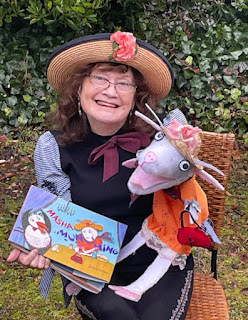
Amalia Hoffman and Sasha

Talented author/artist/creator Amalia Hoffman brings a new candidate to the scene in March with MASHA MUNCHING, a picture book with a story and central character that leaps off the page, "literally" and visually. Masha, the curious, clever, and ravenous goat, has an appetite for something new. She's in search of new faces, new places, and new tastes to please her ravenous palate. Dressed in one of her delightful frocks, she heads to town and finds a glamorous restaurant with countless offerings. What she sees and samples, though, are table offerings that provide a hint of home, not consuming the breads or pastries, but the straw basket they were served in. Or table legs, even tastier than the twigs in her daily menu. 

The very proper (uptight) headwaiter penguin finds Masha's enthusiasm to be appalling, despite Masha's delight and lovely compliments to the cuisine. But her preferences, patterns of behavior, and unabated enthusiasm for consumption soon wear her welcome thin. She (and the establishment) recognize that they are not a good match, so she returns home to friends who missed her. But she does so with a fresh outlook, developing a new take on old favorites, bringing with her a new friend to share in the fun of a barnyard bistro. One that welcomes noisy, lively participants with the manners of animals! 


Endpapers, MASHA MUNCHING

The robust colors, lively action-posed collage characters, and convention-busting choices of Masha and the other characters will have kids giggling or laughing aloud. The dimensional landscapes/scenes add a textured depth to the art, as do the themes of friendship, confidence, and openness to new people and experiences. The truth of the familiar phrase, "There's no place like home" doesn't diminish the parallel truth that "Home" can be as large and welcoming and evolving as your heart has the capacity to make it. 

Yeehoo Press,
Chinese & English versions 
March 2022
MASHA MUNCHING is  scheduled to release in March, 2022, and is available for preorder to share with kids for a vibrant virtual springtime at the farm!

Amalia Hoffman agreed to answer a few of my questions about her inspiration and creation of this new offering. With experience and understanding of just how busy an author can be in the weeks before a book launch, I'm especially grateful that she found time to join us.


SB: Amalia, your writing reaches out to many audiences and ages, on many topics. Can you share a bit about how MASHA MUNCHING first came into your mind and heart? 


Gefen Publishing House


AH:
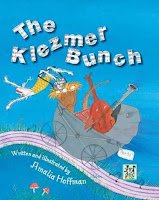
I have another book, The Klezmer Bunch, with a goat character also named Masha so that means that I have a soft spot for goats.  One day, I just came up with this alliteration: Masha Munching. That kind of sat in my brain for a while, till I came up with the idea of a goat that longs for great food. In the beginning, Masha was alone but I always wanted to create a book about farm life so I added pigs and ducks.


SB: When young ones read/listen to your story, is there a theme or message you intended? I felt the presence of several, but you were careful to focus on the entertainment first, always a wise choice!


AH: Yes, I definitely feel that there’s a theme and message in the story: Masha is tired of eating the same boring farm food every day. She says goodbye to her beloved friends and sets off on her search to find something else to eat.

Along the way, Masha discovers a wonderful restaurant where the waiter welcomes her in.

But Masha’s choices of “delicious foods” and her behavior don’t seem to be appropriate for restaurant dining.   The message of the story is that everything is tastier when shared with good friends and the freedom to behave like who you are. Masha returns to the farm and delights her friends by using her experience at the restaurant to make new dishes for them.

The theme of the book is that sometimes, we need to explore outside of our own limited horizon, only to discover that home is where we feel the most comfortable and safe.

Masha is curious. She needs to find out what’s out there. Her journey is one of discoveries and struggles along the way.

At the end, she chooses to go back home but the story makes it clear that the journey was well worth it. Masha has gained knowledge that she can put to good use. Now, she can enrich her friends’ life by using her experiences at the restaurant and making new dishes from the basic ingredients—hay and tree branches!


SB: Your use of collage and paper cuts are both intriguing and have a very “kid-magnet” vibe. The three-dimensional quality feels like it might derive from your experiences with paper constructions and retail window-dressing in your earlier years. The scenes are so colorful and engaging. Would you share a bit about how that three-dimensional aspect of your art moved onto the pages of picture books, and why you considered it a good fit for Masha and her story? Did you consider any other approaches?


AH:  I’ve always loved paper cuts. When I was a kid, my mom used to get me paper cut dolls. They came with assortments of cloths and I could dress the dolls by assembling the paper outfits on them. My sisters and I had a puppet theater that we created ourselves from a mix of newspapers and flour that mom cooked over the stove. My dad brought over a huge box which we turned into a theater. I was always intrigued by how the puppets could be manipulated. When I started designing window displays in major stores in NYC, I created 3D displays to draw attention to the windows. In Masha Munching, I wanted to convey the feeling that things are in motion so I used paper cut technique. I cut and color the elements by hand. I cover the board surface with Liquitex modeling paste and add textures by scraping the surface while it’s wet. When dry, I paint the background on the board. Then I glue all the cut-up elements on the board. When satisfied, I photograph the image. Sometimes, I add more textures, details and color in Photoshop.


SB: I can’t resist this question… Goats have become more popular critters ub current culture, with their strong personalities and capacity to eat nearly anything! At any stage of your life have you had personal experiences ( or relationships!) with goats? I know readers here would enjoy learning about that.


AH: Growing up in Israel, we spent our summers in a small village where farmers raised cows, chickens and goats. We used to laugh as the goats tried to nibble on our cloths and shoes. Each goat had a name. I found out that goats can remember their names and are very friendly! 


SB: I really appreciate your time and responses, Amalia, helping us learn more about you and your memorable new picture book character, Masha. I wish you great success with this project and with future ones, too.


I look forward to sharing Masha with readers. When I do I'll probably share the story a young visiting friend who was proudly wearing sparkly scrunchy bands on her pigtails while we visited a petting zoo. In a flash, one was being snatched by a goat, but I caught it just in time. She kept her ribbons, the goat has handed an actual food pellet, and all was well. Quick reflexes are a must around goats! I suspect many among the listeners will have their own goat-stories to share!


Sandy


Mar 13, 2019

THE BIG UMBRELLA: Kindness Has No Limits

Whether you are a regular viewer of THE ELLEN SHOW or not, you've surely seen and heard her daily closing:  BE KIND TO ONE ANOTHER.


That mantra is a simple one, but profound. 
And true.
That message is undoubtedly a major reason why humans of every age love Ellen. Especially kids.

THE BIG UMBRELLA is authored and illustrated by Amy June Bates and co-authored by Juniper Bates, a mother-daughter team. Kids who get their hands and eyes and hearts on this new picture book will adore it, as will the adults who read and share the book with kids. 
A Paula Wiseman Book, 2019
The cover (including the back cover) suggests the story, but as pages turn and the truth unfolds, the story expands, our hearts expand, and we realize this analogy is even more compelling than we could have imagined. 

That massive, smiling red umbrella on the cover is introduced on the first double spread. There, it's a normal size umbrella, propped at the door, with a snoozing, subtle, smiling face. The page turn reveals the back of a kid, decked out in rain gear, hand on the umbrella. The umbrella's closed eyes have opened and its smile expands knowingly. The text for those two spreads is simple and gentle:        
                                 "By the front door...         there is an umbrella."
On each successive page the umbrella becomes the main character, the one you see on the cover. It likes to help, to spread wide, to give shelter.  It gathers people in, no matter the size, shape or color of the people it encounters. No one is excluded, furry or four-footed, even web-footed.
My favorite spread is when this expansive umbrella seems stretched beyond imagining, surrounded by others on a busy city street, with this text:

         "Some people worry that there won't be enough room under the big umbrella."

And why not? Isn't the world telling us, day after day, that life is a zero-sum game? That anything shared with others reduces what WE have? Aren't modern day messages (to adults) meant to entrench selfishness? To create calculations about just how much anyone can afford to offer in the way of sharing, sheltering, support. We're constantly reminded that we should limit kindness, generosity, caring for fear that the supply could and would run out.

Umbrella knows better. Sunshine knows better. There is always room, and the need will not last forever. And in the process of gathering under THE BIG UMBRELLA, those vast and very diverse sheltered people have become familiar with each other, even becoming friends.


There are plenty of delightful and laughter-inducing picture books that have to do with an everyday object expanding beyond reality. A perfect example is Jan Brett's THE MITTEN.  For lap-reading, class reading, or teen analysis, there are plenty of ways these can be compared, and I encourage that process. Ultimately, though, the question should be: What is this book really saying to you? 
That could (and should) be different for each reader, but there is a universal truth that can be recognized. 
I hope you'll explore that question with kids, but also share THE BIG UMBRELLA with adults. 
Especially those who wear the label fiscal conservatives and social liberals. Consider carefully where the line between those two categories can be drawn, and where the red umbrella would stop providing shelter.
As I so often say, and write, and think:  Little books have big ideas.

Picture books are as versatile and diverse as the readers who enjoy them. Join me to explore the wacky, wonderful, challenging and changing world of picture books.