Mar 31, 2023

March 31, but You Haven't Heard the Last of Women in History

 On these final two days of March I am reviewing nonfiction picture books about women in history- in the ARTS! Louise Borgeois was the subject of a post about rebel artists in the twentieth century in THIS POST, and AMY CHENEY BEACH is the subject of the picture book reviewed below. They are distinctly different books in writing and illustrations styles, even in intended audiences and purposes, and yet they are similar in an important way. Both celebrate women whose lives extended across many decades of unique and brilliant creativity and excellence in artistic fields. Certainly those who study visual art are highly informed about the art and impact of Bourgeois, and those who study classical music composition know the works of Amy Cheney Beach. Even so, neither is well known (if known at all) by the general public. WOMEN'S HISTORY MONTH ebbs away with ongoing attention to famous women leaders, often in fields of science, technology,  mathematics, etc. Artistic leaders of their time matter as much or more to history and culture.. Please share their picture books and other resources all year long.

Calkins Creek, 2023
Astra Publishing


PITCH PERFECT AND PERSISTENT: The Musical Debut of Amy Cheney Beach
is written by Caitlin DeLems and illustrated by Alison Jay. What do you call a one-year-old girl who hums, perfectly and on pitch, forty-four different familiar tunes? A two-year-old who confidently sings out an anthem from start to finish, every word accurate, every note on pitch?

A child who identifies notes and chords by color and emotion?

Most would call her a prodigy, a phenom, at least a  gifted child who should be nurtured and allowed to create.

Not Amy's mother.

Mrs. Cheney was a music teacher who's piano playing was the source of Amy's repertoire, but the family's strong religious beliefs required that no one, especially children, should call attention to themselves. Despite the safe and simple life depicted on the page, despite a sense that the mother's denial of access to a keyboard was from loving concern, despite illustrations with rounded figures and soft edges and tones, despite a charming rustic setting, my heart ached for Amy. Those soothing elements do allow readers to recognize that rules and restrictions of a social/cultural preset can be stifling, but are pointless against a child with a singing heart and soaring spirit. A double-page spread makes it clear how childlike and self-directed Amy was, with nursery rhyme characters dancing across musical bars that suggest the alternative melodies she imagined for those familiar tunes, swirling through her mind and voice like the swallows who dip and flow across the skies.

This deeply and thoroughly researched biography unfolds in chronological order but ascends and dips across Amy's life, revealing opportunities and accolades followed by denials and departures imposed by family and conventions. Eventually a compromise within marriage to an older man allows her a range of activity through which she can pursue her deepest love- musical composition.

The groundbreaking, startling devotion of her life, and source of her ultimate acclaim, was classical composition. That talent, skill, and art is challenging in any time or situation, but it was unheard of for a WOMAN to compose serious music. Amy's work, in fact, developed fully orchestrated symphonies and beyond. After her husband died she was left independent with the means to travel and control her own life. Her immeasurable talent expanded even further, including  travel, performances, and appearances, leading to world renown within the realm of music. 

I found Amy to be as compelling to read about as she was compelled to produce and create music. That's saying a lot. Back matter in these nonfiction picture book biographies is often impressive and informative. This is no exception, but is every bit as impressive in the author's acknowledgement of the many experts who advised or otherwise assured that this seemingly simple picture book rises to a level of scholarly resource, from the main text and from the bibliography provided.

The ability for anyone, but especially for girls and women, to develop and sustain a vision of themselves, their inner resources, and their unique perspectives beyond the moats and gates and walls of cultural norms is necessary and requires intentional effort. Books like this one,  and this one, elevate "out of the box" thinking and self-determination beyond role models to beacons of hope and guiding lights.


Mar 30, 2023

LOUISE BOURGEOIS Made Giant Spiders and Wasn't Sorry

Here we are at the end of another "THEME MONTH": WOMEN'S HISTORY MONTH. My ongoing concern (rant?) about Theme Months is that the topics merit attention ALL YEAR LONG, year after year. Dedicating a month is worthy but risks ignoring the topic for eleven months of the year.


I also worry that the subjects dealt with often focus on familiar figures rather than using the theme to explore and expand lesser known or even untold stories. I began this month with reviews of two such women. If you missed that post, please click on the link and learn more about the inventor of dishwashers and a mathematician whose work made widespread electrification infrastructure possible (and safe).  Throughout the month I've included some "themed" posts and many that were far afield of the theme, because I intend to continue showcasing outstanding books about women throughout the year. 

Yet here we are with two days left in this month dedicated to sharing Women's History.  I will bookend my March posts with this review and one tomorrow, each of which astounded and informed me about women leaders in their fields who were entirely new to me.

Phaidon, 2023


LOUISE BOURGEOIS Made Giant Spiders and Wasn't Sorry
is the latest in a series of picture books about groundbreaking artists by Fausto Gilberti. This title is one of Gilbert's series MY FIRST REBEL ARTIST picture books, from Phaidon For Kids. I reviewed some earlier titles HERE, HERE, and HERE. These share the title lines ...and Wasn't Sorry. For anyone who has drawn outside the lines, intentionally, for those who have looked at familiar things in new ways, and (perhaps especially) those who have never imagined such a rebel approach was possible, these books are as important as they are appealing.

In each earlier case I had been familiar with the artists and their works before reading. In the case of Bourgeois and her giant spiders, I knew of her massive but fragile-looking sculptures but not about much of her other body of work. I had never investigated the artist.                

Louise Bourgeois was born into a talented and loving family, in a rural setting filled with animals who seemed like people to Louise. She was NOT afraid of spiders. These illustrations portray her using stark black-line, silhouette-style images on white background. This allows readers to see her as  a very "spidery" girl, quite literally on one spread. Facts about the way her mother affectionately tickled her head (as if with little spider-leg fingers) and wove/repaired priceless tapestries with uncanny talent made me think this factual tale could inspire a magical one in which a spider is turned to a human and spawns a girl-child who lives in pursuit of finding her true identity. 

And yet this book and the others in the series are firmly anchored in factual content, revealed in both text and images that spin webs of fascination and fondness. Louise's early and ongoing trademark in creating visual art featured two- and three-dimensional pieces that exaggerated/distorted/reoriented reality. She experienced some attention throughout her life, but now her works are treasured among museums across the globe. Even so, at the grand age of 87 she chose to sculpt a spider. An enormous construction of metal and marble that stood many stories tall. A first creation of its kind with the suitable title of MAMAN (French for mother). This, the largest of her many spider sculptures, was duplicated in bronze six times. Those extraordinary spiders demand an outdoor space, and they stand outside the entryways of major art museums.                                        

Louise pursued the artistry of her parents at an early age, learning their techniques, adapting and exploring new applications, and continuing to innovate until the end of her life. In the last years of her work, Louise created woven art out of old clothing and linens. Her success did not arrive early, but her imagination and creativity led to objects and art that astound, producing an impressive body of work that eventually gained attention in sold-out exhibitions. 

The books in this series are a tribute to the artistry and design skills of the author/illustrator, Gilberti. From cover to cover, from end pages to interiors, each incorporates examples of the featured artists best known and some lesser known works, but also reveals the human stories and relationships that had inspired (or created mysteries about) their iconic works. Older readers will find mentor text and intriguing details within the text and back matter, while even youngest audiences will thrill at spotting the tiny (and not so tiny) appearances of spiders throughout the pages. Each of the titles in this series sparks an impulse to "try that", to put hands onto media nd see what might emerge. 

Just as other well-known and hidden figures in women's history are likely to encourage investigation into studies and careers in fields typically controlled/dominated by males, this woman in (art) history deserves our attention during March and throughout the year. And that sentence is intended for adult readers, too!  


Mar 28, 2023

Off We Ride, on WILD BLUE!

 I'll admit that I was always enchanted by horses. (Seriously, who wasn't?) But, perhaps due to realizing that my chances of horseback riding were pretty much limited to nickel-drop mechanicals outside a grocery store, or a ride on a pony in a tethered ring at a fair. I couldn't waste obsessive longing on having a horse when there were so many other dreams I saw as having greater potential for success.

Candlewick Press, 2023
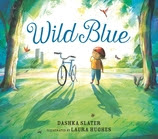
Horseback-riding wannabes abound, and they span many ages. That's why WILD BLUE: Taming a Big Kid Bike feels like it will be a just-right, book-of-my-heart discovery for countless young readers. Even as an  aged-out, unhorsed woman, I found it utterly appealing and heart-racingly compelling. Picture books deal with "next steps" stages of various kinds in childhood development, but the shift from a three-wheeler to a two-wheeler bike is a significant one that has little coverage. Author Dashka Slater and illustrator Laura Hughes have teamed up to make this one a winner.

In this case the child, Kayla, relates her adventure through first person voice. Her imagination is evident from the cover image (look at that again!) and the title page, both of which reveal that Kayla is a buckaroo, a cowgirl, a horseback-rider of unparalleled skill. She sees her red safety helmet as a western hat, and her challenge is to ride that WILD BLUE addition to her life. She has mastered and outgrown her tryke, "Pink Pony".  Language throughout incorporates "on the plains' expressions, as when Kayla reports Daddy putting pony out to pasture and taking her, lasso included, to "wrangle a new one from the herd." Daddy is at her side (with baby sibling nestled against Daddy's chest), helping and encouraging as Kayla worries, wobbles, pumps.

The scene behind this sequence shifts from contemporary to a sheriff's office and a cactus. Just as that pedal-pumping seems to pay off, a page turn reveals WILD BLUE as a bucking bronco who throws Kayla to the ground. Despite determination and encouragement, Kayla concludes that Wild Blue is too spirited and asks for pony to come back. A trip to the park, with Daddy's red stallion and baby in back-seat safety, allows Kayla to take time, check Wild Blue for injuries, sing it a little calming song, and observe countless other "riders" whizzing past on their sturdy steeds. Kayla knows what to do: mounting, pushing off, wobbling and then pumping. She and Wild Blue ride as one. I won't spoil a lovely closing spread and lines, but they resonate with this likable character, family, and situation.

I will never forget my own early attempts to ride a two-wheeler without training wheels. It was a Saturday afternoon outside our urban home, which was situated right next to St. Mary's church. A large playground with a chainlink fence separated our front door from the church entry. A wide expanse of concrete sidewalk lined that route. Solid, safe space to learn to ride a bike. Dad helped me, held the seat, and released once my legs were pumping. A very elderly woman was coming toward me from church. She was undoubtedly grateful to have gone to confession when she saw me pedaling toward her with no sign of stopping, or steering. She edged toward the fence (to avoid edging into a busy street) and I did the same. I have no doubt that Dad was running behind trying to catch me, stop me, but he couldn't reach us in time. My front tire slammed into the fence and jolted me to a stop just as the poor woman shouldered the fence and grabbed it for all she was worth. We stared into each others' eyes for what seemed like forever until I broke into tears. 

I recall being able to ride a two-wheeler after that day, but I have no idea how I managed to get back on and try again, or what that dear woman said to me or to Dad. I just remember seeing that impact coming, feeling sure that i would run right over an old woman and likely kill her! Never underrate the challenges of childhood's developmental stages. If any readers here have a story to share, I'd love to read them!


Mar 26, 2023

Does This Cutie Scare You? OGILVY!

Godwin Books
Henry Holt & Company
Macmillan, 2019


Meet OGILVY, a lovable and self-assured character who won my heart and will win yours, no doubt! OGILVY is written by talented author/rhymer Deborah Underwood and illustrated with the remarkable style and talent of T. L. McBeth.  It's tempting to refer to Ogilvy and those encountered as rabbits, but this story glories in leaving important things unnamed. In this case the author does refer to the community as bunnies, so, okay, let's go with that. In fact, though, it doesn't matter, because these newly encountered folks are very much doing things that bunnies don't do. 

Before addressing that, and the impressive skills providing the text and visual narrative,  the first and foremost gift of this book is the story. Ogilvy enters on the title page, head still not fully released from the neck of an actual striped sweater. It's Ogilvy's happy, hoppy first day in a new town. At the park our character finds plenty of bunnies busily drawing, knitting, climbing, and playing ball.

ALL of the bunnies wear knit clothing, some about knee-length (they call them dresses), while others wear hip-length knits they call sweaters. They demand to know exactly what it is that Ogilvy's wearing, a dress or a sweater. After all, it's mid-thigh,  risking the dire consequences of ambiguity.

Why? Because the dress-wearing bunnies always play ball and knit socks, but bunnies in sweaters make art and climb rocks. Why? Indeed. Ogilvy asks just that, and gets a not-so-surprising answer:

"That's just how it is."

Ogilvy, being a very clever bunny, decides what to enjoy each day and names the clothing chosen for the day to suit the "rules" and play as they wish. Those daily choices always look the same.  Lest a reader imagine that Ogilvy had no choice, a display of  knitwear hangs on Ogilvy's wall, each an identical knit garment. 

Of course, that clever bunny helps everyone realize how silly their "just because" rules were, right? Not that easily. This is where those bunnies take on an obviously MORE human-style behavior than wearing sweaters and dresses. They become ANGRY. They insist, DEMAND, that Ogilvy name clothing one thing or the other and stick with it. 

Ogilvy, not one for confrontation or fuss, made the hardest choice of all. Ogilvy speaks up with a question that was not "WHY?" Ogilvy asks if the bunnies wearing dresses wouldn't want to make art and climb walls? Wouldn't the sweater wearing bunnies enjoy playing ball and knitting? What difference does it actually make if you wear a sweater or a dress? Then Ogilvy NAMES that favorite garment- it is an OGILVY!

Because this is a well-written and story-structured picture book, we know that bunnies realize the foolishness of their rules, but a tense page turn near the end shows a new bunny  wearing some interesting headgear! Will that be a step too far, or will they welcome this new difference/change?

Here is a picture book that can be read as a simple story for the very youngest, or launch for discussion about peer pressure and how rules emerge and remain among elementary readers, and even launch complex debates and supporting arguments among adolescent groups as an analogy for current political and cultural wars. 

The text is delightful rhymed couplets that are as seamless and natural as bunny (kid) conversation can be, while the illustrations will charm the yarn off readers of every age. Settings with white or pastel backgrounds and the characters themselves are cartoon-like drawings with oversized expressive eyes and heavy-lined black edges. The bunnies are made delightfully human by sporting knitwear that is actually knitted. Fans of Jon Klassen's EXTRA YARN will especially adore the technique used, which is not explained within this book. I studied the images endlessly, trying to determine if what are clearly actual knitted garments were overlaid/photographed on the bunnies, or if these little items were made, then photographed and Photoshopped onto the drawings. A check on McBeth's website shared this from a HORN BOOK review:

The Horn Book Magazine - “Illustrations “made with graphite pencils, Adobe Photoshop, and sweaters,” whose bold lines and loose shadows give a classic feel to this fable with a modern message.”


 I couldn't have said that better, and HBM managed it in far fewer words than I would! Oh, how those subtle shadows provide dimension and grounding for this story! I also noted that OGILVY is a multiple award winner with many starred reviews. That was no surprise to me. What does surprise me, in fact appalls me, is that such a wonderfully crafted, entertaining, eye-catching picture book that celebrates acceptance, self-respect, speaking up, and so much more could well be among titles of books for children for which bans are sought. Why wouldn't it? Read my story summary above. There is even a single rear-view of Ogilvy choosing an item to wear from the wardrobe which reveals not a bunny tail but a bit of a bunny butt-crack. In fact, whether labeled as a dress or a sweater, not a single bunny throughout is wearing PANTS! 

If you think I'm exaggerating, check out a sampling of contested children's book on a PARTIAL list, HERE. This is compiled by the ALA (American Library Association) and includes:
  • Carle, Eric. Draw Me a Star
  • Geisel, Theodor Seuss. Hop on Pop: The Simplest Seuss for Youngest Use
  • Geisel, Theodor Seuss. If I Ran the Zoo
  • Hanford, Martin. Where’s Waldo?
  • Silverstein, Shel. A Light in the Attic
I was thinking about the absurdity (and assault on Democracy and common sense) that this movement to restrict access to books represents. I heard about a counter-movement to purchase and add books from such lists to LITTLE FREE LIBRARY sites around the country, but especially in areas where this is being legislated and achieved. As noble as that effort might be, it is even more important to follow OGILVY's lead and SPEAK UP, SHOW UP at school board and municipal and library meetings. To challenge the loudest of voices with the deepest of reason. To read aloud books like these in public spaces and remind other members of the community that their voices are necessary, vital, life-changing. To pose this same question: WHAT ARE YOU AFRAID OF?

Returning to the tag question in the title... Does this little cutie scare you? If you click on OGILVY you can open the book and turn the pages to see for yourself. If you agree that this picture book offers limitless benefits from entertainment to eye-appeal to thought-provoking discussions, it's time to redefine what scares us as adults, and speak up for the freedom to read and choose for ourselves and our own families, but not for cultural constraints on those beyond our own families.

What do you think?


Mar 20, 2023

Serving Up Memories in BOARD BOOKS: Puddles and Beards!

When I read comments or challenges in social media calling for favorite books from childhood, I am reminded of the very limited fare of my own young life. The literary richness I experienced consisted of  endlessly repeated but always entertaining bedtime rereads by Mom or Dad. They were skilled at dramatically voicing one or more of the anthologized folk tales or fairy tales from a few partially illustrated collections that constituted our family library. That limited menu of choices included a few glossy versions of Disney movies (Cinderella, Snow White) and reading the "funny pages" in the daily and Sunday newspaper. Our school classrooms provided a nonexistent "library", and the nearest branch of our public library was multiple bus rides away. 

As a result, I seized on any chance to visit the library, and thought the very limited offerings in the children's section was a treasure trove in comparison to daily life. It is also the place in which I first concluded that books were written by old (dead) men. Among those, though, there were some gems. Edward Lear's BOOK OF NONSENSE limericks as well as THE JUMBLIES were all-time favorites, and I checked those out on alternate visits, year after year. Granted, the small branch library had few offerings, but even in the abundance of a book store I would have included Lear's NONSENSE in any wish list.

Creative Editions, March,2023

That's why I jumped at the chance to see how LEAR was being introduced to youngest of readers in a new BOARD BOOK offering from CREATIVE EDITIONS. This board book, NONSENSE, BOOK 1, offers a single limerick by Edward Lear, richly and delightfully illustrated by Swiss artist Etienne Delessert. 

Featuring what is perhaps Lear's best known limerick, THERE WAS AN OLD MAN WITH A BEARD, the few lines unfold with a visual narrative that turns nonsense into a heartfelt experience. The opening reveals an amiable, long-bearded man, clutching a feather, and closely observed by a lineup of vaguely familiar book characters on a background counter. Each page turn reveals the amazing qualities of that beard length, the owls, hen, larks, and wren who recognize a cozy home when they see it, and other fauna in the countryside who little eyes are sure to spot and celebrate during this simple outing. When the man returns home, with birds "at home" in his beard, the countertop "friends" join in the fun. All in all, there will be countless requests to "read it again. Those little two-to-three-year-old encore audiences will have memorized this clever poem years before I first discovered it!

As you might have imagined, the visual art plays a significant role in making this such a winner. The physical book itself is also a delight, with a small trim size to fit young hands, with a sturdy, hardbound spine and glossy pages that invite stroking and exploration while holding up well to such intimate and tactile "reading". I imagine that Lear would have been pleased with the production quality for this intended audience. The "BOOK 1" subtitle encourages me to hope that the publishers plan a series of these LEAR books. What a fine start to building any child's personal library!

Text aimed at adult readers on the  final page turn reveals information about Lear that was new to me. He was a gifted sketch artist/nature artist until he began losing his sight at an early age. The nonsense poems allowed him to simplify his drawings but he published them under a pen name, considering them less than literary or fine art. Actually his line art in those original books from my childhood was brilliant, IS still brilliant. It was nearly two decades after original publication when he finally used his own name on them and published more, including NONSENSE SONGS and other poems, including the OWL AND THE PUSSY-CAT.

Creative Editions, March, 2023


A more contemporary and familiar style board book is next in the line-up. PUDDLE SONG is written by Laura Purdie Salas  and illustrated by Monique Felix. One glance at that cover calls to mind the splish-splash nature of spring, especially in the midwest. These days, weather extremes offer rainy-day experiences across the country. Heavy rains may even be frightening to small ones. A book like this is exactly the joyful, glistening, imagination-sparking story that might restore impulsive puddle-jumping memories to childhood lives.

Salas is a brilliant wordsmith, rhymer, and image-evoker, whose lines in this short text assume the voice of the puddle. With a call out to those children,  to ALL children, to the child in all of us, puddle calls for boots, stompers, jumpers. Puddle celebrates the potential for dancing, floating, and sloshing in every creature, with a final spread that settles its 'silver skin" into ripples in a breeze. 

With no images at all, this short verse sings like the loveliest of lyrics, as the title suggests. When portrayed in subdued rainbow colors, from charming perspective shifts, and  with reflective light effectively transforming water into magic on every page, the text soars. Young readers will be begging for rain, and boots, and puddles, but will savor the vicarious experience in these pages when those are not on hand.

Several recent reviews and interviews here have emphasized that picture books have important ideas to share with audiences of many ages, including adults. When it comes to board books, adult pleasure is often a by-product of the delight of the child rather than from the materials in the book itself, due to the simplicity that board books generally invite in topic and theme. In the case of these two books, I'm convinced that even adult readers who share them will delight in the joy and grace of the art and text. Take a look and see what you think. 

Copies of both board books were provided by CREATIVE EDITIONS with no promise of a review.


Mar 17, 2023

WOMEN in Congress: Contemporary and Historic Change-Makers!

Calkins Creek, 2023
Imprint of Astra Books for Young Readers

I'm eager to share two important picture books about United States Congresswomen. The first is, in fact, about the very first woman who was elected and served in Congress. A TAKE-CHARGE GIRL Blazes a Trail to Congress is written by Gretchen Woelfle and illustrated by Rebecca Gibbon. Jeannette Rankin's story begins in "the old West". As a teen in Missula, Montana, she helped care for younger siblings, cooked, cleaned, sewed, and stepped up in every emergency that arose. She was no slouch when it came to brains, earning a college degree, teaching school, studying science, and working as a dressmaker and hat designer. Nothing felt "right" to her, until, at age twenty-seven, she visited a San Francisco neighborhood of destitute poverty. She decided she could do the most good by training as a social worker.

After working there and in New York City with women and children in need of everything from food to clothing to health care to shelter to education, she saw an even greater need than one woman or organization could meet. Rankin resolved that the best way to help was to change the laws. But women did not even have the right to vote. In 1910 she traveled and spoke and campaigned across the country for federal laws to allow women to vote. When her home state of Montana led the nation in guaranteeing women's rights to vote in 1914, Jeannette went a step further and ran for office. Her take-charge approach included a grass-roots effort to reach every voter in Montana, and that finally included women. She was a tireless advocate for protections and rights for children and women, declaring, accurately, that she might be the first woman serving in Congress but she would not be the last! 

More than a century has passed since Congresswoman Rankin was sworn in, and female representatives are still far fewer than the 51% of women within our national population. Even so, the current Congress has a record number of female representatives, 29%. That's exactly 128 women members of the total 440. Back matter in this important biographic profile of a female political change-maker highlights some of her many historic accomplishments, including a timeline of her life.

CLARIOON BOOKS, 2022


For a contemporary look at one of those 128 current women elected to serve, read about a Congresswoman whose success is equally remarkable and historic. MAMA IN CONGRESS: Rashida Tlaib's Journey to Washington, is co-authored by Rashida Tlaib, Adam Tlaib, and Miranda Paul, with illustrations by Olivia Asser. The narrator's voice is that of Rashid's son, Adam, who recounts the ways in which his family supports his mother's campaigns and her service, as well the struggles and outright resistance their family has met to help her succeed. Across the intervening century, active resistance is less about her being a woman than it is about her identity. But she was not, would not be stopped.

The causes supported by both Tlaib and Rankin center on JUSTICE, on ensuring a level playing field  for all, and on providing the security of basic life needs for everyone, regardless of background or origins.There is much to learn from both women in these two outstanding picture books, and each title is likely to spark curiosity while  inspiring young girls and women to consider engaging with political roles. There are also valuable nuggets of learning about government functioning and processes in each. Don't miss out on either title.


Mar 15, 2023

Interview with Cathy Stefanec Ogren: PEW! A Nonfiction Winner!


SLEEPING BEAR PRESS, April 15, 2023

Happy "Book Birthday" to 

PEW! THE STINKY AND LEGEN-DAIRY GIFT FROM COLONEL THOMAS S. MEACHAM!

If you missed my review and recommendation of this nonfiction picture book for MANY ages, please consider taking a look and then getting your hands on the book. Author Cathy Stefanec Ogren agreed to answer some questions for us. I am excited to share her responses with readers on this special celebration day! As you'll see, this post will not grow stinky with age, as the wheel of celebration CHEESE eventually did!

SB: Cathy, welcome and thank you. As you know, I am a fan of your new picture book and I'm excited to congratulate you today.

CSO: It’s a pleasure to be here with you, Sandy. I’ve been looking forward to our interview. 


SB: I'm delighted to have you join us, and also to see that your book has been getting some well-deserved attention by reviewers and interviewers. Kirkus review is HERE.

Let's get started, Cathy. How in the world did you first become aware of this remarkable “slice” of history? Can you share that moment and how it led to the creation of your manuscript?


CSO: Ideas are floating around everywhere. A writer needs to be aware when a unique one presents itself and grab hold. The idea for this book came from a program on the history channel. I’m a cheese lover. When I heard the cheese word mentioned, it was like being given a basket of gourmet cheeses. That program had my undivided attention. The idea of a 1,400-pound cheese given to the president was something I could sink my teeth into.


SB: What a superb example of being curious about the world, knowing your own interests, and recognizing kid-friendly topics! This is my Wisconsinite must-ask question: I was intrigued by your careful depiction of the cheese-making process, and wondered if you had prior experience with that process before preparing this manuscript? Have you tried making cheese yourself? Visit any cheese-making factories? 


CSO: My editor and I had many discussions about the cheesemaking process to make sure Lesley Breen, the illustrator, was accurate in her depictions. I researched cheesemaking in the 1800s and found articles that referred to Thomas Meacham’s process, but they didn’t go into much detail. I also found a video on YouTube called Cheesemaking in the Early 19th Century. That was very helpful.  

SB: I found one that was VERY impressive with your lead and linked it HERE for curious readers!

CSO: As far as experiencing the cheesemaking process, my husband and I went to a cheese farm in Vermont, hoping to see the process from cows’ milk to a delicious cheese. Unfortunately, the cheese farm gets its cheese from farmer-owned cooperative creameries. The cheese is then aged and smoked at the farm. We were disappointed we didn’t see the process, but we did enjoy our yummy cheese purchase. 


Since my book is all about a colossal wheel of cheese, I thought I should get a hands-on feel for cheesemaking. I found an easy recipe that I added to my to-do list – it’s still waiting for me to do.


SB:  What a dilemma for a busy person... read, write, or make cheese? You'll get to it!

I love the selections you made for inclusion in the story and the back matter, but I’d bet my last cheddar wedge that there were countless golden morsels that had to be left on the writing room floor. What do you plan to do with those (other than leaving them as a treat for nearby mice). Any chance you have one or more for readers here to savor?


CSO: I certainly do have one or two leftover goodies. 


Below is a fact that I would have loved to work into the story, but I didn’t think it was age appropriate.


After Thomas Meacham presented the president with the enormous cheese, as a thank you, the president gave Meacham half a dozen bottles of choice wine. Wine and cheese – a perfect pairing! 


Other Cheesy Facts left on my writing room floor.


Cheese made from donkey milk is the world’s most expensive cheese. Hee-haw, haw, haw!


This one is for you, Sandy.

Milwaukee, WI uses leftover waste from Mozzarella cheese on icy roads. The high salt content helps melt the ice.


SB: I love that! I knew that the streets are treated with a briny mix to reduce use of salt,  and I know that there are (delicious) cheeses produced locally, but had never put the two together! Bring on the snow, with some marina and pepperoni!


But enough of my easily distracted attention. Back to questions:  I’ve learned from other nonfiction picture book writers that they often discover potential new stories while doing research for their current project. Did that happen to you?


CSO: Although I found many interesting facts and information while researching, nothing wowed me enough to believe there was another unique idea to pursue. 


SB: I understand that with so many great ideas out there it takes something really special to devote precious time and attention to new tangents. Are you free to share any news about other manuscripts in the works? If so, we’d love to get an inside scoop! 


CSO: I’m excited to announce that I have a new picture book coming out in the fall of 2024 from Sleeping Bear Press. LITTLE RED CHAIR is about a special relationship between a young girl and a little red chair. Alexandra Thompson is the illustrator. She has the perfect vision for my book. In the meantime, I'm working on revising a manuscript that is close to my heart that I hope makes it into print someday.  


SB:   How exciting! There are several other books with that title, so I'll make it a point to especially watch for yours. The story sounds totally heartfelt. I'm celebrating for you on this one, and rooting for you on your revision project and any others that are underway. 


CSO: I thoroughly enjoyed doing this interview, Sandy, and I thank you for your fabulous review of PEW! 


SB: I enjoyed it, too, and thank you, Cathy, for sharing your book birthday with your responses here. Also, for a book that is historic, entertaining, and has kid-appeal across many ages. I hope you'll reach out to keep us posted as your new titles approach release dates. 


Cathy Stefanec Ogren

Readers: To learn more about Cathy, subscribe to her blog, and check out other works on her website, try these sources:


Twitter: @CathySOgren 


Facebook: cathy.ogren


LinkedIn: Cathy Stefanec Ogren 


Website: cathystefanecogren.com 


Blog: Humor Me 

Mar 13, 2023

"Cancel Culture" in the World of ART: MARCEL's MASTERPIECE

 The JEWISH MUSEUM OF MILWAUKEE is currently showcasing an exhibit that will never be seen again after it closes. Pieces have been collected/borrowed from local/regional private  owners and will be returned to those folks at the end of the exhibit. If the dangerous and widely used contemporary phrase, CANCEL CULTURE, bothers or confuses you in the least, I urge you to visit this exhibit while it stands to learn from what has happened in the past. 

Globally, a disruptive art movement was intentionally named the nonsense word DADA, This movement originated in Europe but affected artists across the world in the years 1916-1923, wrapping its challenging ideas around the chaos and fears of WWI and the Pandemic of 1917-1919. It poses the question "WHAT IS ART?" and usually involves intentionally non-representational collages using entirely real pop cultures images, news, and other elements. In isolation, each element could tell an individual story, but together the art offers new interpretations when arranged and displayed contrary to expectations. 

The disruption of norms that Dadaism intended and achieved was the antithesis of the emerging Nazi political and cultural power block in Germany and beyond. Dadaism invites rethinking traditional art, assumptions, and depictions while demanding individual thought. That was viewed as threatening to the uniformity and compliance necessary for a successful Third Reich. Thus, all Dada art, modern art, impressionism were actively condemned as "DEGENERATE ART". The works themselves and their creators were challenged as enemies of the people. Cancel culture taken to the ultimate, sometimes murderous, extreme.

Why does this information matter in a blog about pictures books? Because my premise in launching and continuing this blog is that many picture books serve to inform, challenge, and entertain all ages. In this case, a biographic/profile picture book that was among the nominees for Cybils Awards in nonfiction is an extraordinary example of such a picture book that kids will love and also provides older readers with history and food for thought.

Henry Holt & Company, 2022


MARCEL'S MASTERPIECE: How a Toilet Shaped the History of Art
is written and illustrated by Jeff Mack.It's the story of how a young Marcel Duchamp set out to challenge the way art was defined, viewed, discussed, and evaluated. Mack explores both Marcel's life and Dadaism itself using the characteristic collage style of much of Dada art, combining hostage-note-style text clips with drawings, photo clips, and more. Those who embrace messages shaved into hair may be surprised to know that Marcel launched that approach with a star shaved into the back of his head a century ago.

This story features his attempt to bring Dada discussions to America, scouring New York City for a TOILET. Eventually he recognized the perfect piece for his next project in the "toilet store" (yes, you read that right). A particular URINAL offered just the object he desired. He examined it, considered it, and ultimately turned it upside down, signed it R.Mutt 1917, and labeled it FOUNTAIN.

The language within Mack's text is flush with humorous puns, and Marcel's cartoon-style face is perpetually upbeat and lighthearted. He found a clever way to display his FOUNTAIN in a "Fancy Art Show", which spawned criticism and canceling (surrounding it by a screen, trying to keep it out of the news). The more it was denied a place, the more it sparked conversation and heated debates. It was eventually thrown out as trash. Yet Marcel was thrilled with the results, because it led people to think about, talk about, have opinions about ART. Dadaism continues to do that today.

In a few pages following the story of this event in New York City, Mack describes more of Duchamp's choices, art pieces, and the impact of Dadaism on the art world and on people across time. Duchamp's choices involved performance art, like dressing as an alter ego to provoke changed behaviors in those he encountered. The extent to which he and others accomplished their goal continues today, when those (you?) who view art exhibits know you are free to have varied opinions, to even insist that certain pieces are or are not ART. His central question was: WHO GETS TO DECIDE WHAT IS ART?  with the corollary: "Anything is ART if an artists says it is."

As noted in the introduction above, such radically individual insights could undermine the guided and regimented mindsets that eventually formed the foundation of NAZI-ism in the 1930s to the end of WWII. It was this unquestioning approach to every bureaucratic and political decision that girded decisions leading to mass murders and concentration camps, the Holocaust. The Nazi government's anti-DEGENERATIVE ART  movement years before that was a propaganda training ground for turning the German population into practices of compliance and commitment to single-mindedness. 

You may not make it to the exhibit (although I hope those who can will do so), but everyone can enjoy this colorful, informative,  and appealing picture book. I urge you to share it with kids and adults and witness for yourself the variety and intensity of reactions it evokes. Then ask yourselves if such differences and debates aren't more valuable than the most expensive art. Aren't we all a richer community by airing our opinions civilly than we are by demanding exclusion and conformity? Hold that thought, and share that thinking when fearful members of your own community attempt to demand social or governmental uniformity and censorship of anything that reflects differences.


Mar 12, 2023

POETRY and PHYSICS: A Powerful Pair In a Picture Book!

 Science provides surprisingly wonderful topics for poets, and that has been true for many decades and generations. Two of my favorite titles from the past (now out of print but searchable and obtainable, and worth the effort) are Myra Cohen Livingston's SKY SONGS and SEA SONGS. 

I'm not the least bit ashamed to admit that Livingtston's work and these two classics first crossed my path when I changed school districts many years ago. I found myself in a classroom with actual shelves full of books provided by the school(!) instead of relying only on my personal collection. I immediately asked students to spend a few minutes locating their favorite books and then sharing with me why they chose those books. These two poetry collections focus on scientific facts and emotional reactions to aspects of the Sea and the Stars. They were not only among those chosen, but were the favorites of MANY. The books were well-worn and some poems were recited by heart. What a perfect way to be introduced to poetry collections by one of the all time iconic poets for young readers.

WORDSONG, February, 2023
Astra Books for Young Readers


A recent addition to this niche genre of  solid science explored through a collection of poems is PUSH-PULL MORNING: Dog Powered Poems About Matter and Energy, written by Lisa Westberg Peters  and illustrated by Serge Block. Several of Peter's many publications are also powerful poetry collections on science topics. Another student favorite (and a favorite of mine in this vein) is EARTHSHAKE: Poems From the Ground Up (2004). 

Harking back to my classroom experiences, there are few topics that engage kids more eagerly than the elementary physics of force, energy, and simple machines. Few topics in basic science more directly affect daily life than these. Unfortunately, as essential as screws, planes, axles, magnets, and motion are in everything we do, the current pressure to account for each minute in a classroom has limited time for the hands-on explorations that make any science, but especially this topic)  come alive for learners. 

In this recent release, the author and illustrator have packaged basic concepts accurately and entertainingly within  every day interactions between a child and their dog.With comic style illustrations and lively personalities, they reveal Newtonian properties and processes like gravity, inertia, and motion, as well as sound, matter, electricity, reflection and more. The table of contents offers topic tags for each poem, while brief and kid-friendly back matter expands slightly on examples of each with modest doses of added science. These helpfulm additions make the book a handy "grab" to reference" in classrooms and studies, but the whole is never greater than the sum of the poems. This every day awareness of forces and energy at work in a child's life is ideally suited to spark curiosity, investigation, further reading, and conversations. 

More examples of poetry power in science are abundantly at work in Miranda Paul's BEYOND: Discoveries from the Outer Reaches of Space, and, by Joyce Sidman, UBIQUITOUS: Celebrating Nature's Survivors with Poetry, reviewed HERE. In fact, I urge you to click on Sidman's name to learn more about each and every book she has produced to bring science to awaken the poetic language and learning worlds of kids.

These titles and the topics they explore are rich ways to integrate poetry and fine literature into content area studies or personal interests, and also to integrate key concepts into literacy studies, including them as mentor text for young writers to incorporate investigations and topic studies into the flexible forms of poetry. Of all the topics, none can be more immediate and recognizable in daily life than everyday applications of energy, matter, and force. Picture books are guaranteed a warm reception when  they star such a lively and comic pair as this kid-plus-pup. Check it out!

Mar 6, 2023

IN EVERY LIFE: A Picture Book that Is Worth the Wait

I'm among countless folks in proclaiming my admiration for the creations of MARLA FRAZEEI'll nudge my way to the front of that crowd, if necessary, to add my opinion that her work is among the most inspiring and heartwarming of any contemporary artist, whether she is illustrating the work of others (as in ALL THE WORLD), or creating her own stories (as in THE FARMER AND THE CLOWN and its companion titles). These are only some of her many works that deserved and won multiple awards. In other words, she sets a high bar for excellence in each creation.This latest work surpasses that standard.

Beach Lane Books, 2023

After prerelease raves caught my attention, I had to wait through a lengthy "hold" line at my library, but it was finally my turn. Now that I've had my hands and eyes and ears on IN EVERY LIFE, written and illustrated by this enormously talented woman, it was worth the wait. 

Some of those advance raves included starred reviews from SCHOOL LIBRARY JOURNAL ("The combination of the spiritual words and the prosaic moments alternating with grand panoramas bestows a magnitude to the minutiae of the everyday."), PUBLISHERS WEEKLY ("A rich trove of moving images lets Frazee range over an expansive constellation of human experiences, offering fodder to explore and discuss."), and KIRKUS REVIEWS ("This lyrical blessing of a picture book belongs on every shelf.").

Frazee's self-imposed high bar becomes clear in a background note on the dedication page (to her first grandchild). In it, Frazee relates that although the gist of the text is rooted in a Jewish blessing, she first heard it in an Episcopal church in 1998. With the immediate thought that this would make a fine picture book, she struggled to find her way into the text and images to fully capture the power of the emotions and relationships she had felt. In an interview with Roger Sutton of THE HORN BOOK (HERE) she expands on that quarter-of-a-century process, her struggles and insights and revisions that eventually led to this remarkable work of art. 

Ultimately, she took a distinctly bold approach, especially for a seasoned picture book creator. She chose to avoid the expected compelling page turn in favor of an oversized production featuring both the call and response phrasing of each statement on the two sides of a double page spread. This allows the artist to provide nine-to-ten vignettes below the statement in the full text. This approach also invites readers to spend time examining and entering each small story, each experience and relationship pictured. The rich range of characters, settings, relationships, and emotional implications allows anyone and everyone to find themselves within at least some of the situations, and also expand their awareness and empathy for some that are outside personal experiences. When eyes and hearts are fully satisfied on a given spread, the page turn reveals a wordless, edge-to-edge scene in which the characters recede into the foreground within an awe-inspiring view that celebrates the wider world, especially nature. Although the stated target ages are 3-6 years, this is a book for all ages, offering blessings of every kind to anyone who identifies as human. 

The luminous cover is from an interior spread, with each sequence using tones ranging from glowing to intense to reflect the life pattern that is expressed in that text. The opening statement is a natural beginning:

"In every birth... there is a blessing."

The final statement is a natural coda, not about death but about the greatest of truths:

"In every life  ...  blessed is the love."

The opening and closing art mirror swirls of energy and life, with the initial page an amorphous, glowingly galactic suggestion of possibility, and the final page reflecting similar colors with spiraling blossoms, symbols of life. IN EVERY LIFE is a genuine pleasure to hold, read, explore, and share. 

I'm someone who is a fan of many things even though I am reluctant to name favorites among them, including picture books in general. That is also true among a single author's or artist's work, since each shines within its own constellation of qualities. In the case of Frazee, though, I've long held the thought that ALL THE WORLD would, forever, be her crowning  achievement. Perhaps, though, especially over repeated readings of this wonder, she has created a contender for that status.

Don't let another day pass without making every effort to take a look at this book in person. I'll be returning my library copy soon to shorten the hold line, but only because I intend to purchase copies for myself and as gifts.


Mar 3, 2023

Beware the Diminishing Power of Casual Remarks: "It's Just A..."

Before I say a word about this colorful, artful picture book, I confess. I was NEVER a fan of worms as a child. I experienced them as slime trails, squished remains under bike tires, slippery challenges for fishing hooks, and the cause of that post-rain funky smell in the air. That was all to cover up the fact that worms scared me. 

I still have no idea just what I was scared of, but I vividly recall avoiding contact at all costs, and that siblings and their friends knew they could chase me away by holding up a sample.

My adult self "holds" worms in high regard. I dig in garden soil comfortably and try to avoid slicing into those valuable, productive, essential worms below the surface.I can even handle them myself as circumstances require, although that still is NOT something I go out of my way to do. 

Greenwillow Books, March 14, 2023


This new picture book, JUST A WORM, written and created by Marie Boyd, intrigued me on many levels. The extra large image above allows you to appreciate that this was imagined and assembled using an eye-appealing paper-quill-scroll technique combined with photographic capture of three-dimensional layouts. More about that quilling technique below, but first, let's meet WORM. 

As Worm "la-la-la"s its way across the ground, voices related to two sets of kid's legs share an "Ew" and the remark that it is "Just A worm". Those words echo what my childhood self would likely have said. That incident launches lighthearted, wiggly, squiggly Worm on a journey of discovery to prove he can DO things. Things that matter. 

From that point on I was rooting for Worm. My own understanding of what worms DO led the central  process for me hold them in high regard, and to my eagerness to share their ecological value with kids. This is an excellent picture book to make that an appealing experience.

In a beautiful garden that expands in color and variety from page to page, Worm inquires of garden creatures about what THEY can do. In each case, (caterpillar, butterfly, dragonfly, bee, spider, and snail, as suggested on the cover), Worm lacks their skills. In each interaction, though, Worm recognizes what it CAN do, but mentally attaches that "just" qualifier to those seemingly unimportant skills, dismissing their value. It is only when Worm realizes that by cleaning, casting, (okay, pooping), feeding, and digging through the soil, it contributed to this gorgeous, healthy garden. This realization makes the sting of that "just" remark fall away.

The illustrations invite close examination and tempt audiences to wonder how they were made and even try it themselves. Boyd achieves an ideal balance between intricacy and seeming simplicity in each element and in the full scene assemblies. Boyd uses a combination of elaborate quilling in flowers alongside carefully cut and shaped papers with curled edges, some twisted, arched, and otherwise raised from the background page to provide shadows and depth. Overhead clouds tell a story of their own, with sizes, color, quantity, and depth indicating changes of mood and rising tension. I was especially intrigued by the tiny fan-folds in Worm and the subtle shading of its shape and color on the cover image. Worm is rendered in pen and ink throughout the book, except for the final spread, which is the only spread in the story where Boyd made Worm from quilled paper. A two-page spread in back matter demonstrates some examples of the scroll/quill techniques used. Scroll down to the bottom of Boyd's homepage to find examples you can observe in the making: HERE.

Take time to check this one out carefully, exploring connections to environmental education, self-esteem, food cycles, and peer pressure/name-calling.The final page turn provides some additional thoughts from Boyd (attributed to Worm in speech bubbles) that readers and families/classes may explore on these themes and topics, as well as a few added facts about earthworms and a brief glossary. This is an excellent example of a book I wish I'd had while teaching about "decomposers", the remarkably efficient and productive trash disposers/composters of our planet. They are seriously unappreciated and under-protected! Recommended for all ages as nonfiction text and mentor work for art and illustration.

Release date: March 14, 2023       Preorder discount link HERE.


Picture books are as versatile and diverse as the readers who enjoy them. Join me to explore the wacky, wonderful, challenging and changing world of picture books.