Showing posts with label Revolutionary War. Show all posts

Nov 13, 2026

BETH ANDERSON Interview: THE PATRIOTS AND THE POX


Readers, if you missed it, I hope you'll take a moment to read my review and reactions to THE PATRIOTS AND THE POX: GEORGE WASHINGTON’S BATTLE TO SAVE THE CONTINENTAL ARMY, HERE.

ASTRA BOOKS/CALKINS CREEK, 2026

I also urge you to check Beth’s blog notes to read her summary about this recent release, a JUNIOR LIBRARY GUILD  selection. (Congratulations on that, Beth, and your many powerful supportive reviews.) 

There you’ll also find a link to read her excellent post: HOW RESEARCH BECOMES A STORY January 9, 2026  (the first of Beth’s Revolutionary War 250 blog series)

Digging into the intersection of so many related aspects of history, science, and society 

In it Beth says:

“Somehow in this process of sifting and digging and pondering, I find connections across time for myself and endeavor to offer valuable opportunities for young readers to engage with history as critical thinkers able to make connections to their lives and our world”

That, in a nutshell, is what I admire so much about all of Beth's information picture books and the individuals they feature. Those connections of information, historic events or movements, and individual talents are always intriguing, from a subway hero with super-sniffing skills to Washington commanding the troops fighting to create a new nation. Kids are enamored of comic book superheroes, but Beth’s research and storytelling reveal and elevate REAL people in history who made positive changes in impressive ways. 

In  that  blog post she makes clear that FINDING THE STORY involves those familiar 5-Ws we so often talk about. 

WHO?- reveals the people at the intersection of varied information topics

WHY? reveals motivation.

WHEN? And WHERE? Incorporates place, time, facts, and their interrelationships.

And WHAT IF? helps define stakes and risks involved. 

It’s a privilege to have Beth respond to my questions for this post.

SB: Welcome back to the blog, Beth, and thanks for allowing me and my readers to learn more about your writing process.

In THE PATRIOTS AND THE POX, your narrative offers readers the results of careful research and analysis involving highly complex circumstances and solutions.  It’s clear that WASHINGTON was the central figure for this slice of history. At that time he was the designated leader of the makeshift army of a declared/tentative new nation. The motivation and stakes drive the pacing with a page-turning quality that keeps readers in the moment, despite it being an historic account. The complex details of time, places, processes, and sheer numbers of soldiers and colonists must have felt overwhelming. Would you share a bit about the stages of your early engagement with this massive intersection of events and issues in your writing? Was the eventual story structure there from the start or did you make multiple attempts to find an approach?  Was there an AHA! moment or was it a series of blind alleys until you found your way? 


BA: Thanks so much for inviting me back! Your first question hits the overwhelming challenge of this book. So many rabbit holes! Smallpox connected to everything: enlistment practices, able bodied troop numbers, scavenging for food, shortages of supplies, treatment, medical practices, the Continental Congress, British troops, smallpox in England, battles, travel, strategies, discipline, training, and more. Though most of that research is not explicitly in the book, the understanding was essential, and it’s there as an underlayer that affects word choice and much more. 

As always, I saw too much. There I found parallels with the trajectory of Washington’s  battles against the disease and against the British. I gave the battles of Quebec and Montreal more space at first as those showed the devastating effect of smallpox in battle and of self-inoculation without quarantine. For a while I included training troops at Valley Forge as that scene focused on building unity and trust.  I had a stronger thread of the conflict between individual liberty and “liberty for all.” The story ended at Yorktown where the British again sent out people infected with smallpox, echoing back to Boston, but at that point Washington’s troops had immunity and the disease was no longer a weapon. I also was thinking some touchstones for the war were needed, so there was more background in general, as well as interesting details.

The challenge was to strip it back to Washington’s fight against smallpox and his decision to inoculate by cutting most of the military info and letting some of those lofty ideas I loved echo in the background. Many revisions dealt with how to provide necessary context for understanding the science of disease—both with how to say it and where that info was placed.

SB: Whew! I had tried to imagine the extent of options you dealt with, but this is truly impressive. The topic and individuals involved are so much more complex than a single "cradle-to-grave" biography! 

Guest authors on your blog and notes about your own books focus on the heart of the story, even though elements within the covers of each book are factual and historic. I learned so much about history and Washington "the man" in this book, but my heart was always drawn to the struggles Washington faced: on behalf of individuals and families, on behalf of the army as a whole, and on behalf of the budding nation he was attempting to ensure. You balanced these challenges well.  I wonder IF and HOW you found and felt the heart of this story while writing? Did any particular sources or accounts touch you or direct your writing? 

BA: The heaviness of carrying the hopes and dreams of a soon-to-be nation in addition to the human lives came through in some of his letters in the Founders Archives. His letters as commander in chief are strong and sometimes angry and frustrated about the lack of support from the Continental Congress. But the letters to family show a more personal side and the agony of his responsibility. I think his own experience suffering through smallpox likely impacted his actions. 

To me the larger heart that underlies the story deals with the interconnection of liberty and unity. Defeating smallpox required trust and a focus on the good of the whole—and so did winning a war and establishing a nation.

SB:  I felt that as a reader. There was no lack of good will and shared intentions on the parts of colonists, enlistees, and officers, but their personal beliefs, fears, and priorities could come in conflict. What I felt throughout the reading was the sense of "sacrifice" that everyone, from top to bottom, needed to accept. The good of the whole MUST outweigh the individual good, while allowing for individual respect and safety in as many ways as possible. What an achievement for our founders. 

Did you encounter any stumbling spots or gaps while researching? If so, what were they and how did you go about finding resources? 

BA:  We’re fortunate that Washington initiated a system of keeping military records. Though there are some gaps, by following the “breadcrumbs” in bibliographies, I was able to access a range of sources, including scholarly articles on smallpox in the military.  There’s a tremendous amount of information available on the war and Washington, so the challenge becomes wading through it all and finding the pieces to effectively tell the story. 

SB: That almost sounds as if it could occupy an entire life of research and writing. It may do so for some academic scholars. Once again, your presentation of this massive input exemplifies that nonfiction picture books are a valuable resource on their own.

The subjects of your other books aren’t nearly as well-known as WASHINGTON, though JEFFERSON and LINCOLN compete! What led you to focus on Washington, and on this topic in his life story?

 BA:  The timely topic of inoculation/vaccination and the opportunity to expand on what is usually a single sentence in history books about smallpox in the war was irresistible. Though I knew smallpox was a problem at the time, I wasn’t aware of its tremendous impact and the complexity of dealing with it for Washington. I think the typical narrative of the war and Washington’s role tend to be so simplified that we never think about the sacrifices and challenges. Seeing this piece of the reality and the immense difficulty of effective leadership is valuable and opens up our understanding of both the struggle for independence and Washington as a man. Consequences in action, the interconnection of lives, and the concept of liberty also not being as simple as it sounds are ideas that resonate in the present. 

SB: I agree fully. 

Books requiring so much research inevitably leave fascinating facts ”on the cutting room floor”. Are there some particular details you’re eager to mention and even explore when you speak in programs or otherwise interact with your readers?   (Feel free to mention as teasers without elaboration, or spill as much as you’re willing to!) 

BA: A few of those extras ended up in back matter, like the enslaved man, Onesimus, who taught Cotton Mather about inoculation methods that had been practiced in Africa and Asia for centuries. Back matter also mentions that inoculation was banned, divisive, and feared, but there’s also the fact that Washington was defying those bans and inciting public anger and fear when he dared to do it. I think both of these facts are mind-openers for all of us. 

Taking command in Boston was tough for Washington. Troops resisted, and he was shocked at the condition of the camps and unruliness of the men. Though Washington is revered today, not everyone respected him and supported his efforts. 

SB: That's so easy to forget, that few public figures are universally revered  in their own times. It's a reminder to take whatever "glow"  or "gunk" we may attach to historic figures demand a long look back at actual evidence. |t's worth digging deep for as much contemporaneous and factual information as possible, as much context of the times as can be found and considered. Thank oyu for doing that heavy lifting for young readers (and the rest of us) in this title and your others.

Are there other upcoming projects (titles?) that you are allowed to share with us?  Your responses above should make it clear that the time needed to research, write, and revise is extensive, tfollowed by the lengthy process when your work moves into the hands of editors, illustrators, designers, marketers, etc. Meanwhile, you work on new materials. We'd love to hear about what's next. 

BA: The next book, SCULPTING PRESIDENT LINCOLN: VINNIE REAM CARVES OUT HER FUTURE (spring 2027), is about a talented teenage girl who persisted past perceived limits of tradition, gender, age, class, education, and critics to create the Lincoln statue that stands in the Capitol rotunda today.  Her story is one of art and history, of youth and vision, of spunk and grit. Vinnie Ream is an inspiring example of the power of physical, intellectual, and emotional commitment, investing hands, head, and heart. I can’t wait to share her story! 

SB: And I can't wait to read it! 

Anything you were hoping I’d ask you to talk about? 

BA: One thing I do want to mention is the tremendous research that Ashley did for the very thoughtful and creative illustrations, and also the valuable feedback from experts who helped us get everything right—including accurate representation of the men in the army.  I hope readers will ponder all the amazing details. 

SB: I couldn't agree more with your endorsement and admiration of the illustrations. I've been over them time and agin, always noticing even more than previous careful scrutiny had revealed. The art and the visual storytelling are masterful! Once again I thank you for sharing your responses with us, and for the energy, talent, and enthusiasm you bring to finding and sharing stories of admirable figures from the past. For finding the lesser-told scaffolding background that elevated otherwise famous figures as well as revealing lesser-known figures from our history who more than merit the spotlight your books provide. 

Beth's Bio:

Beth Anderson is the award-winning author of more than ten picture books, including HIDING IN PLAIN SIGHT, THOMAS JEFFERSON’S BATTLE FOR SCIENCE, and LIZZIE DEMANDS A SEAT, among others. A former educator, she strives for accidental learning in the midst of a great story and hopes to inspire kids to laugh, ponder, and question. Born and raised in Illinois, Beth now lives in Colorado. Visit https://bethandersonwriter.com


USING BACKMATTER


Jan 21, 2023

Meet Beth Anderson's Remarkable, Revolutionary Deborah Sampson-- CLOAKED IN COURAGE


CALKINS CREEK, 20232
Imprint of Astra Books

CLOAKED IN COURAGE: Uncovering DEBORAH SAMPSON, Patriot Soldier is written by Beth Anderson (longtime fan here!) and illustrated by Anne Lambert  (new fan here!).

This latest offering by a talented researcher/author reveals information about an unknown/unsung woman of the American Revolutionary War. Anderson's writing provides efficient, lyrical narrative, rich with authentic details. Research from a range of sources is woven into a reliable and compelling portrait of the life of Deborah Sampson. Because data gaps and conflicting information left three details unverifiable, Anderson clearly states that this account is informational (or historical) fiction and that the most accepted versions of those details was used.

From the the first pages, readers learn of Deborah's early life challenges, with illustrations suggesting that even as a young child in deep poverty she dreamed of a better life, and a wider world.  

On that opening spread, in large font, a central thesis is stated: Maybe it was just Deborah. 

Interior Spread: Cloaked in Courage


Hard facts of life surface on the next spreads leading to Deborah spending her youth without family, in service (and heavy labor) to a variety of other families. In each circumstance she worked hard, learned all she could (including to read and write), built confidence and strength in her mental and physical potential, and also notes impacted by the events and  principles of the growing colonial rebellion leading to the Declaration of independence and the Revolutionary War.

At eighteen she refused the traditional path of marriage, made a living with trade skills often reserved for men, and then disguised herself as a man and enlisted in the army to fight for freedom. But when her ruse was discovered, she ran away before she could be arrested. In another area where she was not known, she tried again and enlisted as soldier Robert Shurtliff. The following spreads show her as managing every challenge effectively, translating skills from her early service years to those required of soldiers, including taking part in battles. After being wounded, she attempted to dig out the bullet herself to avoid discovery in a medical examination.


She gained respect and was advanced to service for officers, chosen for her outstanding performance in active service. 

With the war nearly over, she had one last mission. But when Sampson fell ill and lay unconscious in the hospital on the brink of death, a doctor discovered her gender.  Stay tuned, there's more to come.

Gorgeous illustrations incorporate information and details that expand the compact text and the landscapes of Sampson's life at every stage. Those are physical, emotional, social, and political. Look closely at that cover art, so evocative of the time, of the complex roles Deborah chose to assume, and the radiant quality of her heroic decisions. This approach both equates and elevates her role compared to those of other soldiers of the revolution. Throughout, we see her full authentic self, the one who grew strong through adversity and hard labor, as well as a limited reflection of that within the career and service she chose despite restrictions that should have locked her into more traditional roles. 

No spoilers are offered here, since I've already revealed much about this remarkable woman and book. Just know that there are substantial and exciting surprises throughout, as well as some questions raised. The important author note in back matter provides readers with some answers  and explains why others don't have easy answers. 

I highly recommend this new title and urge you to read the post that will follow in a few days. Beth kindly agreed to respond to my questions about her research and writing for this important new picture book which you can read then. If the wait has you eager to know more (as I was) I guarantee it will not disappoint. While waiting, check out her interview about previous titles HERE.


Jan 20, 2022

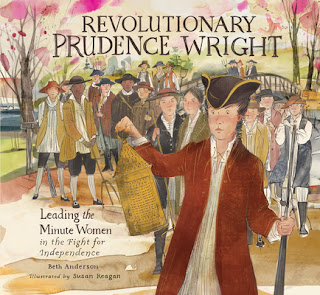
Meet PRUDENCE WRIGHT: Unsung Revolutionary Heroine!


Alert the townsfolk, friends, neighbors, teachers, and readers. A new picture book from the remarkable researcher, author, and hidden-historical specialist BETH ANDERSON is coming soon!

Calkins Creek/Astra Books for Kids 
Feb. 1, 2022

REVOLUTIONARY PRUDENCE WRIGHT: LEADING THE MINUTE WOMEN IN THE FIGHT FOR INDEPENDENCE is written by Beth Anderson and illustrated by Susan Reagan. This is a book steeped in historical revelations, fully developed personalities, and decisive actions that shaped the earliest days of our nation's struggle for freedom. It is worth celebrating as it nears release, and I predict it is destined to become a classic in the years that follow.  
If the name  Prudence Wright doesn't ring a bell, it's no wonder. Unless you happen to be from Pepperell, Massachusetts, that is. The story of Prudence and her Minute Women Bridge Brigade are well known in that area, even though their story is otherwise little-known. Author Anderson approached this shining sliver of history with a diligence and thoroughness that would impress Prudence herself. The primary sources, careful documentation, and expansive notes in back matter make clear that it's a story deserving of the wide audience it will now receive.

Calkins Creek/Astra Books for Kids
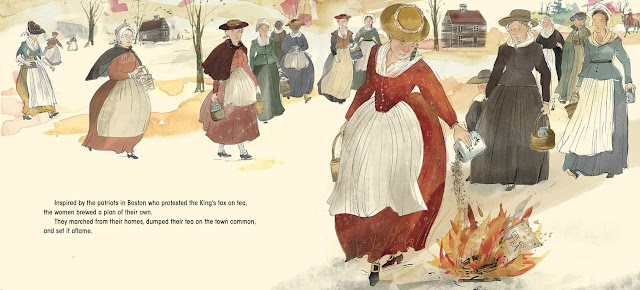
Interior image, used with permission


 Highlights include the fact that Prudence was a thinking woman who made her own choices. She agreed with and married a "Whig", a young man who actively fought the King and British forces.  Her own large family were mostly revolutionary-minded, but two brothers firmly supported England and the king. She suspected they might be spying on local activities. 

Prudence made no attempt to hide her beliefs, organizing other like-minded women in town. They supported protests against tea taxes in Boston Harbor by tossing their British tea into a small fire in the center of town. Keep in mind that this was more than open symbolism. Tea took a big bite out of budgets, with those unreasonable taxes, and was also an essential part of daily culture. They  weren't dumping crates of market tea, they were destroying their own family's supplies!
 
When the Pepperell militia men marched off to support the battles near Lexington and Concord, Prudence realized that spies could report this to nearby British troops. She gathered militia wives and other women to dress in men's clothes and bring any kind of weapon they could find, from rakes to pitchforks to kitchenware. 

That night they kept watch at Jewett's Bridge, the only crossing for potential spies to warn the Redcoats. Crouched in darkness, Prudence and her patrol waited for... a rider or two? or ten or more? An armed squad of men with intentions to quell the revolution? What could those women really hope to accomplish?

They did more than hope. Prudence kept watch. At the sound of approaching horses she signaled to warn the waiting Minute Women to prepare to act. Illustrations in this passage heighten the suspense about the dangers they might face, and the consequences that could ensue for Prudence and her unit of brave women, for the men they loved who were marching into battle not far away, and for the birth of a new nation, free from the tyranny of an angry king. Anyone who considers history to be dry and dull MUST read this picture book, for themselves and with young people in their homes and classrooms.

These are only the nuts and bolts from the account. As intense as they seem, they pale in comparison to Anderson's terse and tense narration throughout, written to reveal details, personality, danger, and inspiration within a remarkable and compelling story. The parallels between a young nation striving to be independent and a young woman whose thinking and choices defied the social standards for females of the day enlighten both sides of the comparison. 

Calkins Creek/Astra Books for Kids
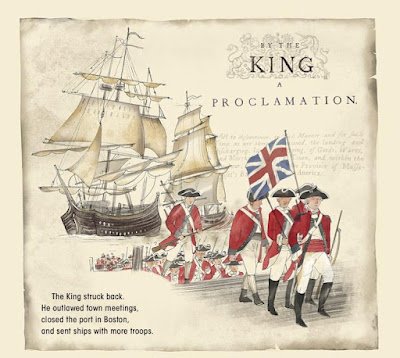
Interior illustration used with permission


Susan Reagan's illustrations expand a significant amount of the drama and detail of this amazing story with subtlety and grace. Throughout, she has rendered fine line drawings on parchment-like backgrounds that depict  accurate elements of uniforms/clothing, settings, and evoke time-true perspectives while washing them with color tones that suggest both vibrance and age. 

In this interior image Regan incorporates within the background one of the  many primary sources used by the author. This page also provides an example of Anderson's talent for conveying complex and powerful content with a few well-chosen words. In her brief lines can be felt the insults and injustices that enflamed the rebellion of the colonists, including Prudence and the Minute Women.

Don't miss this entertaining, exciting, inspiring nonfiction offering, including the notes in back matter, supplementary curricula materials, and the brilliant details within the illustrations. Release date is February 1, but preorders are available now at all online and independent bookstores. Signed copies of all of Beth's books are available at The Wandering Jellyfish Book Store in Niwot, CO   and Old Firehouse Books in Fort Collins, CO  

I've reviewed prior picture books by BETH ANDERSON HERE, and HERE, including an interview  HERE. The unique choices of subject matter, point of view, reliable research, and valuable extension materials that characterize her books guarantee that I'll be sharing even more of her work in the future. 

For example, coming soon!

FRANZ’S PHANTASMAGORICAL MACHINE, illustrated by Caroline Hamel, Kids Can Press, May 3, 2022.

CLOAKED IN COURAGE: UNCOVERING DEBORAH SAMPSON, PATRIOT SOLDIER, illustrated by Anne Lambelet, Calkins Creek/Astra Books for Kids, Nov. 15, 2022

THOMAS JEFFERSON’S BATTLE FOR SCIENCE: BIAS, TRUTH, AND A MIGHTY MOOSE, illustrated by Jeremy Holmes, Calkins Creek/Astra Books for Kids, Fall 2023.


Before closing, I'll link to illustrator Susan Reagan's other offerings, which includes one of my all time favorite picture books, LIGHTS OUT, by Marsha Diane Arnold, which I reviewed HERE. Comparing the stories, subject matter, and styles in that book and this picture book makes clear that she can turn her talent to the service of the story, while in both cases the subtlety of posture, positioning, angle, and glance evoke emotional connection and underlying aspects of each story. It's worth your time to check it out.


NOTE: I have been an adamant feminist since (and before) kindergarten, when I was furious that the play areas, the playground, and many rules strictly separated our class by gender. They  provided BOYS with the best and most creative resources and equipment while  GIRLS had a toy kitchen, cleaning supplies, and an ironing board and few raggedy dolls. If I hadn't had a sense of injustice before that tender age, it would have kicked into high gear in that setting. These two creative women, Beth and Susan, displayed their own excellence in revealing a historic woman of talent and courage. For modern readers they are every bit as inspiring as Prudence Wright. If you have an interest in any of the MANY reviews, interviews, and spotlights I've featured in this  blog about outstanding girls/women in leadership (and fiction), type WOMEN in the search box on the right menu bar and check out some titles from prior posts.


Picture books are as versatile and diverse as the readers who enjoy them. Join me to explore the wacky, wonderful, challenging and changing world of picture books.